A Sequential Model of Dynamic Capabilities in Research Groups and Their Impact on Smart City Development
Un modelo secuencial de capacidades dinámicas en los grupos de investigación y su impacto en el desarrollo de ciudades inteligentes.
 PDF
Received: August 3, 2025
Accepted: May 11, 2026
Bermon Angarita, L., Osorio-Londoño, A. A., & González-Calixto, M. B. (2026). A Sequential Model of Dynamic Capabilities in Research Groups and Their Impact on Smart City Development. Revista CEA, 12(29), e3596. https://doi.org/10.22430/24223182.3596
Abstract
Objective: The aim of this study was to evaluate the systematic influence of the sensing, learning, integrating, and coordinating dimensions of dynamic capabilities on the development of smart cities. Since dynamic capabilities have been examined mainly from the perspective of improving business performance, their relationship with smart cities has received little attention in the scientific literature.
Design/Methodology: A correlational methodology with a quantitative approach was employed. The study proposed hypotheses about the relationships between the sensing, learning, integration, and coordinating capabilities and their impact on the advancement of smart cities. These relationships were assessed in 82 research groups in Manizales, Colombia, through a structural equation model estimated using the Partial Least Squares Structural Equation Modeling (PLS-SEM) technique.
Findings: The results indicate that the dynamic capabilities developed by research groups exert a systematic, positive, and significant influence on smart city development. In addition, the constructs analyzed met the criteria for convergent and discriminant validity, and the model demonstrated acceptable predictive power.
Conclusions: Dynamic capabilities are interdependent and evolve through a cumulative process in which research groups identify opportunities, acquire and manage knowledge, integrate this knowledge into strategic decision-making, and coordinate resources to generate innovations with an impact on urban environments. Therefore, the development and implementation of dynamic capabilities within research groups, aligned with public agendas, are essential to strengthen the shift toward smart cities.
Originality: This study extends the analysis of dynamic capabilities within research organizations. Furthermore, it underlines the role of contextual learning and resource orchestration in fostering responsiveness and innovation across urban ecosystems.
Keywords: dynamic capabilities, smart cities, research groups, Partial Least Squares Structural Equation Modeling (PLS-SEM), knowledge integration.
JEL codes: M12, M15, O18, O21, O32.
Highlights
Resumen
Objetivo: el objetivo de este estudio fue evaluar la influencia sistemática de las dimensiones de detección, aprendizaje, integración y coordinación de las capacidades dinámicas en el desarrollo de ciudades inteligentes. Debido a que las capacidades dinámicas se han estudiado principalmente desde la perspectiva de la mejora del desempeño empresarial, su relación con las ciudades inteligentes ha recibido escasa atención en la literatura científica.
Diseño/Metodología: se adoptó una metodología correlacional con enfoque cuantitativo. Se plantearon hipótesis de las relaciones entre las capacidades de detección, aprendizaje, integración y coordinación, así como su impacto en la consolidación de ciudades inteligentes. Estas relaciones fueron evaluadas en 82 grupos de investigación de la ciudad de Manizales (Colombia) a través de un modelo de ecuaciones estructurales estimado mediante la técnica modelado de ecuaciones estructurales por mínimos cuadrados parciales (PLS-SEM, por sus siglas en inglés).
Resultados: los hallazgos indican que las capacidades dinámicas desarrolladas por los grupos de investigación ejercen una influencia sistemática, positiva y significativa en el desarrollo de ciudades inteligentes. Asimismo, los constructos analizados cumplieron con los criterios de validez convergente y discriminante, y el modelo mostró un nivel de capacidad predictiva aceptable.
Conclusiones: las capacidades dinámicas son interdependientes y evolucionan mediante un proceso acumulativo donde los grupos de investigación detectan oportunidades, adquieren y gestionan conocimiento, integran dicho conocimiento en la toma de decisiones estratégicas y coordinan recursos para generar innovación con impacto en los entornos urbanos. Por lo tanto, el desarrollo y la aplicación de capacidades dinámicas en los grupos de investigación, alineadas con las agendas públicas, resultan fundamentales para fortalecer la transición hacia ciudades inteligentes.
Originalidad: este estudio extiende el análisis de las capacidades dinámicas en el contexto de las organizaciones de investigación. Además, subraya el papel del aprendizaje contextual y la orquestación de recursos para fomentar la capacidad de respuesta y la innovación en los ecosistemas urbanos.
Palabras clave: capacidades dinámicas, ciudades inteligentes, grupos de investigación, modelado de ecuaciones estructurales por mínimos cuadrados parciales (PLS-SEM), integración del conocimiento.
Códigos JEL: M12, M15, O18, O21, O32.
Highlights
1. INTRODUCTION
Organizational theories concerning strategic management include the concept of dynamic capabilities as a competitive advantage that influences organizational performance in response to technological and market changes (
Dynamic capabilities are therefore important instruments for not just projecting performance but also measuring the Research, Development, and Innovation (R&D&I) execution of companies and their impact on smart cities (
The integration of R&D&I activities is crucial for research organizations and their impact on smart city ecosystems with a clear strategic intent of innovation (
In this sense, dynamic capabilities provide a relatively novel approach to smart city contexts. Very few studies have linked these capabilities to smart cities (
Hence, this article evaluates how dynamic capabilities of research groups in the city of Manizales, Colombia, influence smart city dimensions. It addresses the scarcity of studies that examine the factors that foster the development of smart cities in Latin America. In this regard, its novel contribution lies in proposing that dynamic capabilities function as enabling factors for the advancement of smart cities within Latin American urban contexts, strengthening theory and its applications. To date, there is limited scientific literature exploring this relationship, particularly in Colombia and the broader Latin American region.
After this introduction, Section 2 presents the theory of dynamic capabilities and examines the concept of smart cities as the foundations of the study. It also proposes the positive sequential influence of four dynamic capabilities of research groups on smart cities, as well as a conceptual model. Section 3 explains the methodology used to evaluate the measurement model and the structural model. Sections 4 and 5 show and discuss the results according to the theoretical approaches, identifying the practical implications and suggesting future research. Finally, Section 6 presents the conclusions of the study.
2. THEORETICAL FRAMEWORK
Dynamic Capabilities
A firm's dynamic capabilities can be defined as its ability to integrate, develop, and reconfigure both internal and external competencies in response to rapidly changing environments (
A company's ordinary capabilities reflect its current set of operating procedures that it uses to sell its products to the same customers at the same scale (
The interest in dynamic capabilities arises from the intention to change the status quo in the organization through links between strategy, management, entrepreneurship, and leadership. An example of this is when the leaders of an organization propose changes and, as a result, the workforce supports such changes on a regular basis (
Investigations on smart cities and governance have highlighted the critical role of technological preparedness and integrated governance, showing that their absence creates substantial barriers to innovation in developing contexts (
In Brazil, studies have further shown that unequal access to and effective use of digital technologies across individuals, groups, and regions limits the impact of smart government on citizens. This situation highlights tensions between technical capacity, institutional design, and the social demands embedded in governance policies (
Sensing Capability
Sensing allows firms to identify trends, market information, and knowledge that have the potential to influence its competitive position (
Learning Capability
Previous studies indicate that routines are learned through trial and error and by selecting and retaining past behaviors (
Integrating Capability
Through integrating capability organizations can capture the value of consolidated actions during learning, with the purpose of developing and exploiting business opportunities and evading threats that match the organizations’ environment considering their strengths and weaknesses (
Integrating involves bringing together information and knowledge external and internal to the organization, and it is closely related to strategic decision-making (
Coordinating Capability
Coordinating is the ability to enhance, combine, protect, and, when necessary, recombine and reconfigure tangible and intangible assets and organizational structures as the organization grows and markets and technologies change, preventing path dependency and inertia (
Dynamic Capabilities in Knowledge-Based Organizations
Although the literature on dynamic capabilities in research organizations is limited, existing studies emphasize their importance despite perceptions of rigidity to change and reliance on infrastructure for R&D&I outcomes (
In this context, research organizations that effectively exploit dynamic capabilities demonstrate improved performance in turbulent environments by integrating diverse stakeholders and adapting to regional demands (
Smart Cities
The smart city concept is a consequence of the evolution of urban centers. This evolution has progressed from cities as scientific hubs, through eco-cities focused on renewable energy and environmental protection, and digital cities characterized by intensive use of Information and Communication Technology (ICT), to smart cities based on knowledge-driven economies. Today, the most advanced form is a city that uses ICT to enhance the interactivity and efficiency of urban infrastructure and its components, as well as to increase residents’ awareness (
Smart city definitions comprise four common elements (
The smart city framework is structured around six key dimensions: economy, people, environment, governance, mobility, and living. Smart economy emphasizes productivity, flexible labor markets, and innovation-driven industries, particularly through ICT applications in manufacturing and construction, while also addressing challenges in internationalization, infrastructure, and teleworking (
Importantly, smart cities depend directly on the innovation management strategies implemented by public administrations (
From this perspective, smart cities should be approached as open innovation platforms (
Research Hypothesis
Recent scholarship increasingly demonstrates that dynamic capabilities are central to the development of smart cities. Evidence shows that municipalities capable of sensing opportunities, prioritizing initiatives, and reconfiguring resources are more likely to generate public value through projects such as open data and digital services (
Building on this body of research, the present study argues that the systematic interplay of sensing, learning, integrating, and coordinating capabilities represents a fundamental mechanism through which cities advance towards smart models. This perspective provides the rationale for the research hypotheses developed below, which address the systematic influence of the dimensions of dynamic capabilities on the evolution of smart cities.
Influence of Sensing on Learning
Hypothesis 1 (H1): Sensing capability positively influences learning capability in research groups.
Influence of Learning on Integrating
Learning encompasses a wide range of activities, including not only formal communications—such as planning sessions, regular meetings, training programs, and employee education—but also internal and external social interactions to share information (
Hypothesis 2 (H2): Learning capability positively influences integrating capability in research groups.
Influence of Integrating in Coordinating
Integration implies the firm’s ability to assess the value of existing resources and transform them to shape more efficient capabilities (
Hypothesis 3 (H3): Integrating capability positively influences coordinating capability in research groups.
Influence of Coordinating on Smart Cities
Coordination involves orchestrating tasks and activities for the deployment of new capabilities (
Hence, this dynamic capability developed by research groups influences the implementation of smart city dimensions. Notably, these initiatives are based on innovations such as reconfiguring the operational capacity of the city through information technology systems and infrastructure to support and improve traditional city services in the most efficient manner (
Hypothesis 4 (H4): Coordinating capability positively influences the smart city construct in research groups.
The theoretical model tested through a system of structural equations is presented in Figure 1. It shows a causal chain of relationships between dynamic competencies and the smart city construct. This sequential model indicates that dynamic capabilities operate as an interconnected and cumulative mechanism through which research groups contribute to smart city development. First, sensing capability enables the identification, interpretation, and anticipation of environmental opportunities, thereby facilitating organizational learning through the acquisition and analysis of strategic information (
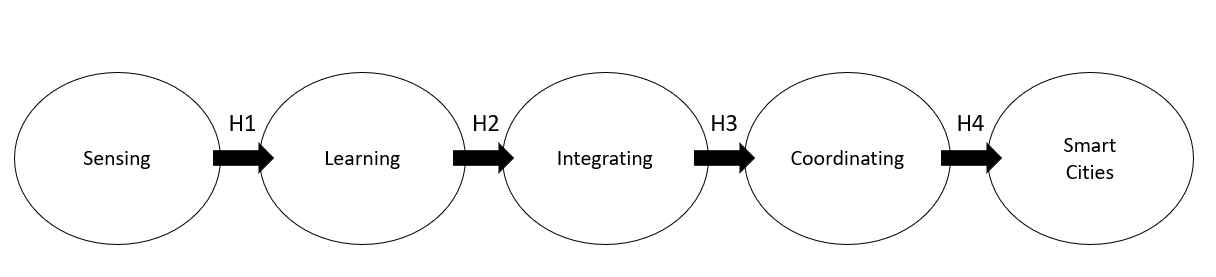
Figura 1. Modelo conceptual
Source: own elaboration.
3. METHODOLOGY
Context of the Study
This study was conducted with research groups in Manizales, Colombia, because they have contributed to this city's capacity to improve its services through their research, development, and innovation results. They have also leveraged information technologies to offer residents novel services and products, facilitating the consolidation of the smart city dimensions mentioned above and generating many of the smart city products offered in Manizales. In addition, since they are constantly creating new knowledge, they have developed dynamic capabilities, transcending from being eminently academic to having a direct impact on market conditions and citizens' welfare (
In particular, Manizales was selected as the empirical setting because it is an intermediate city with demonstrated advances in smart city development in Latin America. It has been ranked by the National Planning Department (DNP) as the most modern city in Colombia, leading in key dimensions such as governance, science and technology, and sustainability (
Sample and Data Collection Procedure
A total of 82 research groups from Manizales participated in this study, out of 182 eligible groups, which represents a response rate of 47%. These groups were selected because they are officially recognized by the Ministry of Science, Technology, and Innovation of Colombia and are affiliated with universities in Manizales. Two surveys were administered. The first survey measured dynamic capabilities using the scale developed by
The survey on dynamic capabilities was administered to research and development directors. In addition, the smart city survey was administered to administrative or general directors of these same groups. This decision reflects differences in expertise. While research and development directors are familiar with the process of developing novel products and services from the perspective of dynamic capabilities, administrative and general directors are more knowledgeable about the application of these capabilities within Manizales. This separation helps reduce potential bias in the analysis of the relationship between dynamic capabilities and smart cities. The surveys were distributed through the SurveyMonkey platform, which enabled monitoring of response progress. Follow-up telephone calls were used to encourage participation. Data collection took place between July and September 2022.
Data Analysis Technique
This study used Partial Least Squares Structural Equation Modeling (PLS-SEM) for data analysis. This technique is appropriate to assess relationships that are new theoretical developments, such as those proposed in this study's hypotheses(
4. RESULTS
As a first step, the literature on PLS-SEM recommends that the evaluation of the measurement model used should be performed on all the constructs involved in the relationships (Hair et al., 2014). Several constructs were integrated into the measurement model: sensing, learning, integrating, coordinating, smart economy, smart people, smart governance, smart mobility, smart environment, smart living, and smart city adoption. This measurement model achieved convergent validity as shown in Table 1.
Tabla 1. Resultados de validez convergente
Construct | Cronbach’s Alpha | Composite Reliability | Average Variance Extracted |
Sensing | 0,85 | 0,89 | 0,63 |
Learning | 0,77 | 0,85 | 0,59 |
Integrating | 0,92 | 0,93 | 0,71 |
Coordinating | 0,84 | 0,89 | 0,68 |
Smart Economy | 0,87 | 0,91 | 0,67 |
Smart People | 0,81 | 0,89 | 0,73 |
Smart Governance | 0,77 | 0,87 | 0,69 |
Smart Mobility | 0,83 | 0,88 | 0,66 |
Smart Environmental | 0,82 | 0,88 | 0,67 |
Smart Living | 0,90 | 0,92 | 0,63 |
Smart City Adoption | 0,91 | 0,93 | 0,66 |
Firstly, all construct items obtained standardized loadings, which were mostly greater than 0.6. This is a requirement according to the PLS-SEM literature because it indicates that the convergent validity values of the items used in the surveys theoretically represent each construct (
In addition, the measurement model achieved discriminant validity, as evaluated through the Heterotrait-Monotrait Ratio of Correlations (HTMT). The literature on PLS-SEM advices that this indicator, which is established between pairs of variables, be less than 0.9 (
Tabla 2. Resultados de la validez discriminante (HTMT)
| Construct | 1 | 2 | 3 | 4 | 5 | 6 | 7 | 8 | 8 | 10 |
| Sensing | ||||||||||
| Learning | 0,71 | |||||||||
| Integrating | 0,82 | 0,85 | ||||||||
| Coordinating | 0,87 | 0,76 | 0,67 | |||||||
| Smart Economy | 0,21 | 0,44 | 0,27 | 0,28 | ||||||
| Smart People | 0,23 | 0,45 | 0,56 | 0,37 | 0,39 | |||||
| Smart Governance | 0,43 | 0,34 | 0,33 | 0,36 | 0,52 | 0,67 | ||||
| Smart Mobility | 0,33 | 0,35 | 0,22 | 0,21 | 0,69 | 0,81 | 0,58 | |||
| Smart Environmental | 0,41 | 0,45 | 0,56 | 0,67 | 0,72 | 0,77 | 0,89 | 0,79 | ||
| Smart Living | 0,24 | 0,27 | 0,28 | 0,31 | 0,73 | 0,67 | 0,59 | 0,73 | 0,65 | |
| Smart City Adoption | 0,33 | 0,40 | 0,52 | 0,35 | 0,78 | 0,70 | 0,83 | 0,81 | 0,76 | 0,88 |
In this study, smart cities was treated as a reflective–formative construct of a second order because it comprises seven variables: smart economy, smart people, smart governance, smart mobility, smart environment, smart living, and smart city adoption. To evaluate this model, the two-stage process recommended in the PLS-SEM literature (
Tabla 3. Evaluación del constructo reflexivo-formativo
Second-order construct | First-order construct | VIF | First-order construct weight on second-order construct |
Smart Cities | Smart Economy | 0,32 | 0,133* |
Smart People | 0,43 | 0,106* |
|
Smart Governance | 0,35 | 0,107* |
|
Smart Mobility | 0,37 | 0,141* |
|
Smart Environmental | 0,37 | 0,170* |
|
Smart Living | 0,39 | 0,243* |
|
Smart City Adoption | 0,19 | 0,100* |
Note: *Weights were significant at 99 %.
Drawing on the literature about PLS-SEM (
Tabla 4. Resultados de la comprobación de hipótesis
Direct effect |
|||
Relationship | Path Coefficient | T-Value | Result |
| Sensing → Learning | 0,64 | 3,45 | H1 supported |
| Learning → Integrating | 0,56 | 4,52 | H2 supported |
| Integrating → Coordinating | 0,70 | 2,67 | H3 supported |
| Coordinating → Smart cities | 0,41 | 4,67 | H4 supported |
| Learning R2: 0,41Integrating R2: 0,31Coordinating R2: 0,49Smart cities R2: 0,17 | |||
* Significance of 99 % for t-values exceeding the threshold of 2.5.
Finally, the predictive power of the identified relationships was evaluated within the sample through the R2 indicator. When exceeding the threshold of 0.1 in the dependent variables, this value indicates that the results have significant predictive power (Hair et al., 2014). This occurred in the four dependent variables established in the model (learning, integrating, coordinating, and smart cities).
5. DISCUSSION
This study introduces an original analytical perspective by empirically examining the sequential interaction of dynamic capabilities within the context of urban processes associated with smart cities. While prior theoretical frameworks have outlined the relevance of such capabilities, empirical evidence on their interconnected progression in research-driven environments remains scarce (
Confirmation of H1 demonstrates that research groups actively monitor their external environments to identify emerging needs and opportunities. This sensing strengthens their learning capabilities by enabling the assimilation of novel routines, behaviors, and knowledge structures (
Support for H2 suggests that learning capabilities have a positive influence on integration capabilities. This result reinforces existing arguments regarding the dynamic nature of organizational knowledge bases, particularly in research institutions (
Building upon this logic, H3 was also supported, substantiating the idea that integrative capabilities enable more effective coordination among research teams. By aligning and mobilizing internal resources, research groups are better positioned to implement innovations or adjust operational procedures (
These findings are consistent with and extend previous research that highlights the central role of dynamic capabilities in the development of smart cities. The dynamic capabilities framework, understood through sensing, learning, integrating and coordinating, shows that cities capable of recognizing opportunities, prioritizing initiatives, and reorganizing resources are more effective in creating public value through projects such as open data systems and digital services (
Beyond these specific mechanisms, research has shown more broadly that cities which cultivate dynamic capabilities are better positioned to sustain innovation, adapt to changing environments, and align diverse stakeholders around coherent strategies. Comparative evidence demonstrates that the systematic development of dynamic capabilities leads cities to achieving more consistent and long-lasting results in implementing smart initiatives, underlining the importance of coordination and institutional flexibility (
Altogether, these perspectives, combined with the evidence presented in this study, suggest that the evolution of smart cities cannot be reduced to the implementation of new technologies alone. What truly drives their formation is the systematic interaction of sensing, learning, integrating and coordinating capabilities. When these capabilities operate together, they allow cities to transform resources, align diverse stakeholders, and implement coherent solutions that balance technological innovation with social, economic, and environmental objectives. This study contributes to this body of knowledge by showing that the convergence of dynamic capabilities provides the institutional and organizational basis required for the sustainable advancement of smart cities.
In practical terms, the findings of this study offer significant implications for urban managers, academic leaders, and public policy makers. The identification of a causal relationship between the dynamic capabilities of research groups and the consolidation of smart city dimensions indicates that the success of urban innovation relies on the effective management of knowledge, resources, and collaborative networks. Within the logic of the triple and quadruple helix, research groups are not only producers of knowledge but also mediators that connect universities, industry, governments, and civil society, thereby facilitating the circulation of ideas and the joint development of solutions. Their ability to anticipate technological trends, combine interdisciplinary expertise, and adapt institutional arrangements is essential for aligning academic research with the demands of society and urban contexts. When governments and institutions provide sustained support through adequate funding, regulatory frameworks, and inclusive policies, these capabilities are translated into concrete applications in domains such as mobility, digital governance, environmental sustainability, and citizen participation. In this process, urban managers and policy makers acquire a strategic role as coordinators who transform fragmented efforts into integrated governance models capable of addressing Latin America’s socio-economic inequalities, institutional constraints, and cultural diversity. As a result, they foster the development of smart cities that are innovative, inclusive, and resilient.
The study was limited to research groups located in Manizales, Colombia, which may constrain the generalizability of the findings. Additionally, the cross-sectional design prevents causal conclusions. Research group leaders' responses may also introduce subjective bias. Nevertheless, the use of PLS-SEM ensured the robustness of the findings by validating both convergent and discriminant measurement properties.
Future studies could explore how dynamic capabilities shape research productivity and innovation outcomes within academic teams. Understanding how scholarly outputs contribute to specific smart city projects remains relevant. Moreover, it is critical to analyze the role of additional stakeholders—such as government agencies, commercial sectors, non-governmental organizations, and civil society—and their interactions with research entities in advancing smart urban ecosystems.
6. CONCLUSIONS
This study advances the understanding of dynamic capabilities by evidencing their sequential structure and collective impact when oriented towards urban innovation processes. The empirical model demonstrates that sensing capabilities initiate a chain reaction, enhancing learning, which then supports integration, ultimately leading to effective coordination. This sequence significantly influences the smart city dimension, challenging the conventional view of capabilities as simultaneous and isolated functions.
By emphasizing the interdependence of these four capabilities, the findings offer a process-based explanation for how research groups contribute strategically to urban development. Such a progression suggests that dynamic capabilities evolve through accumulative refinement rather than separated deployment, especially in knowledge-intensive environments.
The results imply that leaders within research organizations must synchronize their strategies for sensing, learning, integrating, and coordinating. The empirical framework proposed in this study allows for the design of practical pathways to strengthen institutional capacities aligned with urban impact. It also underscores the role of contextual learning and resource orchestration in fostering responsiveness and innovation within city ecosystems.
Strategic information management, facilitated by organizational learning, equips research teams to act decisively and creatively in response to urban challenges. Harmonizing these capabilities with public policy and institutional priorities can bridge the gap between academic expertise and urban transformation agendas. Accordingly, systematically strengthening dynamic capabilities is essential for transforming research entities into catalysts for sustainable and intelligent city change.
CONFLICTS OF INTEREST
The authors declare no financial, professional, or personal conflicts of interest that could have inappropriately influenced the results or interpretations presented in this study.
AUTHOR CONTRIBUTIONS
All authors contributed significantly to the development of this article, including its design, conceptual framework, methodology, data analysis, and manuscript writing and revision the final version of the manuscript.
REFERENCES
- arrow_upward Adjei-Bamfo, P., Maloreh-Nyamekye, T., & Ahenkan, A. (2019). The role of e-government in sustainable public procurement in developing countries: A systematic literature review. Resources, Conservation and Recycling, 142, 189-203. https://doi.org/10.1016/j.resconrec.2018.12.001
- arrow_upward Alvarez, G., Pilbeam, C., & Wilding, R. (2010). Nestlé Nespresso AAA sustainable quality program: an investigation into the governance dynamics in a multi-stakeholder supply chain network. Supply Chain Management, 15(2), 165-182. https://doi.org/10.1108/13598541011028769
- arrow_upward Anthopoulos, L., Janssen, M., & Weerakkody, V. (2016). A Unified Smart City Model (USCM) for Smart City Conceptualization and Benchmarking. International Journal of Electronic Government Research, 12(2), 77-93. https://doi.org/10.4018/IJEGR.2016040105
- arrow_upward Argote, L., & Miron-Spektor, E. (2011). Organizational Learning: From Experience to Knowledge. Organization Science, 22(5), 1123-1137. https://doi.org/10.1287/orsc.1100.0621
- arrow_upward Azkuna, I. (2012). Smart Cities Study: International study on the situation of ICT, innovation and Knowledge in cities. The Committee of Digital and Knowledge-based Cities of UCLG – Mayor of Bilbao. https://www.uclg-cisdp.org/sites/default/files/smartcitiesstudy_en.pdf
- arrow_upward Babelytė-Labanauskė, K., & Nedzinskas, S. (2017). Dynamic capabilities and their impact on research organizations’ R&D and innovation performance. Journal of Modelling in Management, 12(4), 603-630. https://doi.org/10.1108/JM2-05-2015-0025
- arrow_upward Beckers, D., & Mora, L. (2025). Overcoming the Smart City Governance Challenge: an Innovation Management Perspective. Journal of Urban Technology, 32(2), 85-106. https://doi.org/10.1080/10630732.2025.2461983
- arrow_upward Benner, M., & Sandström, U. (2000). Institutionalizing the triple helix: research funding and norms in the academic system. Research Policy, 29(2), 291-301. https://doi.org/10.1016/S0048-7333(99)00067-0
- arrow_upward Bingham, C. B., Heimeriks, K. H., Schijven, M., & Gates, S. (2015). Concurrent learning: How firms develop multiple dynamic capabilities in parallel. Strategic Management Journal, 36(12), 1802-1825. https://doi.org/10.1002/smj.2347
- arrow_upward Bokolo, A. J., Majid, M. A., & Romli, A. (2018). A trivial approach for achieving Smart City: a way forward towards a sustainable society. 2018 21st Saudi Computer Society National Computer Conference (NCC), Riyadh, Saudi Arabia, 2018. IEEE. https://doi.org/10.1109/NCG.2018.8592999
- arrow_upward Cambra‐Fierro, J. J., López‐Pérez, M. E., Melero‐Polo, I., Pérez, L., & Tejada‐Tejada, M. (2024). Smart innovations for sustainable cities: Insights from a public‐private innovation ecosystem. Corporate Social Responsibility and Environmental Management, 31(3), 1654-1666. https://doi.org/10.1002/csr.2660
- arrow_upward Chang, Y. C., Chang, H. T., Chi, H. R., Chen, M. H., & L. L. Deng. (2012). How Do Established Firms Improve Radical Innovation Performance? The Organizational Capabilities View. Technovation 32(7), 441-451. https://doi.org/10.1016/j.technovation.2012.03.001
- arrow_upward Chen, S., Zhang, X., Wang, W., Liang, Y., He, W., & Tan, Z. (2024). The Effect of Smart City Policies on City Innovation — A Quasi-Natural Experiment from the Smart City Pilot Cities in China. Sustainability, 16(18), art. 8007. https://doi.org/10.3390/su16188007
- arrow_upward Chien, S. Y., & Tsai, C. H. (2012). Dynamic capability, knowledge, learning, and firm performance. Journal of Organizational Change Management, 25(3), 434-444. https://doi.org/10.1108/09534811211228148
- arrow_upward Chong, M., Habib, A., Evangelopoulos, N., & Park, H. W. (2018). Dynamic capabilities of a smart city: An innovative approach to discovering urban problems and solutions. Government Information Quarterly, 35(4), 682-692. https://doi.org/10.1016/j.giq.2018.07.005
- arrow_upward Cohen, M. D., & Bacdayan, P. (1994). Organizational Routines are Stored as Procedural Memory: Evidence from a Laboratory Study. Organization Science, 5(4), 554-568. https://doi.org/10.1287/orsc.5.4.554
- arrow_upward Cyfert, S., Chwiłkowska-Kubala, A., Szumowski, W., & Miśkiewicz, R. (2021). The process of developing dynamic capabilities: The conceptualization attempt and the results of empirical studies. PLoS One, 16(4), art. e0249724. https://doi.org/10.1371/journal.pone.0249724
- arrow_upward De Magalhães Santos, L. G. (2023). Dynamic Capabilities and Digital Transformation in Public Sector: Evidence from Brazilian Case Study. In I. Lindgren, C. Csáki, E. Kalampokis, M. Janssen, G. Viale Pereira, S. Virkar, E. Tambouris & A. Zuiderwijk (eds.), International Conference on Electronic Government (pp. 365-380). Springer Nature Switzerland. https://doi.org/0.1007/978-3-031-41138-023
- arrow_upward Departamento Nacional de Planeación [DNP]. (2023). Índice de Ciudades Modernas 2023. Observatorio del Sistema de Ciudades - Gobierno de Colombia. https://osc.dnp.gov.co/resources/icm/Documento-tecnico-ICM-2023.pdf
- arrow_upward Drnevich, P. L., & Kriauciunas, A. P. (2011). Clarifying the conditions and limits of the contributions of ordinary and dynamic capabilities to relative firm performance. Strategic Management Journal, 32(3), 254-279. https://doi.org/10.1002/smj.882
- arrow_upward Escobar, A., Luna, J., & Caraballo, A. (2024). Innovating smart cities in Latin America: Addressing regional urban challenges and opportunities. Journal of Infrastructure, Policy and Development, 8(13), art. 8378. https://doi.org/10.24294/jipd8378
- arrow_upward Ester, R. M., Assimakopoulos, D., von Zedtwitz, M., & Yu, X. (2010). Global R&D organization and the development of dynamic capabilities: Literature review and case study of a Chinese high‐tech firm. Journal of Knowledge-based Innovation in China, 2(1), 25-45. https://doi.org/10.1108/17561411011031972
- arrow_upward Etzkowitz, H., & Leydesdorff, L. (2000). The dynamics of innovation: from National Systems and “Mode 2” to a Triple Helix of university–industry–government relations. Research Policy, 29(2), 109-123. https://doi.org/10.1016/S0048-7333(99)00055-4
- arrow_upward Faccin, K., Balestrin, A., Volkmer Martins, B., & Bitencourt, C. C. (2019). Knowledge-based dynamic capabilities: A joint R&D project in the French semiconductor industry. Journal of Knowledge Management, 23(3), 439-465. https://doi.org/10.1108/JKM-04-2018-0233
- arrow_upward Fernandes, R. A. S., Queiroz, A. O., Lourenço Wilmers, J. T. A. V., & Hoffmann, W. A. M. (2019). Urban governance in Latin America: Bibliometrics applied to the context of smart cities. Transinformação, 31, art. e190014. https://doi.org/10.1590/2318-0889201931e190014
- arrow_upward Ferraris, A., Santoro, G., & Pellicelli, A. C. (2020). “Openness” of public governments in smart cities: removing the barriers for innovation and entrepreneurship. International Entrepreneurship and Management Journal, 16(4), 1259-1280. https://doi.org/10.1007/s11365-020-00651-4
- arrow_upward Fredrich, V., Gudergan, S., & Bouncken, R. B. (2022). Dynamic Capabilities, Internationalization and Growth of Small-and Medium-Sized Enterprises: The Roles of Research and Development Intensity and Collaborative Intensity. Management International Review, 62(4), 611-642. https://doi.org/10.1007/s11575-022-00480-3
- arrow_upward Froehlich, C., Bitencourt, C. C., & Bossle, M. B. (2017). The use of dynamic capabilities to boost innovation in a Brazilian Chemical Company. Revista de Administração, 52(4), 479-491. https://doi.org/10.1016/j.rausp.2017.08.007
- arrow_upward Galvao, A., Mascarenhas, C., Marques, C., Ferreira, J., & Ratten, V. (2019). Triple helix and its evolution: a systematic literature review. Journal of Science and Technology Policy Management, 10(3), 812-833. https://doi.org/10.1108/JSTPM-10-2018-0103
- arrow_upward García Pineda, V., Rojas Arias, J. P., Macías Urrego, J. A., & Rodríguez Correa, P. A. (2023). Identificación de capacidades de innovación en contextos universitarios virtuales: una aproximación desde una institución universitaria privada. Revista CEA, 9(21), art. e2678. https://doi.org/10.22430/24223182.2678
- arrow_upward Gavetti, G., & Levinthal, D. (2000). Looking Forward and Looking Backward: Cognitive and Experiential Search. Administrative Science Quarterly, 45(1), 113-137. https://doi.org/10.2307/2666981
- arrow_upward Gheitarani, F., Nawaser, K., Hanifah, H., & Vafaei-Zadeh, A. (2023). Human-behavioural micro-foundations of dynamic capabilities: a systematic review of the last two decades of research. International Journal of Management and Decision Making, 22(1), 1-26. https://doi.org/10.1504/IJMDM.2023.127685
- arrow_upward Giffinger, R., & Gudrun, H. (2010). Smart cities ranking: an effective instrument for the positioning of the cities? ACE: Architecture, City and Environment, 4(12), 7-26. https://doi.org/10.5821/ace.v4i12.2483
- arrow_upward Giffinger, R., Fertner, C., Kramar, H., Kalasek, R., Pichler-Milanovic, N., & Meijers, E. (2007). Smart Cities–Ranking of European Medium-Sized Cities. Centre of Regional Science (SRF), Vienna University of Technology. https://www.smart-cities.eu/download/smart_cities_final_report.pdf
- arrow_upward Guenduez, A. A., & Mergel, I. (2022). The role of dynamic managerial capabilities and organizational readiness in smart city transformation. Cities, 129, art. 103791. https://doi.org/10.1016/j.cities.2022.103791
- arrow_upward Güldenberg, S., & Leitner, K.-H. (2008). Strategy Processes in Research and Development Organisations: Why Knowledge Management is still more isolated than integrated [paper]. 3th International Conference on Organizational Learning, Knowledge and Capabilities (OLKC), Copenhagen, Denmark. https://warwick.ac.uk/fac/soc/wbs/conf/olkc/archive/olkc3/papers/contribution157.pdf
- arrow_upward Guo, Q., & Zhong, J. (2022). The effect of urban innovation performance of smart city construction policies: Evaluate by using a multiple period difference-in-differences model. Technological Forecasting and Social Change, 184(4), art. 122003. https://doi.org/10.1016/j.techfore.2022.122003
- arrow_upward Gupta, A., Panagiotopoulos, P., & Bowen, F. (2017). Towards a capabilities approach to smart city management. In M. Janssen, K. Axelsson, O. Glassey, B. Klievink, R. Krimmer, I. Lindgren, P. Parycek, H. J. Scholl & D. Trutnev (eds.), Electronic Government: 16th IFIP WG 8.5 International Conference, EGOV 2017, St. Petersburg, Russia, September 4-7, 2017, Proceedings (pp. 25-35). Springer International Publishing. https://doi.org/10.1007/978-3-319-64677-0_3
- arrow_upward Hair Jr., J. F., Black, W. C., Babin, B. J., & Anderson, R. E. (2019). Multivariate Data Analysis (8th ed.). Pearson.
- arrow_upward Hair Jr., J. F., Hult, G. T. M., Ringle, C. M., & Sarstedt, M. (2014). A Primer on Partial Least Squares Structural Equation Modeling (PLS-SEM). Sage Publications.
- arrow_upward Hair Jr., J. F., Matthews, L. M., Matthews, R. L., & Sarstedt, M. (2017). PLS-SEM or CB-SEM: updated guidelines on which method to use. International Journal of Multivariate Data Analysis, 1(2), 107-123. https://doi.org/10.1504/IJMDA.2017.087624
- arrow_upward Hart, S. L., & Sharma, S. (2004). Engaging fringe stakeholder for competitive imagination. IEEE Engineering Management Review, 32(3), 28-28. https://doi.org/10.1109/EMR.2004.25105
- arrow_upward Helfat, C. E., & Raubitschek, R. S. (2000). Product sequencing: co‐evolution of knowledge, capabilities and products. Strategic Management Journal, 21(10‐11), 961-979. https://doi.org/10.1002/1097-0266(200010/11)21:10/11<961::AID-SMJ132>3.0.CO;2-E
- arrow_upward Helfat, C. E., & Winter, S. G. (2011). Untangling Dynamic and Operational Capabilities: Strategy for the (N)ever‐Changing World. Strategic Management Journal, 32(11), 1243-1250. https://doi.org/10.1002/smj.955
- arrow_upward Helfat, C. E., Finkelstein, S., Mitchell, W., Peteraf, M., Singh, H., Teece, D., & Winter, S. G. (2007). Dynamic Capabilities: Understanding Strategic Change in Organizations. John Wiley & Sons.
- arrow_upward Henseler, J., Ringle, C. M., & Sarstedt, M. (2015). A new criterion for assessing discriminant validity in variance-based structural equation modeling. Journal of the Academy of Marketing Science, 43(1), 115-135. https://doi.org/10.1007/s11747-014-0403-8
- arrow_upward Hermawati, A. (2020). The implementation of dynamic capabilities for SMEs in creating innovation. Journal of Workplace Learning, 32(3), 199-216. https://doi.org/10.1108/JWL-06-2019-0077
- arrow_upward Hernández-Linares, R., Kellermanns, F. W., & López-Fernández, M. C. (2021). Dynamic capabilities and SME performance: The moderating effect of market orientation. Journal of Small Business Management, 59(1), 162-195. https://doi.org/10.1111/jsbm.12474
- arrow_upward Hodgkinson, G. P., & Healey, M. P. (2011). Psychological foundations of dynamic capabilities: reflexion and reflection in strategic management. Strategic Management Journal, 32(13), 1500-1516. https://doi.org/10.1002/smj.964
- arrow_upward Iansiti, M., & Clark, K. B. (1994). Integration and Dynamic Capability: Evidence from Product Development in Automobiles and Mainframe Computers. Industrial and Corporate Change, 3(3), 557-605. https://doi.org/10.1093/icc/3.3.557
- arrow_upward Iansiti, M., & Lakhani, K. R. (2020). Competing in the Age of AI: Strategy and Leadership When Algorithms and Networks Run the World. Harvard Business Press. https://www.hbs.edu/faculty/Pages/item.aspx?num=56633
- arrow_upward Jnr, B. A., Majid, M. A., & Romli, A. (2017). Sustainable Adoption and Implementation in Collaborative Enterprise: A Systematic Literature Review. Journal of Theoretical & Applied Information Technology, 95(9), 1875-1915. https://www.researchgate.net/publication/314947566_Sustainable_Adoption_and_Implementation_in_Collaborative_Enterprise_A_Systematic_Literature_Review
- arrow_upward Kale, P., & Singh, H. (2007). Building firm capabilities through learning: the role of the alliance learning process in alliance capability and firm‐level alliance success. Strategic Management Journal, 28(10), 981-1000. https://doi.org/10.1002/smj.616
- arrow_upward Karimi-Alaghehband, F., & Rivard, S. (2020). IT outsourcing success: A dynamic capability-based model. The Journal of Strategic Information Systems, 29(1), art. 101599. https://doi.org/10.1016/j.jsis.2020.101599
- arrow_upward Karna, A., Richter, A., & Riesenkampff, E. (2016). Revisiting the role of the environment in the capabilities–financial performance relationship: A meta‐analysis. Strategic Management Journal, 37(6), 1154-1173. https://doi.org/10.1002/smj.2379
- arrow_upward Kattel, R. (2022). Dynamic capabilities of the public sector: Towards a new synthesis [paper]. Discussion Paper, No. 267. Institute for Applied Economic Research (IPEA). https://doi.org/10.38116/dp267
- arrow_upward Kattel, R., Mazzucato, M., Baafi, K., Fernandez-Monge, F., Goulden, A., Gronchi, I., Kalema, N., & Puttick, R. (2025). Dynamic capabilities for transformative change in city governments [paper]. Working Paper IIPP WP 2025-03. UCL Institute for Innovation and Public Purpose. https://discovery.ucl.ac.uk/id/eprint/10210996/1/Kattel_dynamic_capabilities_for_transformative_change_in_city_governments.pdf
- arrow_upward Kelly, D. (2009). Adaptation and Organizational Connectedness in Corporate Radical Innovation Programs. Journal of Product Innovation Management, 26(5), 487-501. https://doi.org/10.1111/j.1540-5885.2009.00676.x
- arrow_upward Komninos, N., Kakderi, C., Panori, A., & Tsarchopoulos, P. (2019). Smart City Planning from an Evolutionary Perspective. Journal of Urban Technology, 26(2), 3-20. https://doi.org/10.1080/10630732.2018.1485368
- arrow_upward Kulakowski, E. C., & Chronister, L. U. (2006). Research Administration and Management. Jones & Bartlett Publishers.
- arrow_upward Kumar, T. V., & Dahiya, B. (2017). Smart Economy in Smart Cities. In T. M. V. Kumar (ed.), Smart Economy in Smart Cities (pp. 3-76). Springer. https://doi.org/10.1007/978-981-10-1610-3_1
- arrow_upward Kump, B., Engelmann, A., Kessler, A., & Schweiger, C. (2019). Toward a dynamic capabilities scale: measuring organizational sensing, seizing, and transforming capacities. Industrial and Corporate Change, 28(5), 1149-1172. https://doi.org/10.1093/icc/dty054
- arrow_upward Kurtmollaiev, S. (2020). Dynamic Capabilities and Where to Find Them. Journal of Management Inquiry, 29(1), 3-16. https://doi.org/10.1177/1056492617730126
- arrow_upward Lee, S., & Klassen, R. D. (2008). Drivers and Enablers that Foster Environmental Management Capabilities in Small- and Medium-Sized Suppliers in Supply Chains. Production and Operations Management, 17(6), 573-592. https://doi.org/10.3401/poms.1080.0063
- arrow_upward Leite da Silva, A. S., Teixeira, A. A., & Ramos Cavalcanti, T. C. (2022). The Digital Divide and the Smart Digital Governance in Brazil: Tensions between the skills of multiple policy areas and the needs of society. In E. Loukis & M. A. Macadar (eds.), Proceedings of the 14th International Conference on Theory and Practice of Electronic Governance (pp. 129-135). Association for Computing Machinery. https://doi.org/10.1145/3494193.3494298
- arrow_upward Leydesdorff, L. (2012). The Knowledge-Based Economy and the Triple Helix Model. https://www.leydesdorff.net/arist09/arist09.pdf
- arrow_upward Linde, L., Sjödin, D., Parida, V., & Wincent, J. (2021). Dynamic capabilities for ecosystem orchestration A capability-based framework for smart city innovation initiatives. Technological Forecasting and Social Change, 166, art. 120614. https://doi.org/10.1016/j.techfore.2021.120614
- arrow_upward Liu, H. M., & Yang, H. F. (2020). Network resource meets organizational agility. Management Decision, 58(1), 58-75. https://doi.org/10.1108/MD-10-2017-1061
- arrow_upward Liu, H. Y., & Hsu, C. W. (2011). Antecedents and consequences of corporate diversification: A dynamic capabilities perspective. Management Decision, 49(9), 1510-1534. https://doi.org/10.1108/00251741111173961
- arrow_upward Madkour, M., Benhaddou, D., Khalil, N., Burriello, M., & Cline Jr., R. E. (2015). Living Campus: Towards a Context-Aware Energy Efficient Campus Using Weighted Case Based Reasoning [paper]. Workshops at the Twenty-Ninth AAAI Conference on Artificial Intelligence. https://cdn.aaai.org/ocs/ws/ws0126/10191-46031-1-PB.pdf
- arrow_upward Mainka, A., Castelnovo, W., Miettinen, V., Bech‐Petersen, S., Hartmann, S., & Stock, W. G. (2016). Open innovation in smart cities: Civic participation and co‐creation of public services. Proceedings of the Association for Information Science and Technology, 53(1), 1-5. https://doi.org/10.1002/pra2.2016.14505301006
- arrow_upward Makkonen, H., Pohjola, M., Olkkonen, R., & Koponen, A. (2014). Dynamic capabilities and firm performance in a financial crisis. Journal of Business Research, 67(1), 2707-2719. https://doi.org/10.1016/j.jbusres.2013.03.020
- arrow_upward Maranzato, F. P., & Salerno, M. S. (2018). Integration between research and development: A dynamic capabilities perspective. Revista de Administração de Empresas, 58(5), 460-474. https://doi.org/10.1590/S0034-759020180503
- arrow_upward Maranzato, F. P., Salerno, M., Gomes, L. A. V., Barbosa, A. P. F. P. L., & Brasil, V. C. (2019). Mechanisms for the integration between Research and Development: a literature review [paper]. R&D Management Conference 2019. https://www.researchgate.net/publication/334263568_Mechanisms_for_the_integration_between_Research_and_Development_a_literature_review
- arrow_upward Marciniak, K., & Owoc, M. L. (2013). Usability of Knowledge Grid in Smart City Concepts. In S. Hammoudi, L. Maciaszek, J. Cordeiro & J. Dietz (eds.), Proceedings of the 15th International Conference on Enterprise Information Systems - Volume 3: ICEIS (pp. 341-346). ICEIS. https://doi.org/10.5220/0004453903410346
- arrow_upward Matarazzo, M., Penco, L., Profumo, G., & Quaglia, R. (2021). Digital transformation and customer value creation in Made in Italy SMEs: A dynamic capabilities perspective. Journal of Business Research, 123, 642-656. https://doi.org/10.1016/j.jbusres.2020.10.033
- arrow_upward Matysiak, L., Rugman, A.M., & Bausch, A. (2018). Dynamic Capabilities of Multinational Enterprises: the Dominant Logics Behind Sensing, Seizing, and Transforming Matter! Management International Review, 58(2), 225-250. https://doi.org/10.1007/s11575-017-0337-8
- arrow_upward Ministerio de Ciencia, Tecnología e Innovación [MinCiencias]. (n. d.). Resultados de la convocatoria nacional para el reconocimiento y medición de grupos de investigación, desarrollo tecnológico o de innovación. Gobierno de Colombia. https://minciencias.gov.co/resultados-convocatorias-reconocimiento-y-medicion-grupos-investigacion
- arrow_upward Mishra, A. P., Sen, A., & Kumar, A. (2017). Exploring Potentials and Challenges in Making Smart Cities in India: A Case Study of Allahabad City, Uttar Pradesh. In P. Sharma & S. Rajput (eds.), Sustainable Smart Cities in India (pp. 123-142). Springer. https://doi.org/10.1007/978-3-319-47145-7_8
- arrow_upward Okhuysen, G. A., & Bechky, B. A. (2009). Coordination in Organizations: An Integrative Perspective. The Academy of Management Annals, 3(1), 463-502. https://doi.org/10.1080/19416520903047533
- arrow_upward Pavlou, P. A., & El Sawy, O. A. (2011). Understanding the Elusive Black Box of Dynamic Capabilities. Decision Sciences, 42(1), 239-273. https://doi.org/10.1111/j.1540-5915.2010.00287.x
- arrow_upward Philpott, K., Dooley, L., O'Reilly, C., & Lupton, G. (2011). The entrepreneurial university: Examining the underlying academic tensions. Technovation, 31(4), 161-170. https://doi.org/10.1016/j.technovation.2010.12.003
- arrow_upward Protogerou, A., Caloghirou, Y., & Lioukas, S. (2012). Dynamic Capabilities and Their Indirect Impact on Firm Performance. Industrial and Corporate Change, 21(3), 615-647. https://doi.org/10.1093/icc/dtr049
- arrow_upward Ringle, C. M., Wende, S., & Becker, J. M. (2022). SmartPLS 4. https://www.smartpls.com
- arrow_upward Sachitra, V., & Chong, S. C. (2018). Resources, capabilities and competitive advantage of minor export crops farms in Sri Lanka: An empirical investigation. Competitiveness Review, 28(5), 478-502. https://doi.org/10.1108/CR-01-2017-0004
- arrow_upward Sanchez, R., & Heene, A. (1997). Competence-based strategic management: concepts and issues for theory, research and practice. In A. Heene & R. Sanchez (eds), Competence-based Strategic Management (pp. 3-42). John Wiley and Sons.
- arrow_upward Schilke, O., Hu, S., & Helfat, C. E. (2018). Quo Vadis, Dynamic Capabilities? A Content-Analytic Review of the Current State of Knowledge and Recommendations for Future Research. Academy of Management Annals, 12(1), 390-439. https://doi.org/10.5465/annals.2016.0014
- arrow_upward Seisdedos, G. (2016). Hoja de ruta para crear ciudades inteligentes. Harvard Deusto Business Review, (255), 32-44. https://www.harvard-deusto.com/hoja-de-ruta-para-crear-ciudades-inteligentes
- arrow_upward Sikora-Fernández, D. (2017). Factores de desarrollo de las ciudades inteligentes. Revista Universitaria de Geografía, 26(1), 135-152. https://www.redalyc.org/articulo.oa?id=383252125007
- arrow_upward Su, K., Li, J., & Fu, H. (2011). Smart City and the applications. In 2011 International Conference on Electronics, Communications and Control (ICECC), Ningbo, China, 2011 (pp. 1028-1031). IEEE. https://doi.org/10.1109/ICECC.2011.6066743
- arrow_upward Tahir, Z., & Malek, J. A. (2016). Main criteria in the development of smart cities determined using analytical method. Planning Malaysia Journal, 14(5). https://doi.org/10.21837/pmjournal.v14.i5.179
- arrow_upward Tan, S. Y., & Taeihagh, A. (2020). Smart City Governance in Developing Countries: A Systematic Literature Review. Sustainability, 12(3), art. 899. https://doi.org/10.3390/su12030899
- arrow_upward Teece, D. J. (2007). Explicating dynamic capabilities: the nature and microfoundations of (sustainable) enterprise performance. Strategic Management Journal, 28(13), 1319-1350. https://doi.org/10.1002/smj.640
- arrow_upward Teece, D. J. (2009). Dynamic Capabilities and Strategic Management: Organizing for Innovation and Growth. Oxford University Press on Demand.
- arrow_upward Teece, D. J. (2014). The Foundations of Enterprise Performance: Dynamic and Ordinary Capabilities in an (Economic) Theory of Firms. Academy of Management Perspectives, 28(4), 328-352. https://doi.org/10.5465/amp.2013.0116
- arrow_upward Teece, D. J. (2016). Dynamic capabilities and entrepreneurial management in large organizations: Toward a theory of the (entrepreneurial) firm. European Economic Review, 86, 202-216. https://doi.org/10.1016/j.euroecorev.2015.11.006
- arrow_upward Teece, D. J. (2023). The Evolution of the Dynamic Capabilities Framework. In R. Adams, D. Grichnik, A. Pundziene, C. Volkmann (eds.), Artificiality and Sustainability in Entrepreneurship: Exploring the Unforeseen, and Paving the Way to a Sustainable Future (pp. 113-129). Springer International Publishing. https://doi.org/10.1007/978-3-031-11371-0_6
- arrow_upward Teece, D. J., Pisano, G., & Shuen, A. (1997). Dynamic capabilities and strategic management. Strategic Management Journal, 18(7), 509-533. https://doi.org/10.1002/(SICI)1097-0266(199708)18:7<509::AID-SMJ882>3.0.CO;2-Z
- arrow_upward Torres, R., Sidorova, A., & Jones, M. C. (2018). Enabling firm performance through business intelligence and analytics: a dynamic capabilities perspective. Information & Management, 55(7), 822-839. https://doi.org/10.1016/j.im.2018.03.010
- arrow_upward United Nations Educational, Scientific and Cultural Organization (UNESCO). (2020). UNESCO Global Network of Learning Cities. https://www.uil.unesco.org/en/learning-cities
- arrow_upward Vachon, S., & Klassen, R. D. (2006). Extending green practices across the supply chain; The impact of upstream and downstream integration. International Journal of Operations & Production Management, 26(7), 795-820. https://doi.org/10.1108/01443570610672248
- arrow_upward Wdowiarz-Bilska, M. (2012). Od miasta naukowego do smart city. Czasopismo Techniczne. Architektura, 109(1-A/2), 305-314. https://repozytorium.biblos.pk.edu.pl/redo/resources/31126/file/suwFiles/WdowiarzBilskaM_MiastaNaukowego.pdf
- arrow_upward Winter, S. G. (2003). Understanding dynamic capabilities. Strategic Management Journal, 24(10), 991-995. https://doi.org/10.1002/smj.318
- arrow_upward Wohlleber, A. J., Bock, M., Birkel, H., & Hartmann, E. (2024). Implementing Vital Dynamic Capabilities to Succeed in Digital Transformation: A Multiple-Case Study in Maritime Container Shipping. IEEE Transactions on Engineering Management, 71, 13627-13645. https://doi.org/10.1109/tem.2022.3201770
- arrow_upward Yeow, A., Soh, C., & Hansen, R. (2018). Aligning with new digital strategy: A dynamic capabilities approach. The Journal of Strategic Information Systems, 27(1), 43-58. https://doi.org/10.1016/j.jsis.2017.09.001
- arrow_upward Zollo, M., & Winter, S. G. (2002). Deliberate learning and the evolution of dynamic capabilities. Organization Science, 13(3), 339-351. https://doi.org/10.1287/orsc.13.3.339.2780
ANNEXES
Anexo A. Preguntas del cuestionario sobre capacidades dinámicas
| Dynamic capability | Items |
| Sensing capability | SC1 - Frequency of monitoring research projects. |
| SC2 - Level of use of technological and systematic tools in the group's activities. | |
| SC3 - Frequency of information search activities. | |
| SC4 - Frequency of technological surveillance and knowledge updating within the group’s core of expertise. | |
| SC5 - Frequency of monitoring changes in the social and technological environment. | |
| SC6 - Weekly intensity of time devoted to idea generation and new design of capabilities. | |
| Integration capability | IC1 - Level of participation of group members in contributing individual knowledge to projects. |
| IC 2 - Level of understanding of tasks and responsibilities among group members. | |
| IC 3 - Level of identification of skills within the group. | |
| IC 4 - Capability to develop unique and valuable talent and incorporate it into the group’s knowledge base. | |
| IC 5 - Level of interaction among group members. | |
| IC 6 - Level of connectivity among group members. | |
| Coordinating capability | CC1 - Alignment between the group’s capabilities and the general and specialized competencies of its members. |
| CC2 - Level of productivity in response to changes in the sociotechnical and cultural environment. | |
| CC3 - Capability to monitor knowledge gaps. | |
| CC4 - Degree of identification of technological markets within the sociocultural and technical environment. | |
| CC5 - Level of monitoring of technological trajectories in products, processes, and business models. | |
| Learning capability | LC1 - Ability to compare knowledge streams, combine capabilities, and deploy competencies. |
| LC2 - Number of effective routines for identifying, evaluating, and incorporating new information and knowledge into core strategic competencies. | |
| LC3 - Frequency of transforming existing knowledge and information into new knowledge. | |
| LC4 - Effectiveness of transforming existing knowledge and information into new products and processes. |
Anexo B. Preguntas del cuestionario sobre la Ciudad Inteligente
| Smart City Dimensions | Items |
| Smart Economy | SE1 - Deployment of ICT in businesses. |
| SE2 - Strategic planning for the city’s economic development. | |
| SE3 - Talent attraction, retention, and creativity promotion. | |
| SE4 - Support for entrepreneurship. | |
| SE5 - Development of business networks and collaborations. | |
| SE6 - International promotion strategies for the city. | |
| SE7 - Provision of tax payment systems. | |
| Smart People | SP1 - Presence of higher education institutions in the city. |
| SP2 - ICT integration and digital development in classrooms. | |
| SP3 - Collaboration between firms and knowledge institutions. | |
| SP4 - Presence of research, development, and innovation plans. | |
| Smart Governance | SG1 - Promotion of ICT, innovation, and online public services. |
| SG2 - Availability of official government websites. | |
| SG3 - Presence of strategic plans for e‐government development. | |
| SG4 - Use of internet-connected computers by administrative staff. | |
| SG5 - Transparency and citizen participation. | |
| SG6 - Implementation of e‐democracy and electronic voting systems. | |
| SG7 - Availability of birth and death registration. | |
| Smart Mobility | SM1 - International accessibility. |
| SM2 - Availability of innovative and safe transport systems. | |
| SM3 – Effective traffic and parking management systems. | |
| SM4 - Availability of bicycle lanes and unobstructed pedestrian pathways. | |
| SM5 - Availability of ICT infrastructure through internet service providers. | |
| SM6 - Internet use and broadband coverage. | |
| SM7 - Mobile phone and mobile internet use. | |
| SM8 - Availability of public internet access and Wi‐Fi hotspots. | |
| Smart Environment | SEN1 - Attractiveness of natural conditions. |
| SEN2 - Support for pollution reduction. | |
| SEN3 - Environmental protection measures. | |
| SEN4 - Availability of sewerage and wastewater treatment systems. | |
| SEN5 - Adoption of green practices and solid waste recycling. | |
| SEN6 - Promotion of sustainable resource management. | |
| SEN7 - Use of ICT to improve public safety. | |
| SEN8 - Implementation of initiatives for the digitization of cultural heritage assets. | |
| SEN9 – availability of disaster prediction and early warning systems. | |
| SEN10 - Availability of fire stations and disaster alarm systems. | |
| Smart Living | SL1 - Promotion of ICT use in households. |
| SL2 - Implementation of e‐health policies. | |
| SL3 - Availability of online medical services. | |
| SL4 - Availability of emergency response services (e.g., ambulances, emergency units, healthcare facilities). | |
| SL5 - Availability of remote home monitoring or alarm systems for patients. | |
| SL6 - Development of digital inclusion programs for vulnerable populations. | |
| SL7 - Guarantee of personal safety and better housing quality. | |
| SL8 - Promotion of tourism attractiveness and social cohesion. | |
| SL9 - Provision of uninterrupted electricity supply. | |
| SL10 - Provision of uninterrupted water supply. | |
| SL11 - Availability of metering and online payment of public utilities. | |
| Smart City Adoption | SCR1 - My city actively promotes efficient governance and management for sustainable development and improved livability. |
| SCR2 - My city highly values creativity and welcomes new ideas. | |
| SCR3 - My city offers diverse economic opportunities. | |
| SCR4 - My city prioritizes pedestrian mobility over vehicle use. | |
| SCR5 - My city promotes walkability and cycling. | |
| SCR6 - My city preserves and protects its ecological systems. | |
| SCR7 - My city efficiently and effectively manages its natural resources. | |
| SCR8 - My city promotes water conservation and minimizes unnecessary water consumption. | |
| SCR9 - My city has and continually upgrades its resilience to climate change impacts. | |
| SCR10 - My city fosters a low carbon environment through energy efficiency and renewable energy. | |
| SCR11 - My city provides accessible and open public spaces. | |
| SCR12 - My city provides public services and amenities. | |
| SCR13 - My city implements e-governance systems for the benefit of its residents. |

 Google