Mortar Characterization of Granite Polishing Waste as a Partial Substitute for Cement
Caracterización de mortero con residuo de pulido de baldosas como sustituto parcial de cemento
 PDF
Received: May 07 , 2025
Accepted: January 21, 2026
Available: March 16, 2026
A. F. Múnera Yepes, A. F. Conejo López, C. F. Herrera, and A. Gallego Hernández, “Mortar Characterization of Granite Polishing Waste as a Partial Substitute for Cement,” TecnoLógicas, vol. 29, no. 65, e3482, 2026. https://doi.org/10.22430/22565337.3482
Highlights
Highlights
ABSTRACT
Hydraulic cement is an essential construction material; however, it is associated with environmental pollution due to CO2 emissions generated during its production. Therefore, strategies to reduce cement use per cubic meter of mortar can help lower emissions. This study evaluated the effects of using granite polishing waste as a partial replacement for cement on the mechanical properties of mortars. The methodology involved preparing mixtures with cement replaced by granite polishing waste at 0%, 10%, 20%, 30%, 50%, 70%, and 80% by weight. The granite polishing waste had a moisture content of 47% and was used without any treatment or modification. The mixtures were tested in both fresh and hardened states, with flow measured per ASTM C1437-20 and compressive strength tested per ASTM C109/C109M-24. Additionally, petrographic analysis of each mixture was performed using optical microscopy on thin sections per ASTM C856/C856M-25 and electron microscopy techniques. Results showed that both flow and compressive strength decreased as the replacement level increased, with reductions of over 12% in flow and 33% in compressive strength after 20% replacement. Petrographic analysis indicated that significant cement replacements led to decreased adherence and increased voids. In conclusion, replacements of 20% or less have potential for non-structural applications. Using granite polishing waste as a partial cement replacement in mortars offers an alternative disposal method.
Keywords: Alternative materials, construction materials, mortar, mortar petrography, polishing waste.
Resumen
El cemento hidráulico es un material indispensable para la construcción; sin embargo, se encuentra asociado con problemas de contaminación ambiental por las emisiones de CO2 generadas durante su producción, lo que hace necesario buscar estrategias que reduzcan la cantidad de cemento por metro cúbico de mortero y, de este modo, reducir las emisiones. Esta investigación tuvo como objetivo evaluar cambios en el comportamiento mecánico de morteros con residuos como sustituyente parcial del cemento. La metodología empleada consistió en preparar mezclas con sustituciones de cemento por residuo de pulido de baldosas de granito en porcentajes del 0, 10, 20, 30, 50, 70 y 80 %. El residuo presentó una humedad del 47 % y se utilizó sin ningún tratamiento o modificación adicional. Estas mezclas fueron caracterizadas en estado fresco y en estado endurecido mediante pruebas de fluidez ASTM C1437-20 y de resistencia a la compresión ASTM C109/C109M-24, respectivamente. Además, se realizó un análisis petrográfico de cada tipo de mezcla mediante microscopía óptica, con el uso de láminas delgadas ASTM C856/C856M-25 y microscopía electrónica. Los resultados permitieron observar que la fluidez y la resistencia a la compresión disminuyen con el aumento de la sustitución respecto al mortero sin sustitución, experimentando, a partir de la sustitución del 20 %, reducciones superiores al 12 % en fluidez y al 33 % en la resistencia a la compresión. El análisis petrográfico permitió identificar que, con el aumento de la sustitución, disminuyó la adhesión del cementante y aumentaron los espacios vacíos. Finalmente, se concluye que sustituciones iguales o inferiores al 20 % de cemento representan un gran potencial de uso en morteros con aplicaciones no estructurales. La factibilidad de incorporar el residuo de pulido de baldosas de granito en morteros como sustitución parcial del cemento brinda una alternativa de disposición.
Palabras clave: Materiales alternativos, materiales de construcción, mortero, petrografía de mortero, residuo de pulido.
1. INTRODUCTION
In Colombia and other countries around the world, the waste generated by the construction industry is often left unused and ends up in landfills
Granite Polishing Waste (GPW) is a mixture of cement, sand, marble, and granite, consisting of fine particles that tend to agglomerate when moistened
On the other hand, cement is a vital material for the infrastructure sector, but it also requires a large amount of energy during production
Studies that aim to incorporate waste into construction materials have found that material performance depends on the mix design and the type of waste substitution (such as aggregate or binder)
This research aimed to assess the changes in the mechanical behavior of hydraulic cement mortars with partial replacement of cement by GPW. Therefore, this study analyzes GPW in hydraulic cement mortar mixtures with GPW substitutions of 0%, 10%, 20%, 30%, 50%, 70%, and 80% by cement weight, using flow tests, compressive strength tests, and petrographic analyses. This type of research enables the use of alternative materials in aesthetic applications and non-structural elements, thereby reducing cement consumption.
2. METHODOLOGY
The experimental research methodology comprises physical characterization of GPW followed by physical, mechanical, and petrographic analyzes of hydraulic cement mortar mixtures with and without GPW.
2.1 Granite Polishing Waste (GPW)
The GPW used in this study was collected from a company that produces granite tiles in Medellín, Antioquia, Colombia. The GPW residue was obtained directly from the final stage of the sludge treatment, which is part of the water-management process used to polish granite tiles. Treatment features include enhanced sedimentation with a polymer that promotes particle agglomeration. The characterization of waste involved the analysis of physical properties, including color, size, texture, shape, and granulometry.
Physical characterization was conducted by visual inspection using a Boeco stereomicroscope (model BST606) with a B-Cam 16 Boeco camera, located in the laboratory of hydrobiology sanitation of the Universidad de Antioquia. The shape, color, and texture of the GPW in both dry and wet states were described, and the material was then compared macroscopically with hydraulic cement. The specific gravity of the GPW was determined according to ASTM D854-23
2.2 Dosage, preparation, and characterization of mortars
The materials used to prepare the mortar mixtures, with and without GPW, included Granite Polishing Waste, Argos reference cement ASTM C150/C150M-24
The sand used in all mixtures was standardized to meet the limits specified in ASTM C778-21
The mixture was prepared according to ASTM C109/C109M-24
GPW, and water (*M=Mortar 0=replacement substitution)
Source: own elaboration.
| Mortar | M0* | M10 | M20 | M30 | M50 | M70 | M80 |
| Cement, wt% % | 100 | 90 | 80 | 70 | 50 | 30 | 20 |
| GPW, wt% % | 0 | 10 | 20 | 30 | 50 | 70 | 80 |
| Cement, g | 250 | 225 | 200 | 175 | 125 | 75 | 50 |
| GPWwet, g | 0 | 25 | 50 | 75 | 125 | 175 | 50 |
| Water, g | 220 | 220 | 220 | 220 | 220 | 220 | 220 |
| Water/(Cement +GPWwet) | 0.88 | 0.88 | 0.88 | 0.88 | 0.88 | 0.88 | 0.88 |
The dosage for each type of mixture, including the amounts of cement in dry weight and GPW in wet weight, was designed to assess the applicability of GPW directly from the production process without drying (Table 1). Each GPW addition was taken from material with the same moisture content, which means a constant moisture level (w% = 47%) was assumed throughout all mix preparations. A water-to-binder ratio of Water/(Cement + GPWwet) of 0.88 was used in all mixes, as shown in Table 1. The binder consists of cement and GPWwet. The behavior of GPW is particularly complex in the mixture because it easily shifts from a fluid to a hard state; therefore, it was decided to use GPW under the conditions in which it was collected to ensure a controlled fluidity of 110 ± 5% (sample M0, ASTM C109/C109M-24
The GPW is an industrial residue with unique behavior. When the unmodified waste is collected from its source, it appears as an agglomerated material composed of very fine particles. However, these aggregates reach block sizes and seem to exhibit solid block behavior. However, when manipulated, the aggregates quickly lose their cohesion. For mortar mixes, the GPW aggregate used in different mixtures had a diameter of less than 4.75 mm, as ensured by mechanical sieving. Mortar preparation was performed according to ASTM C-305-20
The physical and mechanical properties of the mixture types were assessed by measuring the flow in the fresh state and the compressive strength of the hardened cubes. Flow was measured using the procedure described in ASTM C230/C230M-23
2.3 Petrography of mortar
Petrographic analysis of the mortar characterization allowed us to identify and describe microstructural effects and their connection to macrostructural performance. This research project aimed to study how GPW functions as a substitute for cement within the mortar matrix.
2.3.1 Optical microscopy
Petrographic analyzes were conducted on thin polished sections 20 μm to 30 μm thick. After the compressive strength test failed, thin sections were prepared from the mortar cubes according to ASTM C856/C856M-25
2.3.2 Electronic microscopy
Electron microscopy analysis was performed on fragments from mortar cubes that failed the compressive strength test. The analysis was conducted with a JEOL JSM 6490 LV electron microscope located at the Research Center of the Universidad de Antioquia. The samples were mounted on slides, and a thin gold (Au) coating was applied to each fragment using the Denton Vacuum sputtering technique. The samples were examined with a high-vacuum electron microscope to obtain high-resolution images. The backscattered electron detector was used to evaluate the morphology and topography of the samples. Elemental analysis was performed with an X-ray Microprobe-EDX (reference INCA PentaFETx3, Oxford Instruments). Samples M0 and M30 were selected for electron microscopy analysis to assess the quality of the binder material and its relationship to the aggregates at the microstructural level. Additionally, the percentage of M30 was chosen as the limit based on the strength test, which indicates that percentages above 30% significantly alter the physical and mechanical properties.
3. RESULTS AND DISCUSSION
Characterizing granite polishing waste and cement in the mortar mixture provides insight into their physical and mechanical properties on different scales and under various hardening conditions.
3.1 Characterization of Granite Polishing Waste (CPW)
The initial inspection of the GPW at the generation site revealed solid consistency fragments, ranging in size from 75 mm to pieces smaller than 4.75 mm, as shown in Figure 1a. Under a stereomicroscope, the GPW appeared as particles smaller than a millimeter, mostly gray in color (Figure 1b), including agglomerated fragments (Figure 1b). Black particles were also observed. Based on the materials used to make the tiles, the black dots seen in Figure 1c, within the red square, are rock fragments produced during polishing; however, the shape and texture of the particles are not distinguishable at the stereomicroscope level. GPW tends to agglomerate when moistened, similar to hydraulic cement (Figure 1b).
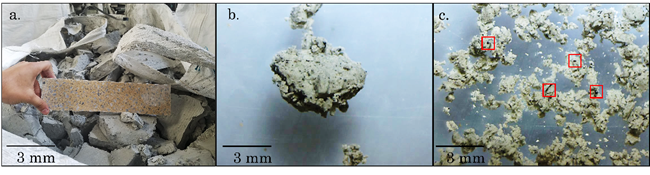
b) dry GPW sample viewed under a stereo microscope, and c) GPW aggregates
Source: own work
XRD analysis of the GPW confirmed that its primary composition is calcite, with smaller amounts of quartz (Figure 2).
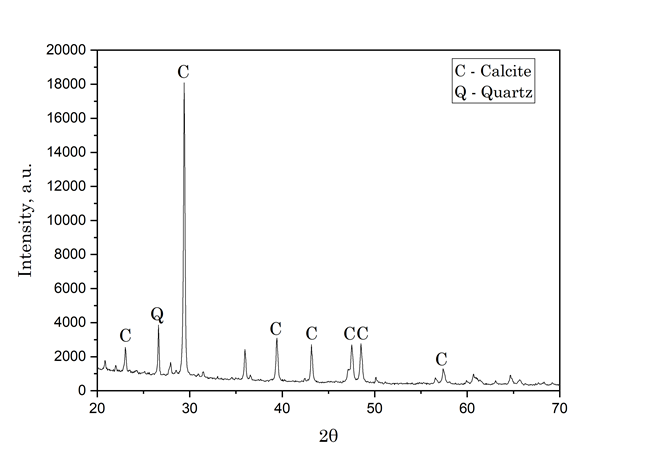
Source: own elaboration.
The granulometry test shows that 93% of the GPW has a particle size smaller than 0.075 mm (sieve No. 200). Hydrometer analysis indicates that the sample contains 64.86% of particles between 0.0408 mm and 0.0013 mm, classifying it as a fine-granular soil according to the Soil Unified Classification System (SUCS), ASTM D2487-17
The particle-size characteristics defined for the GPW in this study are similar to those reported in another research worldwide
Regarding the size of the GPW particles,
Therefore, GPW consistency indicates that, when calculated using Atterberg limits according to ASTM D4318-17
3.2 Elaboration of the mortar mixture
In Figure 3, the line with black squares shows the granulometric curve of the Argos reference sand. Lines with white circles indicate the upper and lower limit granulometric curves as specified in ASTM C-778-21
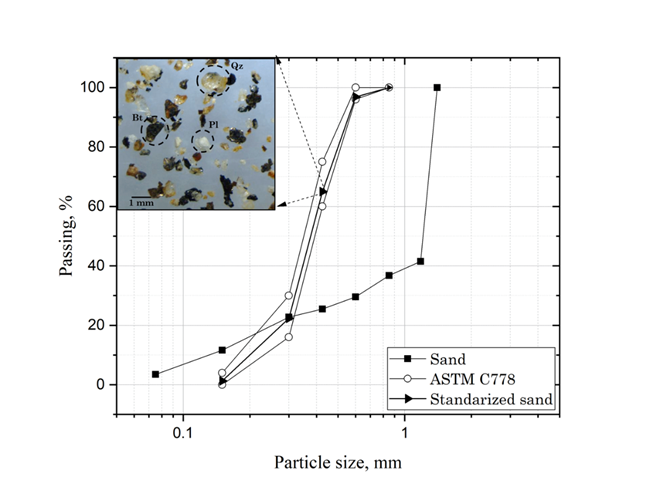
Source: own elaboration.
The standardized sand was examined using a stereomicroscope; quartz (Qz), plagioclase (Pl), and biotite (Bt) were identified as part of its mineral composition (Figure 3). The particles are light and dark in color and are present in similar proportions, leading us to conclude that there are equal amounts of ferromagnesian and non-ferromagnesian minerals.
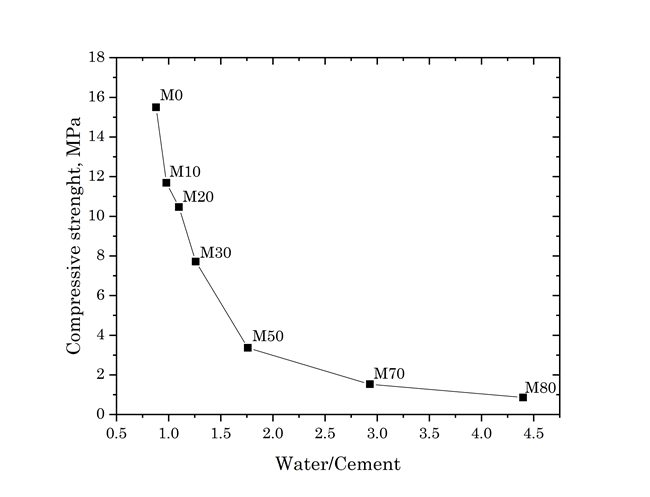
The GPW was incorporated in its original form, including agglomerate fragments, and no issues were encountered during the mixing process. Because GPW was incorporated in its original state at 47% moisture and already contained water, the Water/(Cement+GPW) ratio decreased as the substitution increased, since the water content of the GPW remained constant. The mixtures account for the added water, including both liquid water and water added for GPW moisture. As a result of keeping the Water/(Cement + GPWwet) ratio constant, both Water/(Cement + GPWdry) and Water/(Cement) increase significantly when analyzing their relationships (Table 2).
Source: own elaboration.
| Mortar | M0 | M10 | M20 | M30 | M50 | M70 | M80 |
| GPWdry , g | 0,00 | 13,25 | 26,50 | 39,75 | 66,25 | 92,75 | 106,00 |
| Water/(Cement +GPWdry)* | 0,88 | 0,92 | 0,97 | 1,02 | 1,15 | 1,31 | 1,41 |
| Water/(Cement) | 0,88 | 0,98 | 1,10 | 1,26 | 1,76 | 2,93 | 4,40 |
3.3 Physical characterization of the mortar
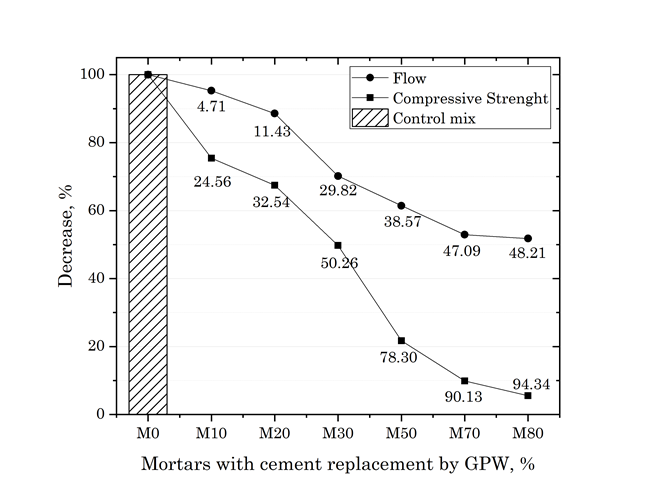
For each substitution percentage listed in Table 2, the flow of the mixture decreased as the amount of cement replaced by GPW increased. Figure 4 shows the variation in the flow of the mixture. For the control mix, M0, the samples M10 and M20 showed flow decreases of 4.71% and 11.43%, respectively. In contrast, the M30 and M50 mixes experienced decreases in flow of 29.82% and 38.57%, respectively. Furthermore, at 70% and 80% substitution of cement with GPW (M70 and M80), the mixes lose roughly 50% of their flow and show no workability. Figure 5 presents the flow test results for M0, M20, and M50, indicating a decrease in workability with increasing GPW addition.
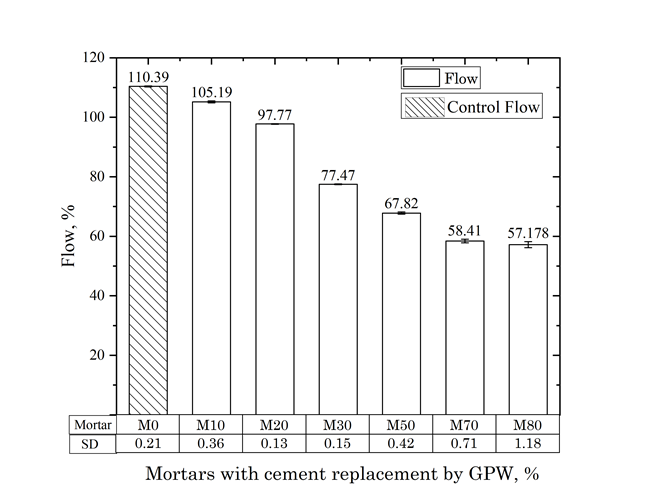
Source: own elaboration.
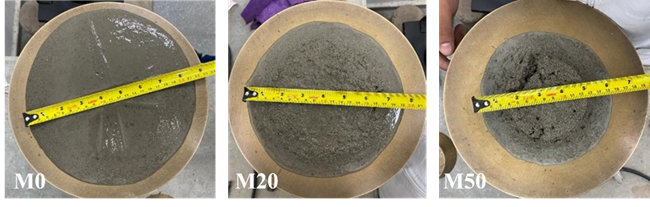
workability for mixtures M0, M20, and M50
Source: own elaboration
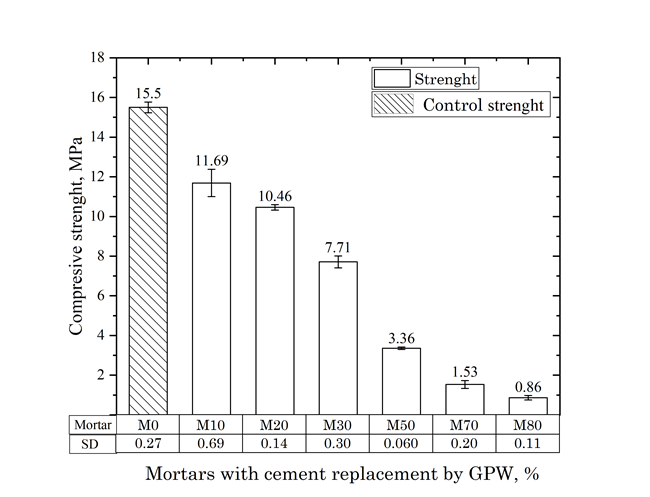
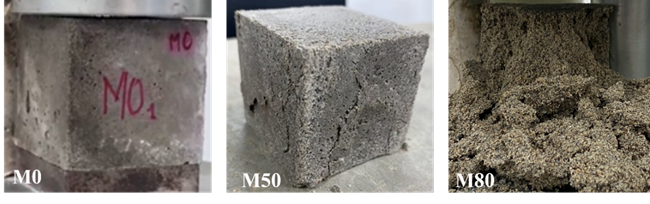
The compressive strength of the mortar cubes decreased with increasing replacement level (Figure 6). M10, M20, and M30 mixes showed reductions in compressive strength of approximately 25%, 33%, and 50%, respectively, compared to the control cubes (M0). At substitution levels above 30% (M30, M50, M70, and M80), compressive strength dropped by more than 50% compared to the strength of the mix without substitution. The reduction in strength is also linked to the water/cement ratio (Figure 7), which decreased as substitution increased. As cement replacement with GPW increased, cubes with substitution levels above M50 tended to fail explosively. The types of failure observed in some of the cubes are shown in Figure 8.
Source: own elaboration
Source: own elaboration
Source: own elaboration
Replacement of hydraulic cement with GPW in mortars reduced both the compressive strength and the flowability of the mixes, consistent with the results of other studies using similar waste binders
Source: own elaboration.
According to
In general, the effectiveness of a residue as a partial cement substitute and a binding agent depends on the amount used and its pozzolanic properties, especially its chemical composition
Despite this, the fluidity of the mixes and the compressive strength of the mortars did not show significant decreases compared to other studies, such as those of
Therefore, although compressive strength and flow decrease compared to the mortar without substitution (M0), this does not indicate that GPW, in small proportions, loses its value as a binding agent in mortars. Other studies incorporating GPW-like waste in the production of building materials have shown that these wastes do not consistently improve the mechanical properties of the resulting materials; however, they can still meet regulatory specifications
According to Colombian standards, the results of the compressive strength indicate that the M10, M20, and M30 mortars can be classified as types of N or O mortars, according to ASTM-C270-25
3.4 Characterization of mortar physics
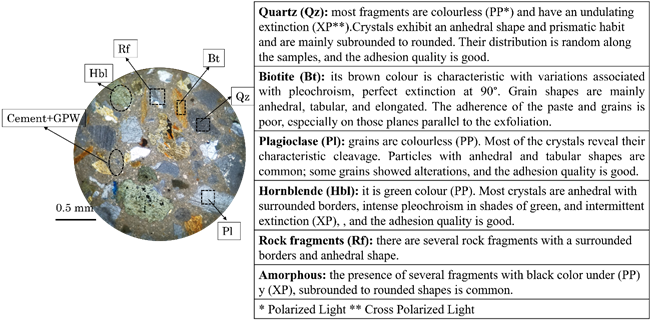
The petrographic study identified the primary mineral phases present in the sand. The sand consists of quartz (Qz), biotite (Bt), plagioclase (Pl), and hornblende (Hbl). Additionally, rock fragments (Rf) and some amorphous grains did not show optical properties under the microscope. Figure 10 illustrates the physical and optical properties of each mineral phase
Source: own elaboration
Seven thin polished sections were observed and analyzed to complete the optical identification. Thirty visual fields were examined in each thin section; with the data collected, it was possible to determine the percentage relationships of sand to cement and GPW to voids (Figure 11). The distribution of cementitious material (cement + GPW) and aggregate material showed that the extent of the cementitious matrix decreased as the substitution of cement with GPW increased. In addition, an increase in the number of voids between the cementitious phase and the aggregate material was observed.

Source: own elaboration
According to the central limit theorem, which states that samples tend to follow a normal distribution across thirty visual fields, the validity of this assertion is supported. Additionally, phase identification and counting enabled us to determine the percentage distribution of mineral phases and rock fragments in the sand of M0 mortar as follows: quartz (Qz) 24.26%, plagioclase (Pl) 18.16%, biotite (Bt) 11.36%, hornblende (Hbl) 8.73%, rock fragments 37.08%, and amorphous material 0.40%.
From the thin-section analyzes, no distinctive feature in the cementitious matrix was identified that could be directly linked to the GPW. The cementitious phase at each substitution level exhibited a uniform color, suggesting that the GPW did not undergo harmful chemical reactions during its interaction with hydraulic cement.
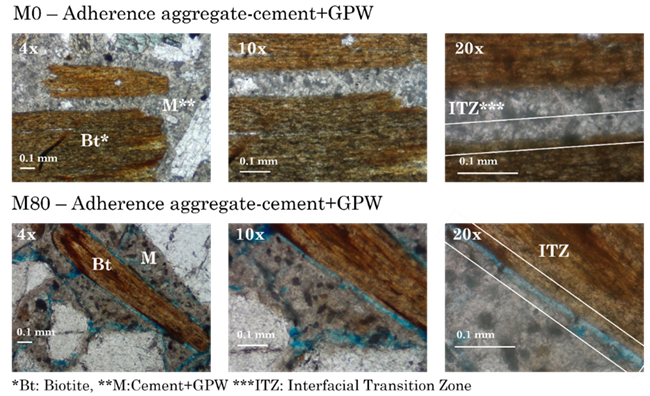
The adhesion between the cementitious material and the aggregate decreased as the amount of GPW increased. Substituting more than 30% of hydraulic cement with GPW increased voids in the interstitial zone, which is associated with a loss of adhesion between the matrix and the aggregates. Furthermore, petrographic analyses indicate that substitutions up to M20 are suitable for producing non-structural mortars
Figure 12 compares the adhesion of a biotite grain in the M0 mixture with that of a biotite grain in the M80 mixture. Similarly, petrographic analyzes suggest that as residue substitution increases, the number of voids and adhesion issues in the cementitious phase also increases, which accounts for the loss of strength in the cementitious phase
Source: own elaboration
The petrographic analyzes allowed us to identify various mixtures that do not contain reactive or hazardous aggregates. According to
3.5 Scanning Electron Microscopy SEM
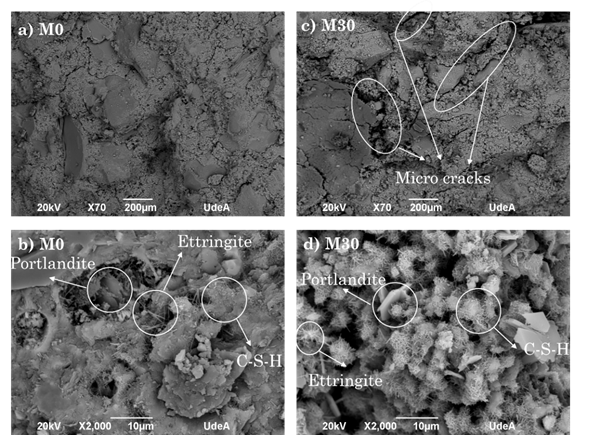
The surface of the M0 mixture is compact, without visible voids or flaky grains, and the paste adheres fully to the sand particles (Figure 13a). In addition, the cement mineral phases, including ettringite, portlandite, and CSH, develop continuously throughout the examined area (Figure 13b). The surface of sample M30 shows microcracks in the interstitial zone, along with aggregates (Figure 13c). Compared to the M0 mixture (Figure 13b), the 2000x micrograph shows more pores, and the CSH phases in M30 appear to be discontinuous and sparse (Figure 13d).
Source: own elaboration
Figure 13. The figure shows morphological differences observed in backscattered electron images of mortars M0 and M30. Images 13a) and 13c) display their morphological features, while images 13b) and 13d) show the cement mineralogy. Source: own elaboration.
Mortars made with GPW substitution were produced from the original residue without additional treatment, thereby avoiding higher energy costs and facilitating their incorporation at the construction site. Other studies, such as those of
Integrating waste into construction materials involves reintroducing industrial waste into the production process, which reduces waste management costs and the expense of producing construction materials
Therefore, if the GPW is used as a binder rather than an aggregate, as shown in the research of
4. CONCLUSIONS
This study shows that GPW waste has potential as a cement substitute due to its composition, although it presents challenges to handle. Characterization of GPW indicates that a chemical reaction occurs during the sedimentation of the waste, which affects the physical properties of the material related to the moisture content. Despite a high moisture level (47%), the consistency of the material before mixing resembles a solid with plasticity, suggesting low workability in a cement mixture.
The analysis of mortars using the design employed in this research shows that the addition of waste directly from the production process is feasible without additional economic or energy costs for preparing the waste.
Physical-mechanical characterization tests for the fluidity and strength of mix designs with less than 20% cement substitution by GPW demonstrate adequate performance for using this type of mixes in non-structural applications, in accordance with Colombian regulations.
Petrographic analysis identifies the aggregate composition and indicates that there are no potential chemical reactions that are likely to affect the physical properties of the mortars. Additionally, petrographic analyzes of thin sections show that mixtures containing GPW at up to 20% replacement produce consistent, high-quality cementitious material. Petrography also reveals microstructural changes associated with increasing the replacement of cement with GPW. A decrease in adhesion between the cementitious matrix and the sand particles in the interstitial zone is observed. Furthermore, the percentages of the cementitious matrix and voids increase with increasing substitution level.
Finally, the use of GPW in mortar mixes offers an opportunity for waste reuse, thus reducing cement use and providing an alternative disposal method.
For future research on GPW as a cementitious material, it is advisable to develop tests for pozzolanic activity and durability to assess the long-term performance of materials incorporating GPW.
5. ACKNOWLEDGMENTS
The authors thank the GII-Infrastructure research group for their collaboration and support.The authors would like to thank ¨Semilleros de investigación-Vicerrectoria de Investigación-Universidad de Antioquia–Fundación Universidad de Antioquia¨ for the financial support IdeaCION-2023 program.
6. REFERENCES
- arrow_upward [1] C. S. Giordano Penteado, E. Viviani De Carvalho, and R. C. Cecche Lintz, “Reusing ceramic tile polishing waste in paving block manufacturing,” J. Clean. Prod., vol. 112, Part 1, pp. 514-520, Jan. 2016. https://doi.org/10.1016/j.jclepro.2015.06.142
- arrow_upward [2] L. G. Li, Z. Y. Zhuo, A. K. H. Kwan, T. S. Zhang, and D. G. Lu, “Cementing efficiency factors of ceramic polishing residue in compressive strength and chloride resistance of mortar,” Powder Technol., vol. 367, pp. 163-171, May. 2020. https://doi.org/10.1016/j.powtec.2020.03.050
- arrow_upward [3] M. C. Bignozzi, and A. Saccani, “Ceramic waste as aggregate and supplementary cementing material: A combined action to contrast alkali silica reaction (ASR),” Cem. Concr. Compos., vol. 34, no. 10, pp. 1141-1148, Nov. 2012. https://doi.org/10.1016/j.cemconcomp.2012.07.001
- arrow_upward [4] B. Barrero Martínez, “Recomendaciones para el empleo del lodo residual de la producción de baldosas de terrazo,” Tesis de pregrado, Universidad Central Marta Abreu de las Villas, Santa Clara, Cuba, 2009. https://dspace.uclv.edu.cu/handle/123456789/5074
- arrow_upward [5] E. Viscay Maceo, S. Campos Movilla, and Y. Sierra Riveron, “Caracterización De Los Lodos Residuales Del Pulido De Baldosas Para La Elaboración De Mortero Cola,” presented at 9na Conf. Cient. Int. Univ. Holguín, Holguín, Cuba, 2019.
- arrow_upward [6] L. R. Steiner, A. M. Bernardin, and F. Pelisser, “Effectiveness of ceramic tile polishing residues as supplementary cementitious materials for cement mortars,” Sustain. Mater. Technol., vol. 4, pp. 30-35, Jul. 2015. https://doi.org/10.1016/j.susmat.2015.05.001
- arrow_upward [7] Y. Quevedo Rodríguez, “Evaluación de residuales del proceso de pulido de baldosas, para su uso en mezclas para morteros en el municipio de Holguín,” Tesis de grado, Universidad de Holguín, Cuba. 2017.
- arrow_upward [8] S. S. G. Nathan, and S. Bincy, “Study of the Effect of Seismic Pounding on Tall Buildings,” in Proc. SECON’19, Struct. Eng. Constr. Manag., K. Dasgupta, A. Sajith, G. Unni Kartha, A. Joseph, P. Kavitha, and K. Praseeda, Eds. 2020, vol. 46, pp. 615-621. https://doi.org/10.1007/978-3-030-26365-2_57
- arrow_upward [9] G. Karam, and M. Tabbara, “Properties of pre-cast terrazzo tiles and recommended specifications,” Cerâmica, vol. 55, no. 333, pp. 84-87, Mar. 2009. https://doi.org/10.1590/s0366-69132009000100011
- arrow_upward [10] S. Taha Abdulhussain, “Comparative Investigation on Properties of Various Local and Imported Terrazzo Tiles,” J. Phys. Conf. Ser., vol. 1973, no. 1, 2021. https://doi.org/10.1088/1742-6596/1973/1/012005
- arrow_upward [11] S. Bautista Carrascosa, C. Martín de la Morena, and J. M. Mieres Royo, “Recomendaciones técnicas para la reducción de patologías en el terrazo,” Inf. Constr., vol. 49, no. 454, pp. 57-63, Apr. 1998. https://doi.org/10.3989/ic.1998.v49.i454.910
- arrow_upward [12] L. V. Vanegas Useche, M. Á. Granada Mejía, S. E. Arbeláez Ríos, and L. S. Arias Maya, “Determinación de propiedades de baldosas de grano lavado, usando una mezcla de cemento, granito y caucho triturado en la capa de desgaste,” Sci. Tech., vol. 27, no. 1, pp. 42-51, Mar. 2022. https://doi.org/10.22517/23447214.24505
- arrow_upward [13] E. B. C. Costa, B. P. Barros, and M. do R. de M. Maron da Costa, “Influência da granulometria e do teor de resíduo de polimento de placas cerâmicas na resistência mecânica de matrizes cimentícias,” Matéria (Rio Janeiro), vol. 25, no. 4, 2020. https://doi.org/10.1590/s1517-707620200004.1167
- arrow_upward [14] J. J. Chen, B. H. Li, P. L. Ng, and A. K. H. Kwan, “Adding granite polishing waste to reduce sand and cement contents and improve performance of mortar,” J. Clean. Prod., vol. 279, p. 123653, Jan. 2021. https://doi.org/10.1016/j.jclepro.2020.123653
- arrow_upward [15] T. Ramos, A. M. Matos, B. Schmidt, J. Rio, and J. Sousa-Coutinho, “Granitic quarry sludge waste in mortar: Effect on strength and durability,” Constr. Build. Mater., vol. 47, pp. 1001-1009, Oct. 2013. https://doi.org/10.1016/j.conbuildmat.2013.05.098
- arrow_upward [16] A. Al-Fakih, A. Abujamil, M. A. Al-Shugaa, R. Assaggaf, M. A. Al-Osta, and A. Albu Shaqraa, “Utilization of ceramic polishing sludge in masonry cement mortar: Mechanical strength and thermal behavior,” Results Eng., vol. 27, p. 107058, Aug. 2025. https://doi.org/10.1016/j.rineng.2025.107058
- arrow_upward [17] M. C. Pacheco-Menor, I. Flores-Colen, and J. de Brito, “The use of stone waste as fine aggregate or cement replacement in cement-based mortars: A review,” J. Build. Eng., vol. 106, p. 112503, Jul. 2025. https://doi.org/10.1016/j.jobe.2025.112503
- arrow_upward [18] L. G. Li, Z. Y. Zhuo, J. Zhu, J. J. Chen, and A. K. H. Kwan, “Reutilizing ceramic polishing waste as powder filler in mortar to reduce cement content by 33% and increase strength by 85%,” Powder Technol., vol. 355, pp. 119-126, Oct. 2019. https://doi.org/10.1016/j.powtec.2019.07.043
- arrow_upward [19] M. A. G. P. Perera, and P. G. Ranjith, “Greener horizons: Revolutionizing construction materials with waste-based innovations - An experimental study,” J. Build. Eng., vol. 103, p. 112211, Jun. 2025. https://doi.org/10.1016/j.jobe.2025.112211
- arrow_upward [20] A. T. M. Marsh, A. P. M. Velenturf, and S. A. Bernal, “Circular Economy strategies for concrete: implementation and integration,” J. Clean. Prod., vol. 362, p. 132486, Aug. 2022. https://doi.org/10.1016/j.jclepro.2022.132486
- arrow_upward [21] M. Salah Nasr, A. Abdulhussein Shubbar, Z. Al-Abideen Raed Abed, and M. Sami Ibrahim, “Properties of eco-friendly cement mortar contained recycled materials from different sources,” J. Build. Eng., vol. 31, p. 101444, Sep. 2020. https://doi.org/10.1016/j.jobe.2020.101444
- arrow_upward [22] IPCC Grupo Intergubernamental de Expertos sobre el Cambio Climático, “Comunicado de prensa del IPCC,” Aug. 9, 2021. [Online]. Available: https://www.ipcc.ch/site/assets/uploads/2021/08/IPCC_WGI-AR6-Press-Release-Final_es.pdf
- arrow_upward [23] R. Teja Kusuma, R. B. Hiremath, P. Rajesh, B. Kumar, and S. Renukappa, “Sustainable transition towards biomass-based cement industry: A review,” Renew. Sustain. Energy Rev., vol. 163, p. 112503, Jul. 2022. https://doi.org/10.1016/j.rser.2022.112503
- arrow_upward [24] G. Murali, N. Hassas, and H. S. Abdelgader, “Ceramic waste as a sustainable cementitious resource: pathways to cleaner and high-performance concrete,” Clean. Mater., vol. 18, p. 100352, Dec. 2025. https://doi.org/10.1016/j.clema.2025.100352
- arrow_upward [25] M. Ferro Beltrán, “El Camino de Colombia hacia las edificaciones Neto Cero Carbono,” Tesis de maestría, Universidad de los Andes, Bogotá, Colombia, 2021. https://doi.org/10.71590/1992/50631
- arrow_upward [26] S. Subedi, T. Aalam, S. Ranabhat, P. Baral, L. Bhujel, and T. Raj Gyawali, “Physical and mechanical characterization of mortar with partial cement replacement by white mud (kamero),” Clean. Waste Syst., vol. 12, p. 100380, Dec. 2025. https://doi.org/10.1016/j.clwas.2025.100380
- arrow_upward [27] M. K. Pathak, and M. B. Baldania, “Eco-Friendly Utilization of Ceramic WTP Sludge,” SSRG Int. J. Civ. Eng., vol. 11, no. 7, pp. 58-72, Jul. 2024. https://doi.org/10.14445/23488352/IJCE-V11I7P106
- arrow_upward [28] A. Rodrigo-Bravo, S. Pavía, V. Calderón Carpintero, L. A. Cuenca-Romero, and S. Gutiérrez-González, “Valorisation of gypsum boards with polyurethane waste to promote their circular economy,” Resour. Conserv. Recycl. Adv., vol. 25, p. 200240, Apr. 2025. https://doi.org/10.1016/j.rcradv.2024.200240
- arrow_upward [29] L. Gautam, J. Kumar Jain, A. Jain, and P. Kalla, “Recycling of bone china ceramic waste as cement replacement to produce sustainable self-compacting concrete,” Structures, vol. 37, pp. 364-378, Mar. 2022. https://doi.org/10.1016/j.istruc.2022.01.019
- arrow_upward [30] M. Tahir, B. Hu, M. Shoaib Karam, M. Atasham ul Haq, and A. Rehman, “Experimental investigation and GEP-based design of sustainable concrete incorporating untreated-CBA,” Case Stud. Constr. Mater., vol. 23, p. e05216, Dec. 2025. https://doi.org/10.1016/j.cscm.2025.e05216
- arrow_upward [31] O. Farooq, H. Bilal, L. Cavaleri, and A. Khan, “Properties of blended mortars produced with recycled by-products from different waste streams,” Dev. Built Environ., vol. 14, p. 100156, Apr. 2023. https://doi.org/10.1016/j.dibe.2023.100156
- arrow_upward [32] M. A. Al-Shugaa, A. Al-Fakih, W. Al-Awsh, and M. A. Al-Osta, “Pozzolanic performance and characteristic analysis of binary blended cement incorporating ceramic polishing sludge,” J. Mater. Res. Technol., vol. 29, pp. 3711-3725, Mar.-Apr. 2024. https://doi.org/10.1016/j.jmrt.2024.02.119
- arrow_upward [33] J. Rodríguez, M. Frías, and J. I. Tobón, “Eco-efficient cement based on activated coal washing rejects with low content of kaolinite,” Constr. Build. Mater., vol. 274, p. 122118, Mar. 2021. https://doi.org/10.1016/j.conbuildmat.2020.122118
- arrow_upward [34] Standard Test Methods for Specific Gravity of Soil Solids by Water Pycnometer 1, ASTM D854-23, ASTM International, West Conshohocken, USA, 2023. https://doi.org/10.1520/D0854-23
- arrow_upward [35] Standard Test Methods for Particle-Size Distribution (Gradation ) of Soils Using Sieve Analysis, ASTM D6913/D6913M-17, ASTM International, West Conshohocken, USA, 2017. https://doi.org/10.1520/D6913_D6913M-17R25
- arrow_upward [36] Standard Test Method for Particle-Size Distribution (Gradation) of Fine-Grained Soils Using the Sedimentation (Hydrometer) Analysis, ASTM D7928-21e1, ASTM International, West Conshohocken, USA, 2021. https://doi.org/10.1520/D7928-21E01
- arrow_upward [37] Standard Test Methods for Liquid Limit, Plastic Limit, and Plasticity Index of Soils, ASTM D4318-17, ASTM International, West Conshohocken, USA, 2018. https://doi.org/10.1520/D4318-17E01
- arrow_upward [38] Standard Specification for Portland Cement, ASTM C150/C150M-24, ASTM International, West Conshohocken, USA,2024. https://doi.org/10.1520/C0150_C0150M-24
- arrow_upward [39] Standard Specification for Mixing Water Used in the Production of Hydraulic Cement Concrete,” ASTM C1602/C1602M-22, ASTM International, West Conshohocken, USA, 2022 https://doi.org/10.1520/C1602_C1602M-22
- arrow_upward [40] Standard Specification for Standard Sand, ASTM C778-21, ASTM International, West Conshohocken, USA, 2021. https://doi.org/10.1520/C0778-17
- arrow_upward [41] Standard Test Method for Compressive Strength of Hydraulic Cement Mortars (Using 50 mm [2 in.] Cube Specimens), ASTM C109/C109M-24, ASTM International, West Conshohocken, USA, 2025. https://doi.org/10.1520/C0109_C0109M-23
- arrow_upward [42] J. V. S. Silva, E. D. Reis, and F. S. J. Poggiali, “Experimental investigation on structural mortars with partial cement replacement by semi-coke,” J. Build. Eng., vol. 111, p. 113239, Oct. 2025. https://doi.org/10.1016/j.jobe.2025.113239
- arrow_upward [43] Standard Practice for Mechanical Mixing of Hydraulic Cement Pastes and Mortars or Plastic Consistency, ASMT C305-20, ASTM International, West Conshohocken, USA, 2020. https://doi.org/10.1520/C0305-20
- arrow_upward [44] Standard Specification for Flow Table for Use in Tests of Hydraulic Cement, ASTM C230/C230M-23, ASTM International, West Conshohocken, USA, 2023. https://doi.org/10.1520/C0230_C0230M-23
- arrow_upward [45] Standard Test Method for Flow of Hydraulic Cement Mortar: C1437-01, ASTM C1437-20, pp. 7-8, ASTM International, West Conshohocken, USA, 2020. https://doi.org/10.1520/C1437-20
- arrow_upward [46] Standard Practice for Petrographic Examination of Hardened Concrete, ASTM C856/C856M-25, ASTM International, West Conshohocken, USA, 2025. https://doi.org/10.1520/C0856
- arrow_upward [47] AStandard Practice for Classification of Soils for Engineerinng Purposes (Unified Soil Classification System)1, ASTM D2487-17, ASTM International, West Conshohocken, USA 2025. https://doi.org/10.1520/D2487-17R25
- arrow_upward [48] D. W. S. Ho, A. M. M. Sheinn, C. C. Ng, and C. T. Tam, “The use of quarry dust for SCC applications,” Cem. Concr. Res., vol. 32, no. 4, pp. 505-511, Apr. 2002. https://doi.org/10.1016/S0008-8846(01)00726-8
- arrow_upward [49] P. Kumar Metha, and P. J. M. Monteiro, Concrete. Microestructural, properties, and Materials. Columbus, Oh, USA: McGraw-Hill; 2017.
- arrow_upward [50] A. O. Mashaly, B. N. Shalaby, and M. A. Rashwan, “Performance of mortar and concrete incorporating granite sludge as cement replacement,” Constr. Build. Mater., vol. 169, pp. 800-818, Apr. 2018. https://doi.org/10.1016/j.conbuildmat.2018.03.046
- arrow_upward [51] A. Salonny Nascimento et al., “Production of plaster mortar with incorporation of granite cutting wastes,” J. Clean. Prod., vol. 265, p. 121808, Aug. 2020. https://doi.org/10.1016/j.jclepro.2020.121808
- arrow_upward [52] S. Saad Mansoor, S. Mahmoud Hama, and D. Natiq Hamdullah, “Effectiveness of replacing cement partially with waste brick powder in mortar,” J. King Saud Univ. - Eng. Sci., vol. 36, no. 7, pp. 524-532, Nov. 2024. https://doi.org/10.1016/j.jksues.2022.01.004
- arrow_upward [53] I. Bekem Kara and C. Kara, “Exploring the potential of tea waste ash in cement mortar : A focus on mechanical and durability properties,” Environ. Res., vol. 287, p. 123107, Dec. 2025. https://doi.org/10.1016/j.envres.2025.123107
- arrow_upward [54] Y. Zhou, P. Yu, H. Yang, S. Li, and S. He, “Pore structure and compressive strength of alkali activated mortar with sewage sludge ash (SSA) under optimal incineration conditions,” Constr. Build. Mater., vol. 433, p. 136745, Jun. 2024. https://doi.org/10.1016/j.conbuildmat.2024.136745
- arrow_upward [55] P. Kumar Sharma, A. J. N. MacLeod, L. P. Aldridge, F. Collins, and W. P. Gates, “Gravel wash fines with mixed mineralogy as sources of supplementary cementitious material in cement mortars,” Constr. Build. Mater., vol. 496, p. 143852, Oct. 2025. https://doi.org/10.1016/j.conbuildmat.2025.143852
- arrow_upward [56] ASTM International, “Standard Specification for Mortar Unit Masonry1,” ASTM C270-25a, 2025. https://doi.org/10.1520/C0270-25A
- arrow_upward [57] Reglamento Colombiano de Construcción Sismo Resistente, NSR-10, Comision Asesora Permanente para el Regimen de Construcciones Sismo Resistentes, 2010. [Online]. Available: https://www.unisdr.org/campaign/resilientcities/uploads/city/attachments/3871-10684.pdf
- arrow_upward [58] L. Gutierrez de López, El concreto y otros materiales para la construcción. Bogotá, Colombia: Universidad Nacional de Colombia; 2003. https://repositorio.unal.edu.co/items/95fb1661-7765-42e1-a332-72d1e47737f4
- arrow_upward [59] W. D. Nesse, Introduction to optical mineralogy, 4th ed. Oxford, U.K.: Oxford University Press; 2004.
- arrow_upward [60] A. B. Poole, and I. Sims, Concrete Petrography, A Handbook of Investigative techniques, 2nd ed. London, U.K.: CRC Press, 2016. https://doi.org/10.1201/b18688
- arrow_upward [61] S. H. Kosmatka, B. Kerkhoff, and W. C. Panarese, Design and Control of Concret Mixtures. Portland, USA: Portland Cement Association; 2008.
- arrow_upward [62] K. Doughmi, K. Baba, and A. Nounah, “Mechanical properties of eco-friendly cement based composite mortars plastic fiber reinforced partially replaced by natural pozzolan and marble waste,” Mater. Today Proc., Jul., 2023. https://doi.org/10.1016/j.matpr.2023.07.203
- arrow_upward [63] M. R. Gehlot, and S. Shrivastava, “Sustainability assessment of granite cutting waste incorporated cement sand rendering mortar: Technical, environmental, cost, and social parameters,” J. Clean. Prod., vol. 480, p. 144108, Nov. 2024. https://doi.org/10.1016/j.jclepro.2024.144108
- arrow_upward [64] M. Pakkiyachandran, and N. Sathiparan, “Comparative study on quarry waste, manufactured sand, quarry dust as river sand replacement in cement mortar: Mechanical characteristics, durability, and eco-benefit,” Materialia, vol. 40, p. 102395, May. 2025. https://doi.org/10.1016/j.mtla.2025.102395
CONFLICT OF INTEREST
The authors declare that they have no known competing financial or personal interests that could have appeared to influence the work reported in this paper.
AUTHORSHIP CONTRIBUTION
Andrés Felipe Múnera Yepes: Conceptualization, Methodology, Experimentation, Writing, Formal Analysis.
Andres Felipe Conejo López: Conceptualization, Methodology, Experimentation, Writing, Formal Analysis.

 Google