Environmental Impact Assessment of the Bioprocesses on the Plantain Supply Chain in Mexico
Evaluación del impacto ambiental de los bioprocesos de la cadena de suministro del plátano en México

Received: June 11, 2025
Accepted: April 15, 2026
Available: May 21, 2026
L. A. Alonso Gómez, A. Estrada-Baltazar, and L. R. Miramontes Martínez, “Environmental Impact Assessment of the Bioprocesses on the Plantain Supply Chain in Mexico,” TecnoLógicas, vol. 29, no. 66, e3524, 2026. https://doi.org/10.22430/22565337.3524
Highlights
Highlights
ABSTRACT
The waste, by-products, and rejects generated in the processing, distribution, and sale of bananas are not optimally utilized. If not properly managed, this organic waste can cause serious environmental problems. Between 24% and 40% of bananas are not marketed and end up in landfills until they decompose, mainly because they do not comply with export regulations. Although it is feasible to use this waste to produce flour and bioethanol, it is necessary to evaluate the potential environmental consequences of these processes. This study assessed the environmental viability of flour and bioethanol production from immature plantain within the plantain production chain in Mexico, using life cycle analysis (LCA). The functional unit for the agronomic stage was 1 kg of plantain produced for direct sale. In contrast, for the industrial processes, 1 kg of flour produced was used as the functional unit, with bioethanol as a co-product. A sensitivity analysis was performed by varying the allocation between mass and economic value, while holding the total product flow constant across scenarios. E-LCA was performed using SimaPro 9.6.0.1 with ReCiPe Midpoint (H) v1.13 and Ecoinvent v3.3 data. Monte Carlo simulations modeled input uncertainty using probability distributions, enabling variability/sensitivity analysis to support robust environmental results. The results showed that the transport of inputs, together with the use of machinery, fertilizers, herbicides, and insecticides, has the most significant environmental impact during cultivation. In addition, the production of flour and bioethanol has substantial implications due to the complexity of the underlying technological processes. In conclusion, this work provides reliable environmental inventories and criteria to support decisions aimed at reducing environmental impacts in the banana marketing chain, thereby contributing to its sustainability and the circular economy.
Keywords: Bioethanol, circular economy, environmental impact, life cycle analysis,
sustainability.
Resumen
Los subproductos generados en la cadena productiva del plátano no se aprovechan de manera óptima. Su mala gestión genera impactos ambientales graves. Entre el 24 % y el 40 % de los plátanos no se comercializan, principalmente por no cumplir con la normativa de exportación, y terminan en vertederos, donde se descomponen. Aunque es viable aprovechar estos residuos para producir harina y bioetanol, es necesario evaluar las posibles consecuencias ambientales de dichos procesos. Este estudio tuvo como objetivo evaluar la viabilidad ambiental de la producción de harina y bioetanol a partir de plátano inmaduro en la cadena productiva del plátano en México, mediante el análisis del ciclo de vida (ACV). La unidad funcional para la etapa agronómica fue de 1 kg de plátano producido para la venta directa, mientras que, para los procesos industriales, se consideró 1 kg de harina producida, con el bioetanol como coproducto. Se realizó un análisis de sensibilidad variando la asignación entre masa y valor económico, considerando el flujo total de productos en cada escenario. La evaluación del ACV se realizó con SimaPro 9.6.0.1, el método ReCiPe Midpoint (H) v1.13 y la base de datos Ecoinvent v3.3. Las simulaciones de Monte Carlo modelaron la incertidumbre de los insumos mediante distribuciones probabilísticas, lo que permitió analizar la variabilidad y la sensibilidad para obtener resultados ambientales robustos. Los resultados mostraron que el transporte de insumos, junto con el uso de maquinaria, fertilizantes, herbicidas e insecticidas, genera el mayor impacto ambiental durante el cultivo. Además, la producción de harina y bioetanol conlleva impactos significativos debido a la complejidad de los procesos tecnológicos implicados. En conclusión, este trabajo aporta inventarios y criterios ambientales confiables para apoyar decisiones orientadas a reducir el impacto ambiental a lo largo de la cadena de comercialización del plátano, contribuyendo así a su sostenibilidad y a la economía circular.
Palabras clave: Bioetanol, economía circular, impacto ambiental, análisis de ciclo de vida, sostenibilidad.
1. INTRODUCTION
Plantains in México are grown in the coastal regions of the Pacific Ocean and the Gulf of Mexico. In 2022, production was 2 652 188 tons from an arable land area of 164 057 ha. The primary producing states are Tabasco (24%), Chiapas (19.7%), Veracruz (13.6%), and Colima (8%) [
In 2024, approximately 11 500 hectares of plantain were cultivated in Colima, of which 5% was exported to foreign markets, and 95% was sold locally [
Environmental Life Cycle Assessment (E-LCA) is a reliable method for assessing the environmental impacts of processes and products. E-LCA's method seeks to accurately identify and quantify the energy required and the flows released to the environment. E-LCA assesses which flows have the greatest impact on the environment, human health, and natural resources [
Recent LCA studies of banana and plantain supply chains reveal consistent climate-change hotspots, dominated by farm production, international transport (for plantain exports), and waste management. The environmental profile of Ecuadorian export bananas confirms this pattern, identifying synthetic fertilizers, on-farm fuel consumption, and long-distance refrigerated shipping as key hotspots of greenhouse gas emissions along the cradle-to-port system [
There have been few studies focusing on the E-LCA of tropical, perennial agricultural products. [
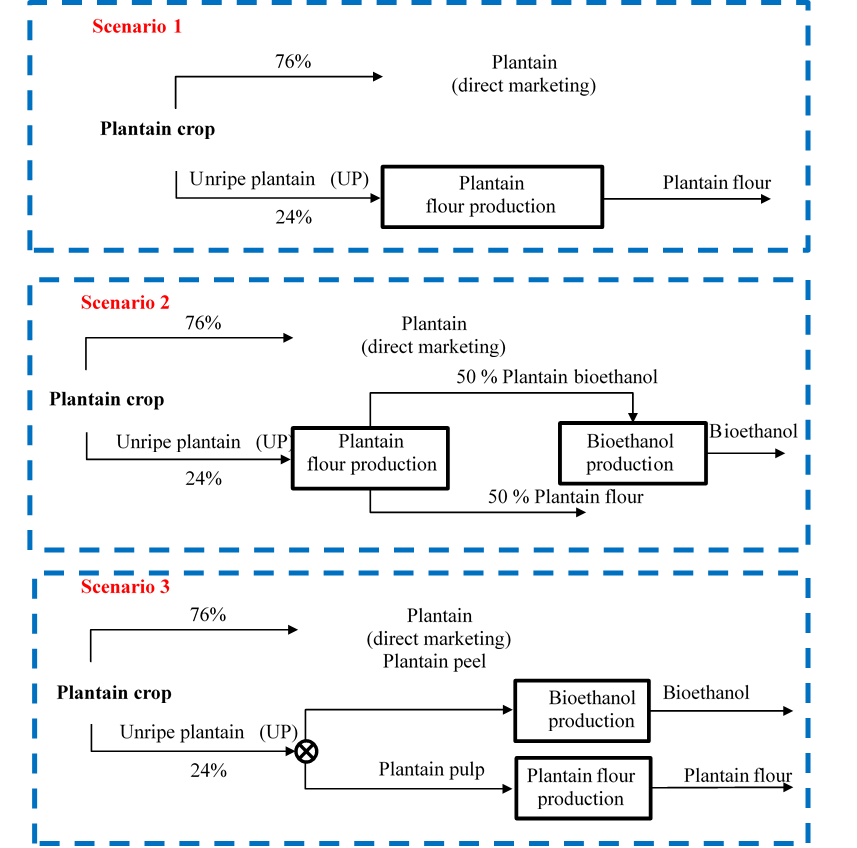
To assess the environmental impact of flour and bioethanol production, using unripe plantain with peel as raw material, this research employs the E-LCA method to analyze environmental indicators and identify hotspots for improvement. For this analysis, Mexico was selected as a case study. Unripe plantain was chosen as the main product for commercialization, while rejected plantain (24%) was used to produce flour and ethanol in four scenarios, including a base case. Across the three scenarios, 76% of the harvested product is marketed, with the remaining 24% processed. In the first scenario, 100% of the unripe plantain (UP) was used to produce flour. In the second scenario, bioethanol and plantain flour were produced using UP; in the third scenario, plantain pulp flour and bioethanol from the peel were produced. The objective of this study is to evaluate the environmental implications of bioprocesses applied to rejected unripe plantain within the Mexican plantain supply chain.
2. MATERIALS AND METHODS
The E-LCA was carried out in accordance with the methodology reported in ISO 14040:2006 [
2.1 goal scope definition
The first step describes the system boundary, functional unit, allocation, and sensitivity analysis.
2.1.1 Goal
The E-LCA aims to evaluate the environmental impact of different valorization scenarios of UP in the productive chain in Mexico (Colima, 18°56′13″N 103°57′54″O). The cradle-to-gate approach was implemented in the E-LCA, beginning with the germination of the plantain crop and ending at the UP valorization, across three process scenarios. Finally, an attributional analysis was performed by varying the allocation (sensitivity analysis).
2.1.2 Scope
The E-LCA was conducted considering the stages of the plantain production chain in Mexico. In this sense, the agronomic stage (plantain crop) and the UP valorization to produce flour and ethanol were considered. Plantain crop data were taken from bibliographic sources in the Mexican context [
The material and energy balances for UP valorization were taken from [
2.1.3 Functional unit
The functional unit (FU) for the E-LCA of the agricultural stage was defined as 1 kg of plantain produced for direct sale. For the technological scenarios, the FU was defined as 1 kg of flour produced. This was selected based on the objective of the analysis (the plantain and flour production chains in Mexico). Figure 1
Source: own elaboration.
2.2 Sensitivity analysis
The sensitivity analysis was performed by varying the allocation type (mass and economic). In the mass allocation, the flow of all products across all scenarios was taken into account. On the other hand, the estimated sale prices of the products were used in the economic allocation: 0.152 USD kg-1 for plantain, 3.09 USD kg-1 for flour, and 1.13 USD kg-1 for ethanol [
2.3 System boundaries
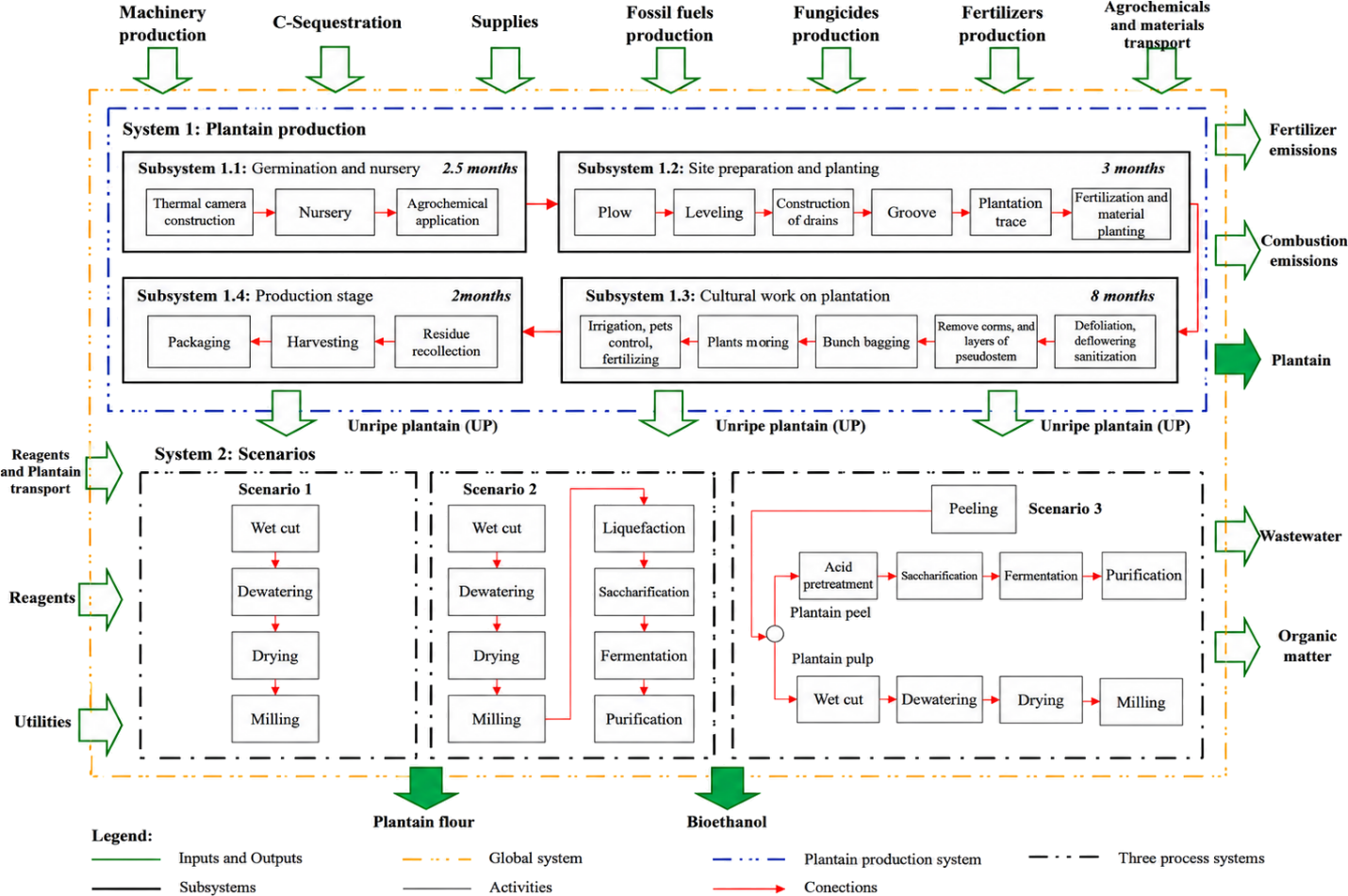
Figure 2 shows the system boundaries for the E-LCA of the plantain production chain, considering the valorization of UP. The plantain crop is based on 1 ha, with a density of 2000 plants and a 10-month cycle. Plantain production encompasses all activities from corm multiplication to harvest and bunch packaging. System 1 comprises four subsystems: (i) germination and the nursery stage; (ii) land preparation and planting; (iii) cultural work on the plantation; and (iv) harvesting.
Source: own elaboration.
(i) The subsystem involves three key steps: constructing a thermal chamber and storage room and applying agrochemicals. In the chamber, healthy corms (1–1.5 kg) are selected, cleaned of roots, and disinfected using a solution of sodium hypochlorite (1%), cypermethrin (2.2 g per corm), and thiabendazole (0.125 cm³ per corm). The corms are then placed in 25–30 cm of rice husk, spaced 10 × 20 cm apart, and exposed to a temperature of 50–70 °C and humidity of 30–100% [
ii) The land preparation and planting subsystem has seven activities: plowing, leveling, drainage construction, furrowing, plantation layout, fertilization, and planting. The plantain cycle in the central-western region of Mexico requires 355 days of spray irrigation. In Colima, irrigation is necessary during dry months and late production stages. Plowing is carried out to a depth of 30-60 cm, with a minimum depth of 30 cm. The depth of plowing is proportional to the consumption of diesel. Approximately 10 days after passing the plow, two transverse passes of a sea mi-heavy harrow are made to reduce the particle size of the soil. When the soil contains more than 60% clay, it is necessary to incorporate organic matter to improve soil structure, aeration, and nutrient exchange [
Working at hand requires a backhoe. The accumulated soil from the drainage construction can be used for leveling [
iii) The cultural work subsystem on the plantation includes irrigation, pest control, fertilization, plant mooring, bunch bagging, corm removal, deflowering, shoring, and leaf removal. Weed infestation is one of the most serious problems on the plantation and requires significant labor and capital investment. However, as most activities are manual, the environmental impact is reduced. When considering environmental impact, the use of fertilizers and materials such as bags and raffia is commonly discussed. Manual control (traditional) is one alternative for weed control and consists of hoeing around the plant. The disadvantage of this method is that weeds quickly recover during the rainy season, increasing labor costs [
iv) The production stage subsystem includes waste collection, harvesting, and packaging. Around 80% of plantations are harvested by creating an open space (patio) within the plantation. In this system, the transport vehicle (truck) is moved to the plantation and loaded on site. This manual work involves a cutter, a packer, a stevedore, and two packers and helpers to remove the rachis. Additionally, a vehicle transports water, and a washing tank is used to disinfect the bunch crown by adding iodine. Finally, the fruit is removed from the plantation by conveyors [
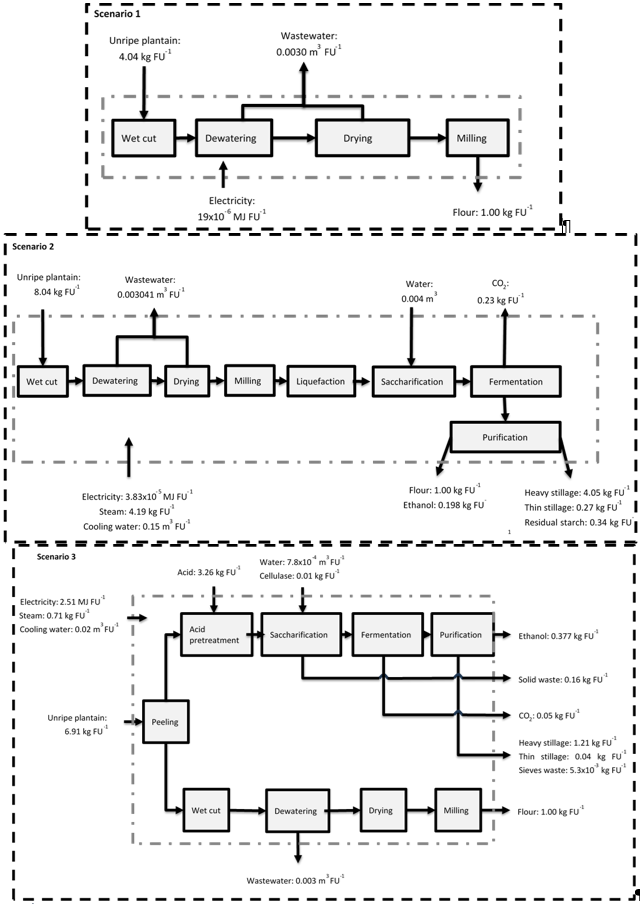
System 2 comprises the UP valorization and is divided into three scenarios (Figures 1 and 2). In scenario 1, unit operations are wet cutting, dewatering, drying, and milling. After the plantain chips cutter machine was used, the UP slices were dewatered and dried at 45°C in an electric forced-air oven. The dried slices were crushed in an industrial hammer mill to produce the flour. Scenario 2 comprises the production of bioethanol and flour using UP. In this scenario, 50% of the UP flour was used to produce bioethanol. The most used method in the industry for producing ethanol from raw materials with high starch content is dry grinding [
Scenario 3 involves producing flour and bioethanol separately from the pulp and peel (pulp flour and peel bioethanol). The bioethanol production process consists of acid pretreatment, saccharification, fermentation, and purification (distillation and dehydration). The bioethanol production process was simulated using only the cellulose content in the peel.
2.4 Environmental life cycle inventory
The inventory data for the plantain production, including all stages, is presented in Supplementary Material 1. The diesel emissions from tractor use are determined by the combustion factors reported in [
The mass and energy balances used to calculate the scenarios were derived from the process design in Aspen Plus® v8.0. Properties and kinetic expressions were taken from [
Source: Own work
2.5 Environmental life cycle evaluation
E-LCA was conducted using SimaPro 9.6.0.1 PhD© [
3. RESULTS AND DISCUSSION
Table 1 shows the yields (kg kg⁻¹ of feedstock) of various products reported in the literature for biorefinery schemes.
[
Source: own elaboration
| Feedstock | Yields (kg kg-1 of feedstock) | Reference | ||||
|---|---|---|---|---|---|---|
| Bioethanol | Flour | Fertilizer | Electricity* | Xylooligo-saccharides | ||
| Bread waste | 0.242 | 0.050 | 0.045 | [ | ||
| Potatoes | 0.167 | [ | ||||
| Sugarcane | 0.167 | [ | ||||
| Citrus waste | 0.124 | [ | ||||
| Barley Straw and brewer's spent grain | 0.123 | 0.094 | [ | |||
| Rice straw | 0.078 | [ | ||||
| Unripe plantain | 0.055 | 0.145 | This study (scenario3) | |||
| Cattle manure | 0.036 | [ | ||||
| Unripe plantain | 0.025 | 0.125 | This study (scenario 2) | |||
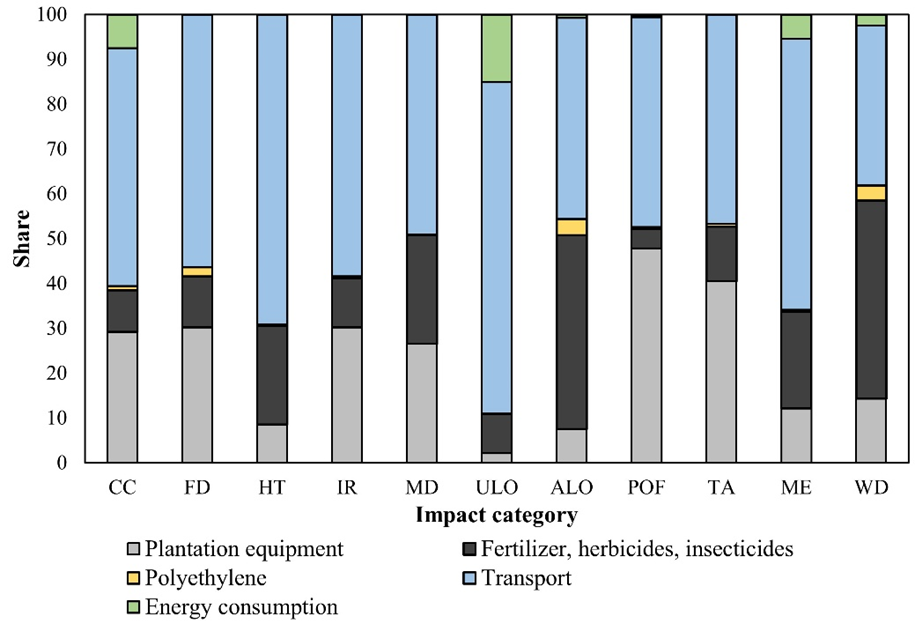
The selected impact categories are climate change (CC—kg CO2 eq), fossil depletion (FD—kg oil eq), human toxicity (HT—kg 1.4-DCB eq), ionizing radiation (IR— Bq U235 eq), metal depletion (MD—kg Fe eq), urban land occupation (ULO—m2 y-1), agricultural land occupation (ALO—m2 y-1), photochemical oxidant formation (POF—kg NMVOC eq), terrestrial acidification (TA—kg SO2 eq), marine ecotoxicity (ME—kg N eq) and water depletion (WD—m3).
The environmental impact categories were classified by relevance, and the most relevant factors are shown in Figure 4 and Table 2. The most affected impact categories in the cultivation stage are CC, FD, HT, and IR. During cultivation, transportation is the activity that most affects CC, FD, HT, and IR (53%, 56%, 69%, and 58%, respectively). Followed by plantation equipment that affects CC, FD, and IR (29%, 30%, and 30%, respectively); fertilizer, herbicide, and insecticide activities affect HT in third place (22%).
Ionizing radiation (IR), Metal depletion (MD), Urban land occupation (ULO), Agricultural land occupation (ALO),
Photochemical oxidant formation (POF), Terrestrial acidification (TA), Marine ecotoxicity (ME), Water depletion (WD)
Source: own elaboration.
Source: own elaboration.
| Impact categories | Unit | Plantation equipment | Fertilizer, herbicides, insecticides | Polyethylene | Transport | Energy consumption | Total |
|---|---|---|---|---|---|---|---|
| CC | kg CO2 eq | 4.76×10⁻¹ | 1.51×10⁻¹ | 1.58×10⁻² | 8.65×10⁻¹ | 1.22×10⁻¹ | 1.630 |
| FD | kg oil eq | 1.65×10⁻¹ | 6.25×10⁻² | 1.10×10⁻² | 3.08×10⁻¹ | 5.06×10⁻⁹ | 0.547 |
| HT | kg 1.4-DCB eq | 2.93×10⁻² | 7.54×10⁻² | 1.06×10⁻³ | 2.37×10⁻¹ | 3.36×10⁻⁴ | 0.343 |
| IR | kg Bq U235 eq | 3.26×10⁻² | 1.17×10⁻² | 5.52×10⁻⁴ | 6.29×10⁻² | 1.86×10⁻⁶ | 0.108 |
| MD | kg Fe eq | 1.85×10⁻² | 1.69×10⁻² | 9.98×10⁻⁵ | 3.42×10⁻² | 4.55×10⁻⁶ | 0.070 |
| ULO | m2 y-1 | 1.10×10⁻³ | 4.46×10⁻³ | 4.62×10⁻⁵ | 3.76×10⁻² | 7.66×10⁻³ | 0.051 |
| ALO | m2 y-1 | 1.86×10⁻³ | 1.07×10⁻² | 8.89×10⁻⁴ | 1.11×10⁻² | 1.75×10⁻⁴ | 0.025 |
| POF | kg NMVOC | 6.53×10⁻³ | 5.86×10⁻⁴ | 6.49×10⁻⁵ | 6.38×10⁻³ | 8.41×10⁻⁵ | 0.014 |
| TA | kg SO2 eq | 3.83×10⁻³ | 1.15×10⁻³ | 5.49×10⁻⁵ | 4.41×10⁻³ | 5.68×10⁻⁶ | 0.009 |
| ME | kg N eq | 9.51×10⁻⁴ | 1.68×10⁻³ | 3.81×10⁻⁵ | 4.73×10⁻³ | 4.24×10⁻⁴ | 0.008 |
| WD | m3 | 9.81×10⁻⁴ | 3.02×10⁻³ | 2.30×10⁻⁴ | 2.44×10⁻³ | 1.68×10⁻⁴ | 0.007 |
Ionizing radiation (IR), Metal depletion (MD), Urban land occupation (ULO),
Agricultural land occupation (ALO), Photochemical oxidant formation (POF),
Terrestrial acidification (TA), Marine ecotoxicity (ME), Water depletion (WD)
The cultivation stage has the greatest impact on the productive chain proposed in this study. The hotspots with the greatest contribution to climate change at this stage are the transportation of 0.86 kg CO₂-eq kg⁻¹ of plantain produced for direct marketing, accounting for 53% of CC. This is followed by plantation equipment (29%) and fertilizers, herbicides, and insecticides (9%). Plantation equipment (tractors, excavators, and skid-steer loaders) can have environmental impacts. Benzothiazole is used as an inducer of plant immune systems. Additionally, phosphate fertilizer (DAP) and polyethylene, used in plastic bags covering bunches, have significant pollution potential.
The results for the three proposed agro-industrial transformation scenarios are presented in Figure 5. In this figure, only the categories that offered the most significant impact in all scenarios (CC, FD, HT, and ALO) are shown. Scenario 1 (milling for flour production) involves the least complex use of machinery, equipment, and inputs, resulting in lower environmental impact in terms of both mass and economic allocation. Conversely, scenario 2, in which banana flour and ethanol are produced, shows the most significant environmental impact. Scenario 3 exhibits an intermediate impact compared to scenarios 1 and 2. The sensitivity analysis with allocation variations yielded different results. For example, CC in Scenario 2 has the greatest impact, generating 18.73 kg CO₂ eq for economic allocation, compared to 11.56 kg CO₂ eq for mass allocation. This ratio is consistent across most of the four major impact categories, except for ALO. In this category, ALO are matched in scenario 1 in 0.03 m2 y-1.
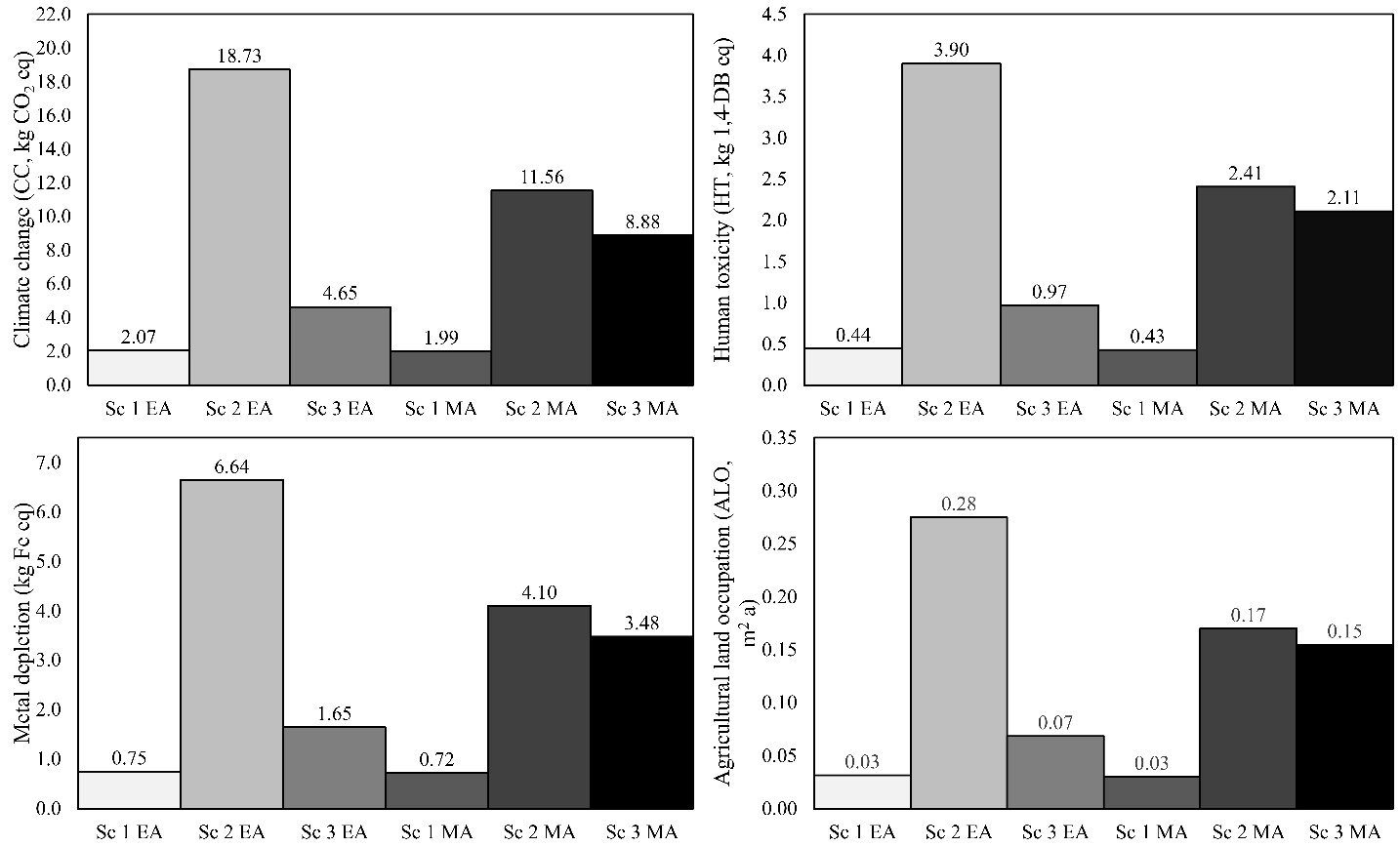
Source: own elaboration.
Figure 4. Distribution of environmental impacts by plantain cultivation stage. Climate change (CC), Fossil depletion (FD), Human toxicity (HT), Ionizing radiation (IR), Metal depletion (MD), Urban land occupation (ULO), Agricultural land occupation (ALO), Photochemical oxidant formation (POF), Terrestrial acidification (TA), Marine ecotoxicity (ME), Water depletion (WD). Source: own elaboration.
Climate change (CC), Fossil depletion (FD), Human toxicity (HT), Ionizing radiation (IR), Metal depletion (MD), Urban land occupation (ULO), Agricultural land occupation (ALO), Photochemical oxidant formation (POF), Terrestrial acidification (TA), Marine ecotoxicity (ME), Water depletion (WD)
Research consistently identifies agricultural production as the most impactful stage in the plantain life cycle [
The second factor with the greatest impact on the environment during cultivation is the use of machinery. In this region of Mexico, soil mechanization is commonplace, and the land in question was not constructed with irrigation drains. A backhoe loader is required for the construction of the drains, and a semi-heavy harrow maquila is used to mechanize site preparation. Therefore, it is reasonable to conclude that the use of machinery for cultivation has a significant environmental impact, given that this analysis considers the construction of this machinery and all the industrial processes involved.
The third factor most affecting the environment during cultivation is the use of fertilizers, herbicides, and insecticides. It is important to note that Black Sigatoka is caused by the fungus Mycosphaerella fijiensis [
Benzothiazole is a plant defense inducer that mimics the function of salicylic acid, a plant's immune hormone. It is therefore widely used to protect crops against disease by inducing plant defense responses. However, benzothiazole also has a high environmental impact.
Please note that the Colima method uses a pump to spray water, which can create puddles that promote pathogen growth. Drip irrigation is therefore recommended. This reduces the need for irrigation water and avoids the formation of inoculum sources for black Sigatoka. It is also advisable to use innovative methods, such as conditional pesticide application based on spore detection (i.e., fungicide application contingent on pest pressure), as recommended by [
As shown in Table 3, producing 1 ton of plantain in Mexico has a high CO₂ equivalent contribution, greater than that of any other raw material compared. This can be attributed to the long distances traveled by the chosen transport system in moving inputs and supplies from Mexico City, which is 700 km from the crop. Similarly, the contribution of heavy machinery must be considered, given that the assessed farms are highly mechanized.
Source: Own work
| Feedstock | kg CO2 eq t-1 of crop | Type of crop | Country | Reference |
|---|---|---|---|---|
| Plantain crop | 1 630 | Plantain | Mexico | This study |
| Orange production | 128 | Orange | Mexico | [ |
| Sugar | 719 | Sugar | Mexico | [ |
| Plantain losses and waste | 1 370 | Plantain | Mexico | [ |
| Avocado losses and waste | 1 300 | Avocado | Mexico | [ |
| Orange peel waste | 1 420 | Orange | Colombia | [ |
| Creole avocado | 593 | Avocado | Colombia | [ |
In scenario 1, the most significant residual flux is water vapor, produced by the dehydration of flour. Therefore, the highest degree of pollution is attributable to electricity consumption and the Mexican energy matrix, which derives over 80% of its energy from hydrocarbons
[
Furthermore, the scenarios presented in this work can handle 5.5 t h-1 of unripe plantain, with the sanitary landfill serving as the final disposal site. The Mexican Biogas Model
[
The proposed scenarios for flour and bioethanol production present considerable environmental impacts due to the incorporation of complex technological processes in the plantain marketing chain. The cradle-to-gate E-LCA implemented for this study did not consider the possibility of using rejected plantain-based bioethanol in place of commercial sugarcane-based ethanol in scenarios 2 and 3, which could have a positive environmental impact. Using bioethanol in combination with conventional fuel for vehicles could reduce the environmental impact of the evaluated scenarios. Further studies are needed to determine the environmental viability of plantain-based bioethanol. However, the results of this study and the inventories generated during the agricultural and technological phases will provide insight into this type of process.
4. CONCLUSIONS
This study evaluated the environmental viability of biorefinery schemes for producing flour and bioethanol by managing unripe plantain (UP) within the Mexican marketing chain. Mathematical models were applied alongside a cradle-to-gate life cycle assessment methodology, considering three technological scenarios: exclusive flour production (scenario 1), joint flour and bioethanol production (scenario 2), and bioethanol production from UP peel combined with flour produced from pulp (scenario 3). Scenario 2 achieved a bioethanol yield of 0.055 kg kg⁻¹ of feedstock, while scenario 3 registered significantly lower values (0.025 kg kg⁻¹ of feedstock), attributable to the absence of UP pulp in the bioethanol production process. The environmental impact analysis identified that, during the agricultural phase, the most relevant categories were climate change, fossil fuel depletion, human toxicity, and ionizing radiation. At this stage, transportation was the primary source of environmental impact, followed by planting activities, agricultural machinery use, and the application of fertilizers, herbicides, and insecticides.
The climate change potential was estimated at 1 630 kg of CO₂ eq per ton of plantain cultivated, primarily due to long transport distances and high mechanization in agricultural areas. Scenarios that integrate the simultaneous production of flour and bioethanol impose greater environmental burdens, as they involve incorporating more complex technological processes into the production system.
This work defines robust environmental and technological criteria to support decision-making to mitigate environmental impacts in the plantain supply chain. Its results offer tools to promote sustainable development and innovation in the agricultural and bioenergy sectors, particularly in the Mexican context. Likewise, agribusinesses can use these findings to increase flour and bioethanol production while reducing their environmental footprint by adopting efficient, low-impact technologies.
Among the main limitations of the study is the use of generic inventories, such as ECOINVENT, which may increase the uncertainty of the results. Future research could focus on developing specific regional inventories, incorporating additional impact categories, such as eutrophication, and expanding the system's boundaries to evaluate the substitution of conventional sugarcane-derived ethanol with bioethanol obtained from UP. These strategies could further reduce the environmental burdens of the scenarios being assessed.
Finally, technological advancement in this area could be strengthened by designing integrated biorefineries that generate a diverse range of bioproducts from UP, with an emphasis on improving energy efficiency, incorporating renewable energy sources, and integrating the banana production chain with other value chains.
5. ACKNOWLEDGMENTS
The research leading to these results was funded by Universidad de los Llanos, Villavicencio, Colombia, under Grant Agreement No. (project C01-01-2025-002). The SIMAPRO license used for the analyses in this study was registered under the name ITC 002 at the Instituto Tecnológico de Celaya in Mexico. Alonso-Gomez would like to thank the personnel of the Instituto de Biotecnología y Agroindustria, Departamento de Ingeniería Química, of the Universidad Nacional de Manizales, Research group: Procesos químicos catalíticos y biotecnológicos.
REFERENCES
- arrow_upward [1] INEGI, “Censo Agropecuario (CA) 2022,” inegi.org, 2022. [Online]. Available: https://www.inegi.org.mx/programas/ca/2022/
- arrow_upward [2] Dirección General del Servicio de Información Agroalimentaria y Pesquera, “Anuario Estadístico de la Producción Agrícola,” nube.agricultura.gob, 2024. [Online]. Available: https://nube.agricultura.gob.mx/cierre_agricola/
- arrow_upward [3] A. M. Afanador, “El banano verde de rechazo en la producción de alcohol carburante,” Rev. EIA, vol. 2, no. 3, pp. 51-68, Jan.-Jun. 2013. http://www.scielo.org.co/scielo.php?script=sci_arttext&pid=S1794-12372005000100005
- arrow_upward [4] L. A. Bello‐Pérez, F. J. Pineda‐Tapia, G. Pacheco‐Vargas, R. Carmona‐Garcia, and J. Tovar, “Whole Unripe Plantain Flour as Unconventional Carbohydrate Source to Prepare Gluten‐Free Pasta with High Dietary Fiber Content and Reduced Starch Hydrolysis,” Starch, vol. 76, no. 1-2, Jan. 2024. https://doi.org/10.1002/star.202200222
- arrow_upward [5] K. Kunyanee, T. Van Ngo, S. Kusumawardani, and N. Luangsakul, “Enhancing Banana Flour Quality through Physical Modifications and Its Application in Gluten-Free Chips Product,” Foods, vol. 13, no. 4, p. 593, Feb. 2024. https://doi.org/10.3390/foods13040593
- arrow_upward [6] M. Tibiru Apaliya et al., “Effect of different drying methods on the rehydration kinetics, physiochemical and functional properties of unripe plantain (Musa parasidiaca) flour,” Food Chem. Adv., vol. 4, p. 100610, Jun. 2024. https://doi.org/10.1016/j.focha.2024.100610
- arrow_upward [7] L. A. Alonso‐Gómez, E. Heredia‐Olea, S. O. Serna‐Saldivar, and L. A. Bello‐Pérez, “Whole unripe plantain (Musa paradisiaca L.) as raw material for bioethanol production,” J. Sci. Food Agric., vol. 99, no. 13, pp. 5784-5791, Oct. 2019. https://doi.org/10.1002/jsfa.9847
- arrow_upward [8] L. A. Alonso-Gómez, J. C. Solarte-Toro, L. A. Bello-Pérez, and C. A. Cardona-Alzate, “Performance evaluation and economic analysis of the bioethanol and flour production using rejected unripe plantain fruits (Musa paradisiaca L.) as raw material,” Food Bioprod. Process., vol. 121, pp. 29-42, May. 2020. https://doi.org/10.1016/j.fbp.2020.01.005
- arrow_upward [9] J.-F. Mercure et al., “System complexity and policy integration challenges: The Brazilian Energy- Water-Food Nexus,” Renew. Sustain. Energy Rev., vol. 105, pp. 230-243, May. 2019. https://doi.org/10.1016/j.rser.2019.01.045
- arrow_upward [10] L. Hoxha, and M. J. Taherzadeh, “Sustainable Valorization of Plant-Derived Agri-Food Side-Streams Through Fungal Biorefinery: Supporting Bioeconomy Strategy,” Curr. Pollution Rep., vol. 12, no. 1, p. 8, Dec. 2026. https://doi.org/10.1007/s40726-026-00399-5
- arrow_upward [11] Environmental management - Life cycle assessment - Principles and framework, ISO 14040:2006, International Organization for Standardization, Geneva, Switzerland, 2006. [Online]. Available: https://www.iso.org/standard/37456.html
- arrow_upward [12] S. Piedrahita-Rodríguez, S. Cardona Urrea, D. A. Escobar García, M. Ortiz-Sánchez, J. C. Solarte-Toro, and C. A. Cardona Alzate, “Life cycle assessment and potential geolocation of a multi-feedstock biorefinery: Integration of the avocado and plantain value chains in rural zones,” Bioresour. Technol. Rep., vol. 21, p. 101318, Feb. 2023. https://doi.org/10.1016/j.biteb.2022.101318
- arrow_upward [13] C. A. García, M. Morales, J. Quintero, G. Aroca, and C. A. Cardona, “Environmental assessment of hydrogen production based on Pinus patula plantations in Colombia,” Energy, vol. 139, pp. 606-616, Nov. 2017. https://doi.org/10.1016/j.energy.2017.08.012
- arrow_upward [14] K. Veliz, L. Chico-Santamarta, and A. D. Ramirez, “The Environmental Profile of Ecuadorian Export Banana: A Life Cycle Assessment,” Foods, vol. 11, no. 20, p. 3288, Oct. 2022. https://doi.org/10.3390/foods11203288
- arrow_upward [15] N. Suppen-Reynaga, A. B. Guerrero, E. R. Dominguez, E. Sacayón, and A. Solano, “Life cycle assessment of bananas, melons, and watermelons from Costa Rica,” Clean. Circ. Bioecon., vol. 9, p. 100120, Dec. 2024. https://doi.org/10.1016/j.clcb.2024.100120
- arrow_upward [16] A. F. da S. Lima et al., “Carbon and water scarcity footprints of banana under current and future climate conditions in the Brazilian semiarid region,” Environ. Dev., vol. 51, p. 101034, Sep. 2024. https://doi.org/10.1016/j.envdev.2024.101034
- arrow_upward [17] Z. Rozaki et al., “Assessing the Environmental Impacts of Banana Farming in Yogyakarta Special Region Using Life Cycle Assessment (LCA),” Int. J. Des. Nat. Ecodynamics, vol. 20, no. 1, pp. 159-167, Jan. 2025. https://doi.org/10.18280/ijdne.200117
- arrow_upward [18] L. Coltro, and T. U. Karaski, “Environmental indicators of banana production in Brazil: Cavendish and Prata varieties,” J. Clean. Prod., vol. 207, pp. 363-378, Jan. 2019. https://doi.org/10.1016/j.jclepro.2018.09.258
- arrow_upward [19] Secretaría de Agricultura y Desarrollo Rural, Panorama Agroalimentario 2025, Dirección General del Servicio de Información Agroalimentaria y Pesquera, Ciudad de México, México, 2025. [Online]. Available: https://nube.agricultura.gob.mx/panorama_dgsiap/2025.pdf
- arrow_upward [20] E. Agama-Acevedo, J. A. Sañudo-Barajas, R. Vélez De La Rocha, G. A. González-Aguilar, and L. A. Bello-Peréz, “Potential of plantain peels flour (Musa paradisiaca L.) as a source of dietary fiber and antioxidant compound,” CyTA. J. Food, vol. 14, no. 1, pp. 117-123, Jan. 2016. https://doi.org/10.1080/19476337.2015.1055306
- arrow_upward [21] S. S. Cronauer, and A. D. Krikorian, “Multiplication of Musa from Excised Stem Tips,” Ann. Bot., vol. 53, no. 3, pp. 321-328, Mar. 1984. https://doi.org/10.1093/oxfordjournals.aob.a086696
- arrow_upward [22] Z. Shen et al., “Suppression of banana Panama disease induced by soil microbiome reconstruction through an integrated agricultural strategy,” Soil Biol. Biochem., vol. 128, pp. 164-174, Jan. 2019. https://doi.org/10.1016/j.soilbio.2018.10.016
- arrow_upward [23] M. Rocha dos Santos, S. L. Rodrigues. Donato, A. De Magalhães Arantes, E. F. Coelho, and P. M. De Oliveira, “Gas exchange in ‘BRS Princesa’ banana (Musa spp.) under partial rootzone drying irrigation in the north of Minas Gerais, Brazil,” Acta Agron., vol. 66, no. 3, pp. 378-384, Jul. 2017. https://doi.org/10.15446/acag.v66n3.55056
- arrow_upward [24] Y. Zhang et al., “Soil Acidification caused by excessive application of nitrogen fertilizer aggravates soil-borne diseases: Evidence from literature review and field trials,” Agric. Ecosyst. Environ., vol. 340, p. 108176, Dec. 2022. https://doi.org/10.1016/j.agee.2022.108176
- arrow_upward [25] A. Muscalu, C. Sorică, C. Persu, A.-M. Andrei, A. Dorogan, and C. Tudora, “Researches on ecological weed control in vegetable crops,” E3S Web Conf., vol. 112, p. 03008, Aug. 2019. https://doi.org/10.1051/e3sconf/201911203008
- arrow_upward [26] V. Sánchez, F. J. López-Bellido, M. A. Rodrigo, F. J. Fernández, and L. Rodríguez, “A mesocosm study of electrokinetic-assisted phytoremediation of atrazine-polluted soils,” Sep. Purif. Technol., vol. 233, p. 116044, Feb. 2020. https://doi.org/10.1016/j.seppur.2019.116044
- arrow_upward [27] K. Lohaus, and S. Vidal, “Nitrogen supply in conventional versus organic farming systems: effects on the performance of cereal aphids,” Org. Agr., vol. 3, no. 2, pp. 129-139, Jun. 2013. https://doi.org/10.1007/s13165-013-0051-1
- arrow_upward [28] G. Manzo‐Sánchez et al., “Genetic variability of Pseudocercospora fijiensis, the black Sigatoka pathogen of banana (Musa spp.) in Mexico,” Plant Pathol., vol. 68, no. 3, pp. 513-522, Apr. 2019. https://doi.org/10.1111/ppa.12965
- arrow_upward [29] R. Swennen, and E. De Langhe, “Growth Parameters of Yield of Plantain (Musa cv. AAB),” Ann. Bot., vol. 56, no. 2, pp. 197-204, Aug. 1985. https://doi.org/10.1093/oxfordjournals.aob.a087003
- arrow_upward [30] D. Munro-Olmos, R. Vasquez-Castrejon, A. Romero, and J. Figueroa, “Paquete tecnológico para el cultivo del Plátano en Colima,” 2012, Gobierno del Estado de Colima, Secretaría de Desarrollo Rural de Colima. [Online]. Available: https://es.scribd.com/document/804856854/270988103-Paquete-Tecnologico-Del-Platano
- arrow_upward [31] W. J. Orts, and C. M. McMahan, “Biorefinery Developments for Advanced Biofuels from a Sustainable Array of Biomass Feedstocks: Survey of Recent Biomass Conversion Research from Agricultural Research Service,” Bioenerg. Res., vol. 9, no. 2, pp. 430-446, Jun. 2016. https://doi.org/10.1007/s12155-016-9732-4
- arrow_upward [32] T. Nemecek, and T. Kägi, “Life Cycle Inventories of Agricultural Production Systems,” Ecoinvent Report. vol. 2, no. 15, pp. 1-360, Jan. 2007. https://www.researchgate.net/publication/263239333_Life_Cycle_Inventories_of_Agricultural_Production_Systems
- arrow_upward [33] D. Rossier, and R. Charles, Ecobilan: Adaptation de la méthode écobilan pour la gestion environnementale de l’exploitation agricole (S. romand de vulgarisation agricole Lausanne), Lausanne, SWI: SRVA, Service romand de vulgarisation agricole, 1998. https://bib.rero.ch/global/documents/392009
- arrow_upward [34] R. Dalgaard, N. Halberg, and J. E. Hermansen, “Danish pork production an environmental assessment,” DJF Anim. Sci., no. 82, pp. 1-38, Nov. 2007. https://2-0-lca.com/publications/show/danish-pork-production-an-environmental-assessment/
- arrow_upward [35] R. M. Altarawneh, “Levels of selected heavy metals (Pb, Ni, Cd, and Cr) in various widely consumed fruits and vegetables in Jordan,” Int. J. Environ. Anal. Chem., vol. 101, no. 7, pp. 1026-1033, May. 2021. https://doi.org/10.1080/03067319.2019.1675653
- arrow_upward[36] S. K. Gupta, F. A. Ansari, M. Nasr, M. Chabukdhara, and F. Bux, “Multivariate analysis and health risk assessment of heavy metal contents in foodstuffs of Durban, South Africa,” Environ. Monit. Assess., vol. 190, no. 3, p. 151, Mar. 2018. https://doi.org/10.1007/s10661-018-6546-1
- arrow_upward [37] V. Aristizábal-Marulanda, C. A. García-Velásquez, and C. A. Cardona Alzate, “Environmental assessment of energy-driven biorefineries: The case of the Coffee Cut-Stems (CCS) in Colombia,” Int. J. Life Cycle Assess., vol. 26, pp. 290-310, Feb. 2021. https://doi.org/10.1007/s11367-020-01855-0
- arrow_upward [38] SimaPro 9.6. Full update instructions, PRé Sustainability, Amersfoort, The Netherlands, 2024. [Online]. Available: https://simapro.com/wp-content/uploads/2024/07/FullUpdateInstructionsToSimaPro960.pdf
- arrow_upward [39] G. Wernet, C. Bauer, B. Steubing, J. Reinhard, E. Moreno-Ruiz, and B. Weidema, “The ecoinvent database version 3 (part I): overview and methodology,” Int. J. Life Cycle Assess., vol. 21, no. 9, pp. 1218-1230, Sep. 2016. https://doi.org/10.1007/s11367-016-1087-8
- arrow_upward [40] R. H. Hafyan et al., “Integrated biorefinery for bioethanol and succinic acid co-production from bread waste: Techno-economic feasibility and life cycle assessment,” Energy Convers. Manag., vol. 301, p. 118033, Feb. 2024. https://doi.org/10.1016/j.enconman.2023.118033
- arrow_upward [41] G. H. Klein et al., “Utilization of banana peel waste for the production of bioethanol and other high-value-added compounds,” Food Human., vol. 3, p. 100376, Dec. 2024. https://doi.org/10.1016/j.foohum.2024.100376
- arrow_upward [42] M. Balcerek, U. Dziekońska-Kubczak, K. Pielech-Przybylska, A. Oleszczak, M. Koń, and A. M. Patelski, “Waste Bread as Raw Material for Ethanol Production: Effect of Mash Preparation Methods on Fermentation Efficiency,” Appl. Sci., vol. 14, no. 20, p. 9565, Jan. 2024. https://doi.org/10.3390/app14209565
- arrow_upward [43] F. Demichelis, M. Laghezza, M. Chiappero, and S. Fiore, “Technical, economic and environmental assessement of bioethanol biorefinery from waste biomass,” J. Clean. Prod., vol. 277, p. 124111, Dec. 2020. https://doi.org/10.1016/j.jclepro.2020.124111
- arrow_upward [44] M. Kayanda Kiteto, B. Minayo Vidija, and C. Achisa Mecha, “Production of bioethanol from citrus peel waste: A techno – economic feasibility study,” Energy Convers. Manag. X, vol. 26, p. 100916, Apr. 2025. https://doi.org/10.1016/j.ecmx.2025.100916
- arrow_upward [45] S. González-García, P. Comendador Morales, and B. Gullón, “Estimating the environmental impacts of a brewery waste–based biorefinery: Bio-ethanol and xylooligosaccharides joint production case study,” Ind. Crops Prod., vol. 123, no. 4, pp. 331-340, Nov. 2018. https://doi.org/10.1016/j.indcrop.2018.07.003
- arrow_upward [46] V. Ieremia, E. Loiseau, and A. Geeraerd Ameryckx, “Benchmarking the environmental impacts of Leuven’s urban food system using territorial Life Cycle Assessment: What we eat matters the most,” Sustain. Cities Soc., vol. 135, p. 106966, Dec. 2025. https://doi.org/10.1016/j.scs.2025.106966
- arrow_upward [47] C. Salas-Vargas, L. Brunett-Pérez, V. E. Espinosa-Ortiz, and C. G. Martínez-García, “Environmental impact of Oaxaca cheese production and wastewater from artisanal dairies under two scenarios in Aculco, State of Mexico,” J. Clean. Prod., vol. 311, p. 127586, Aug. 2021. https://doi.org/10.1016/j.jclepro.2021.127586
- arrow_upward [48] S. Babu et al., “Designing energy-efficient, economically sustainable and environmentally safe cropping system for the rainfed maize–fallow land of the Eastern Himalayas,” Sci. Total Environ., vol. 722, p. 137874, Jun. 2020. https://doi.org/10.1016/j.scitotenv.2020.137874
- arrow_upward [49] R. M. de Souza, D. Seibert, H. B. Quesada, F. de Jesus Bassetti, M. R. Fagundes-Klen, and R. Bergamasco, “Occurrence, impacts and general aspects of pesticides in surface water: A review,” Process Saf. Environ. Prot., vol. 135, pp. 22-37, Mar. 2020. https://doi.org/10.1016/j.psep.2019.12.035
- arrow_upward [50] M. A. Liñan-Cabello, A. L. Quintanilla-Montoya, C. Sepúlveda-Quiroz, and O. D. Cervantes-Rosas, “Anthropogenic Susceptibility to environmental variability of the aquaculture sector in the State of Colima, Mexico: case study,” Lat. Am. J. Aquat. Res., vol. 44, no. 3, pp. 649-656, Feb. 2017. https://doi.org/10.3856/vol44-issue3-fulltext-24
- arrow_upward[51] P. Chopin, J. Tirolien, and J.-M. Blazy, “Ex-ante sustainability assessment of cleaner banana production systems,” J. Clean. Prod., vol. 139, pp. 15-24, Dec. 2016. https://doi.org/10.1016/j.jclepro.2016.08.036
- arrow_upward [52] J. Bonales-Revuelta, R. Musule, F. S. Navarro-Pineda, and C. A. García, “Evaluating the environmental performance of orange production in Veracruz, Mexico: A life cycle assessment approach,” J. Clean. Prod., vol. 343, p. 131002, Apr. 2022. https://doi.org/10.1016/j.jclepro.2022.131002
- arrow_upward [53] L. P. Güereca, A. Padilla-Rivera, and N. Aguilar-Rivera, “Life cycle assessment of nine representative agroindustrial systems of sugar production in Mexico,” Food and Bioprod. Process., vol. 131, pp. 164-175, Jan. 2022. https://doi.org/10.1016/j.fbp.2021.11.001
- arrow_upward [54] A. López-Sánchez et al., “Food loss in the agricultural sector of a developing country: Transitioning to a more sustainable approach. The case of Jalisco, Mexico.,” Environ. Chall., vol. 5, p. 100327, Dec. 2021. https://doi.org/10.1016/j.envc.2021.100327
- arrow_upward [55] M. Ortiz-Sanchez, and C. A. Cardona Alzate, “Comparative environmental life cycle assessment of orange peel waste in present productive chains,” J. Clean. Prod., vol. 322, p. 128814, Nov. 2021. https://doi.org/10.1016/j.jclepro.2021.128814
- arrow_upward [56] J. C. Solarte-Toro, M. Ortiz-Sanchez, and C. A. Cardona Alzate, “Environmental life cycle assessment (E-LCA) and social impact assessment (SIA) of small-scale biorefineries implemented in rural zones: the avocado (Persea Americana var. Americana) case in Colombia,” Environ. Sci. Pollut. Res., vol. 30, no. 4, pp. 8790-8808, Jun. 2022. https://doi.org/10.1007/s11356-022-20857-z
- arrow_upward [57] Global Energy Monitor, “Perfil energético: México,” gem.wiki, 2022. [Online]. Available: https://www.gem.wiki/Perfil_energ%C3%A9tico:_M%C3%A9xico
- arrow_upward [58] S. Banacloche, Y. Lechon, and A. Rodríguez-Martínez, “Carbon capture penetration in Mexico’s 2050 horizon: A sustainability assessment of Mexican CCS policy,” Int. J. Greenh. Gas Control, vol. 115, p. 103603, Mar. 2022. https://doi.org/10.1016/j.ijggc.2022.103603
- arrow_upward [59] Manual del Usuario Modelo Mexicano de Biogás 2.0., Agencia para la Protección del Ambiente (U.S. EPA), Washington, United States, 2009. [Online]. Available: https://globalmethane.org/documents/models/pdfs/manual_del_usuario_modelo_mexicano_de_biogas_v2_2009.pdf
CONFLICTS OF INTEREST
The authors declare no conflict of interest.
AUTHOR CONTRIBUTIONS
Leonardo Alexis Alonso-Gomez: Conceptualization, Scenario design, Calculations and Analysis of results, Fund management, Research development, Drafting, and Final revision of the manuscript.
Alejandro Estrada-Baltazar: Drafting and Final revision of the manuscript.
Luis Ramiro Miramontes-Martínez: Calculations and Analysis of results, Drafting and final revision of the manuscript.

 Google