STUDY OF PHYSICOCHEMICAL, MORPHOLOGICAL, FUNCTIONAL, RHEOLOGICAL AND THERMAL PROPERTIES OF NATIVE ANDEAN POTATO STARCH AND ITS APPLICATION IN BIOBASED MATERIALS
Estudio de las propiedades fisicoquímicas, morfológicas, funcionales, reológicas y térmicas de almidón de papas nativas andinas y su aplicación en materiales biobasados
 PDF
Received: August 12, 2025
Accepted: May 18, 2026
Available: June 5, 2026
D. F. López Enríquez, A. J. Yamá Hernández, A. Figueroa Benavides, L. Bravo, O. Osorio, and A. Ayala Aponte, “Study of Physicochemical, Morphological, Functional, Rheological and Thermal Properties of Native Andean Potato Starch and its Application in Biobased Materials,” TecnoLógicas, vol. 29, no. 66, e3610, 2026. https://doi.org/10.22430/22565337.3610
Highlights
Highlights
Abstract
Starch is the most widely used biopolymer for packaging production. Starch obtained from native potatoes (Solanum phureja) may represent an alternative for the development of packaging materials due to its biodegradable nature, providing a potential use that may encourage the cultivation and valorization of these varieties. The objective of this study was to characterize starch from the potato varieties Curiquinga, Ratona Roja (Solanum phureja), and Diacol Capiro (Solanum tuberosum), and to evaluate the mechanical properties of starch-based films produced from these starches. The methodology consisted of determining moisture content and functional indices by gravimetry, granule size and morphology by scanning electron microscopy, amylose content by spectrophotometry, the amylographic profile by rapid viscosity analysis, and thermal properties by thermogravimetry and differential scanning calorimetry. The films were prepared using the casting method. The results showed that the amylose content of Ratona Roja and Diacol Capiro starches was 2% higher than that of Curiquinga starch, possibly due to their larger granule size. Ratona Roja starch exhibited lower water absorption index, swelling power, and maximum viscosity; however, its water solubility index and final viscosity were higher compared with the other varieties. The mechanical properties of films prepared with Ratona Roja starch showed greater elongation at maximum force (%) and Young’s modulus (MPa), whereas tensile strength (MPa) was higher in films prepared with Diacol Capiro potato starch. It is concluded that the functional indices, viscosity profile, and thermal properties may be associated with amylose content and granule size, and these properties determine their potential applications. Starches from native potatoes may be an alternative biopolymer for the production of biodegradable materials.
Keywords: Biomaterial, biopolymers, food packaging, mechanical properties, potato starch.
Resumen
El almidón es el biopolímero más usado para la elaboración de empaques. El almidón obtenido de papas nativas (Solanum phureja) puede ser una alternativa para el desarrollo de empaques debido a su naturaleza biodegradable, generando una alternativa de uso que incentive el cultivo y su aprovechamiento. El objetivo del articulo consistió en caracterizar el almidón de las variedades de papas Curiquinga, Ratona Roja (Solanum phureja) y Diacol Capiro (Solanum tuberosum), y evaluar las propiedades mecánicas de biopelículas elaboradas con estos almidones. La metodología consistió en determinar el contenido de humedad e índices funcionales mediante gravimetría, el tamaño y forma del gránulo mediante microscopia electrónica de barrido, el contenido de amilosa mediante espectrofotometría, el perfil amilográfico mediante análisis rápido de viscosidad, y las propiedades térmicas usando termogravimetría y calorimetría diferencial de barrido. Las películas se elaboraron con el método “casting”. Los resultados indicaron que el contenido de amilosa en las variedades Ratona Roja y Diacol Capiro fueron 2 % más altos que en la variedad Curiquinga, posiblemente por un tamaño de gránulo mayor. El almidón de la variedad Ratona Roja presentó un índice de absorción de agua, poder de hinchamiento y viscosidad máxima menores; sin embargo, el índice de solubilidad en agua y la viscosidad final fueron mayores en comparación con las otras variedades. Las propiedades mecánicas de las películas con almidón variedad Ratona Roja presentaron mayor elongación a la fuerza máxima (%) y módulo de Young (MPa), mientras la resistencia a la tracción (MPa) fue mayor en la película con almidón de papa Diacol Capiro. Se concluye que los índices funcionales, el perfil de viscosidad y las propiedades térmicas pueden estar relacionadas con el contenido de amilosa y tamaño de gránulo, estas propiedades determinan sus posibles usos. Los almidones de papas nativas puede ser un biopolímero alternativo para la elaboración de materiales biodegradables.
Palabras clave: Biomaterial, biopolímeros, empaques de alimentos, propiedades mecánicas, almidón de papa.
1. INTRODUCTION
Potato (Solanum tuberosum) is a crop that constitutes a fundamental pillar of the economy of Colombia. More than 100 000 producers are engaged in potato cultivation; this activity generates over 350 000 direct and indirect jobs and is estimated to account for approximately 20 million labor-days per year. In Colombia, 90% of the potato-growing area is concentrated in four departments: Cundinamarca (36%), Boyacá (27%), Nariño (22%), and Antioquia (5%)
Of total national potato production, 6.8% corresponds to a wide diversity of native potatoes (Solanum phureja). However, these tubers show a clear tendency toward disappearance due to low demand, limited technological innovation, and the absence of industrial processing for transformation and preservation
The importance of starch is due to its wide application in food and non-food sectors
The properties of starches extracted from different botanical sources, together with compositional differences, determine the properties of films produced from this biopolymer
2. METHODOLOGY
2.1 Raw material and starch extraction
Two native potato varieties, Curiquinga and Ratona Roja (Solanum phureja), and one commercial potato variety, Diacol Capiro (Solanum tuberosum), cultivated in the department of Nariño, Colombia, were selected. The tubers were sorted, washed, and disinfected. Starch extraction was carried out using the wet-milling method, with 1% sodium bisulfite added to prevent enzymatic browning. The extracted starch was dried at 45 °C for 24 h in a convection dryer (Industrias Químicas FIQ). Subsequently, the dried starch was milled, sieved through a No. 100 mesh, and stored in resealable bags under ambient conditions (T: 18 ± 2 °C; RH: 60 ± 5%) until further use.
2.2 Yield, moisture content, amylose content, granule size and shape
The extraction yield (%) was calculated as the amount of starch extracted (g) per amount of processed potato (g). Moisture content (%) was determined by gravimetry using a drying oven (Thermolab TH53) at 100 °C for 24 hours. Amylose content was determined by the amylose-iodine colorimetric method, using a UV-VIS spectrophotometer (Mapada P4). The shape and size of the starch granules were analyzed by Scanning Electron Microscopy (Quanta 200), the micrographs were analyzed using ImageJ software.
2.3 Pasting properties
The amylographic profile was determined by rapid viscosity analysis using a rotational rheometer (TA Instruments AR1500EX) according to the methodology reported by
2.4 Functional properties
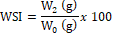
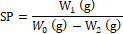
The functional properties that were calculated were: the Water Absorption Index (WAI), Water Solubility Index (WSI) and Swelling Power (SP), using equations (1) (2) and (3) following the methodology described by
 (1)
 (2)
 (3)
Where:
W0 is the weight (g) of the starch sample on a dry basis (D.B)
W1 is the weight (g) of the starch gel gelatinized at different temperatures
W2 is the weight (g) of soluble starch in the supernatant
Solutions were prepared by adding 1 g of starch (W₀) in 25 mL of distilled water, heated in a water bath at different temperatures (60, 70, 80 and 90 °C) for 10 min, then cooled to up to 25 °C using an ice bath, the samples were shaken in a centrifuge (Dynamica 18R) at 4900 rpm for 30 minutes. Then, the supernatant was separated and its volume (mL) measured, the centrifuge tube was weighed and the weight of the gel (W₁) was calculated; A 2 ml aliquot was taken from the supernatant and placed in a Petri dish to be dried at 70°C for 4 hours in a forced air dryer oven (Biobase BOV-V45F), The amount of soluble starch was weighed and the weight of the total soluble (W₂) was calculated with respect to the total volume of the supernatant.
2.5 Thermal properties
The thermal properties of the starches were determined by thermogravimetric analysis and differential scanning calorimetry (TA Instruments SDT-Q600). From the thermograms, the following were determined: degradation stages (%), residual mass (%), peak gelatinization temperature (Tp – °C) and maximum degradation temperature (Tmax – °C).
2.6 Production and mechanical evaluation of bioplastic films
The films were prepared according to the Casting method or solvent evaporation described by some authors
2.7 Statistical analysis
A completely randomized design was used and an analysis of variance (ANOVA) with Fisher’s LSD test at 95% confidence level was performed to identify significant differences among the properties of each starch type. The results were reported as mean ± standard deviation. In the case of functional properties, temperature was included as a covariate in the analysis. To evaluate the mechanical properties of the films, the same statistical analysis was applied, comparing the different starch types. The number of replicates (n) is indicated in the results tables for each variable. The denomination of the extracted starches is: Ratona Roja variety – RRS, Curiquinga variety – CQS and Diacol Capiro variety – DCS.
3. RESULTS AND DISCUSSION
The results of the chemical, physical, pasting, functional and thermal properties of the starches extracted from the native potato varieties RRS and CQS and the commercial variety DCS are presented below.
3.1 Extraction yield, moisture content and amylose content of starches from three potato varieties
The yield (%) in starch extraction for the native potato varieties was slightly higher than that obtained for the commercial potato variety (Table 1), however, there were no statistical differences among the varieties (see Table 1). Yield depends on several factors: the extraction parameters, the potato variety and the physiological condition of the tuber; at an advanced maturity stage, the available starch decreases due to hydrolysis processes; a wide range of yields has been reported, for sweet starch extracted from different native potato varieties between 9.63 – 14.99%
and granule diameters (µm) of starches extracted from different potato varieties*
Source: own elaboration.
| Physical properties | Type of Starch | ||
| DCS | RRS | CQS | |
| Yield (M.B) (%) (n=3) | 10.21 ± 0.80 a | 11.84 ± 1.78 a | 11.65 ± 0.59 a |
| Moisture content (%) (n=9) | 11.12 ± 0.79 ª | 11.76 ± 0.92 ª | 11.80 ± 0.89 ª |
| Amylose content (%) (n=10) | 33.09 ± 2.45 b | 33.01 ± 1.13 b | 31.25 ± 0.32 a |
| Average diameter of the major axis (µm) (n=250) | 25.03 ± 15.51 b | 22.63 ± 16.68 b | 16.95 ± 15.88 a |
| Average diameter of the minor axis (µm) (n=250) | 19.18 ± 9.70 c | 16.70 ± 10.09 b | 12.53 ± 10.00 a |
The moisture content of starch is important because it determines its storage stability, at higher moisture content starch is susceptible to microbial attack and loss of its properties. Some authors report a wide moisture range for starch obtained from Andean potato varieties (subsp. Phureja): between 14.15 – 15.62%
DCS and RRS have higher amylose content than CQS, possibly because larger granule size is associated with a higher amount of amylose
Variations in amylose content may be due to several factors, cultivation conditions and harvest times, crop altitude (Andean zone), soil organic matter content, as well as factors associated with the genetics of each variety, amylose synthesis conditions and the physiological state of the plant. It is important to know the amylose-amylopectin content and ratio in starch to select a plant material that allows obtaining a biopolymer with functional characteristics for the production of biodegradable packaging, the amount of amylose determines the functional properties of starch and its capacity to generate a bioplastic material in combination with other ingredients. Amylose content provides mechanical strength in films, however, it makes starch more prone to retrogradation and susceptible to contact with water
3.2 Granule size and shape
In the results presented in Table 1, it is observed that the granule size of DCS and RRS are comparable, unlike the CQS granule which is relatively smaller (see Table 1). The microphotographs (Figure 1) show the shapes of the potato starch granules of the varieties DCS (a.), RRS (b.) and CQS (c.), a heterogeneous distribution in granule size is observed, generally with uniform smooth surfaces with very few protuberances and absence of pores, this type of surface reduces water absorption
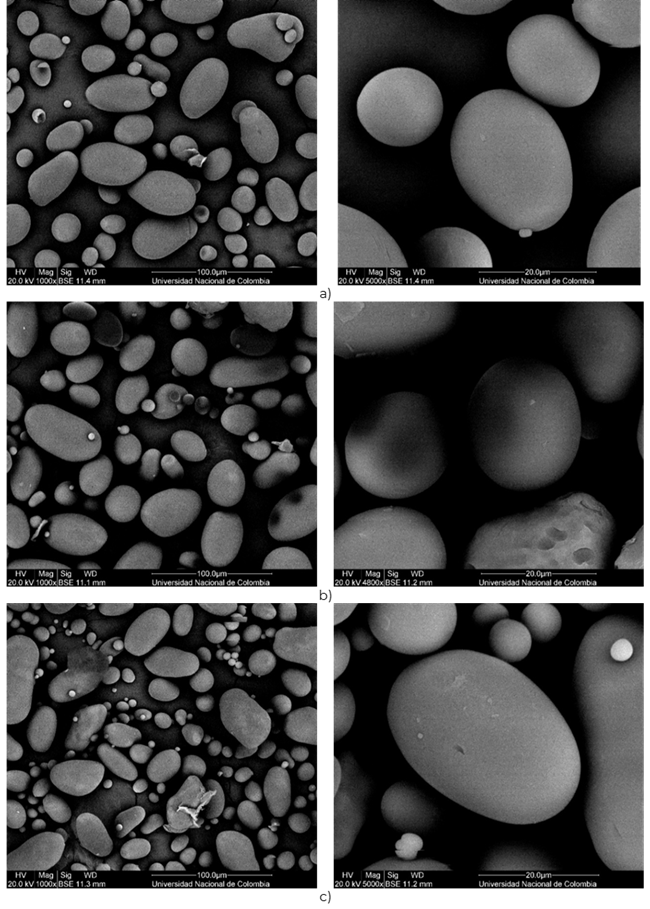
a) DCS, b) RRS and c) CQS
Source: own elaboration.
Potato starch has a wide granule size distribution depending on the variety, but also on the previous conditioning processes; diameters between 12 µm to 72 µm have been reported for starch granules isolated from native potatoes from Peru
The granule size of the native potato starches was relatively small due to the sieving processes, the main disadvantage of obtaining a small granule size lies in the energy requirements for its disintegration, since a smaller size indicates greater thermal stability
3.3 Pasting properties
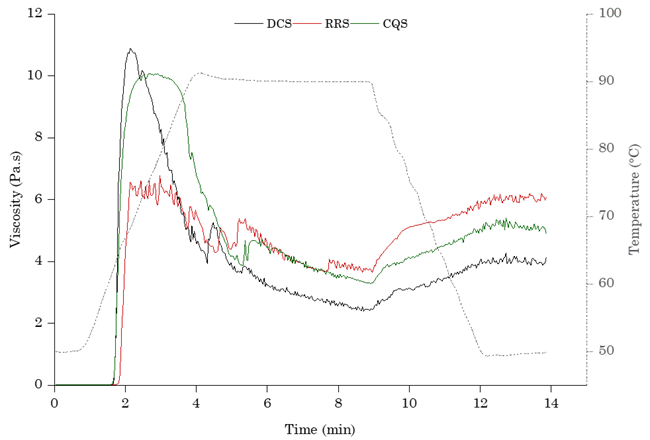
The analysis of the starches from the three potato varieties is presented in Figure 2. The PT was 63.9 °C; 64.5 °C and 66.6 °C for the DCS, CQS and RRS varieties, respectively. PT may vary depending on other components in the starch, according to
Source: own elaboration.
A higher amylose content tends to generate a lower MV, since amylose tends to interact with lipids forming complexes that reduce granule swelling
The RV was 8.46 Pa.s; 6.78 Pa.s and 3.05 Pa.s for DCS, CQS and RRS, respectively. The SV was 0.68; 5.19 and 6.96 for the RRS, CQS and DCS varieties. According to
The FV was higher for RRS (6.08 Pa.s), followed by CQS (4.89 Pa.s) and the lowest was for DCS (3.94 Pa.s); FV refers to the capacity of starch to form viscous pastes, a positive correlation between amylose content and FV has been reported
3.4 Functional properties
Table 2 presents the results of the functional properties Water Absorption Index (WAI), Water Solubility Index (WSI) and Swelling Power (SP) of two native potato varieties: RRS and CQS and the commercial variety DCS at different evaluation temperatures 60, 70, 80, 90 °C (see Table 2).
and Swelling Power (SP) of different starches from potato varieties*
Source: own elaboration.
| Functional properties | Evaluation temperature | Type of starch | ||
| DCS | RRS | CQS | ||
| WAI (g of water/g of starch) | 60 | 10.46 ± 0.83 b | 8.83 ± 0.26 a | 11.21 ± 0.81 c |
| 70 | 14.29 ± 0.65 c | 11.63 ± 0.25 a | 13.51 ± 0.81 b | |
| 80 | 15.50 ± 0.33 c | 12.70 ± 0.44 a | 14.82 ±0.67 b | |
| 90 | 16.64 ± 0.96 b | 15.48 ± 0.40 a | 16.66 ± 1.12 b | |
| WSI (g of soluble starch/g of starch - %) | 60 | 0.68 ± 0.05 b | 0.22 ± 0.03 a | 0.66 ± 0.07 b |
| 70 | 1.19 ± 0.10 b | 0.59 ± 0.07 a | 1.09 ± 0.13 b | |
| 80 | 1.65 ± 0.23 b | 1.23 ± 0.17 a | 1.40 ± 0.13 a | |
| 90 | 1.62 ± 0.20 b | 2.42 ± 0.24 c | 1.42 ± 0.09 a | |
| SP (g of gel/g of hydrated starch) | 60 | 10.78 ± 1.00 b | 8.69 ± 0.35 a | 11.28 ± 0.80 b |
| 70 | 14.46 ± 0.34 c | 11.59 ± 0.48 a | 13.64 ± 0.79 b | |
| 80 | 16.07 ± 0.35 c | 12.85 ± 0.46 a | 15.17 ± 0.59 b | |
| 90 | 16.93 ± 0.96 b | 15.85 ± 0.43 a | 16.89 ± 1.17 b | |
WAI and SP are characteristics that indicate the capacity of the starch granule to hydrate and incorporate water into its molecular structure, while WSI indicates the fraction of starch soluble in water; these properties are directly related to its structure, size and composition. The results indicate that these functional properties tend to increase proportionally with temperature, for any potato starch variety. This behavior coincides with that reported in other studies
The crystalline structure of starch granules is altered when they are hydrated and subjected to high temperatures, water molecules form bonds with the exposed hydroxyl groups of amylose and the side chains of amylopectin, the increase in temperature weakens the internal associative forces that maintain the granular structure of native starches, facilitating hydration and swelling, thus the capacity of starch granules to retain water is influenced by amylose content, at lower amylose content a higher swelling power is exhibited
Granule size can also influence the swelling power of starches. Small granule sizes tend to have a greater surface area and therefore faster and greater hydration
The results of the functional properties are within the ranges reported by other authors:
The functional indices are closely related to the amylographic behavior obtained for the potato varieties, in the production of starch-based sheets it is important to have low solubility indices, while at the same time an intermediate water absorption and swelling capacity that allow amylose release during gelatinization and water release during drying.
3.5 Thermal properties
In the thermogravimetric analysis shown in Figure 3, two degradation stages are observed for the three starches evaluated, the first corresponds to water evaporation and the second to depolymerization. Water evaporation was 14.19% (139.76 °C); 13.08% (111.27 °C) and 9.96% (131.44 °C) for RRS, DCS and CQS, respectively. Depolymerization was 64.13% (319.41 °C), 65.84% (322.01 °C) and 67.58% (331.45 °C) for DCS, RRS and CQS, respectively. The residual mass was 22.79; 22.47 and 19.97% for DCS, CQS, RRS starch, respectively.
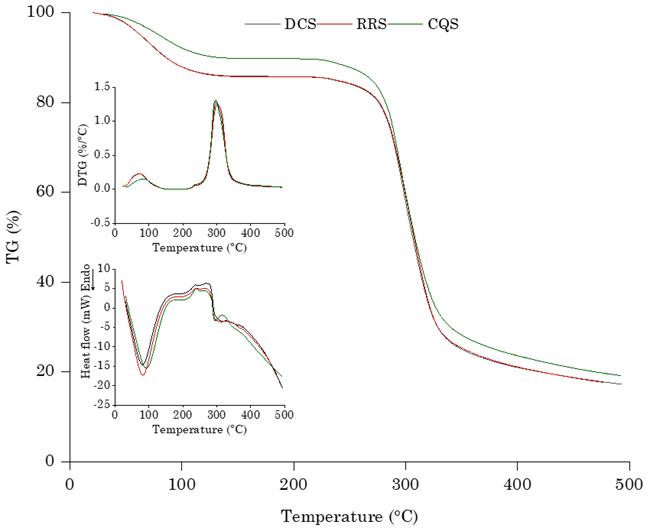
of starches from different potato varieties DCS, RRS, CQS
Source: own elaboration. Source: Own work
The differential scanning calorimetry analysis shown in Figure 3, corresponds to an endothermic process, that is, heat energy is required for gelatinization, it is observed that Tp was 80.44; 81.68 and 91.87 °C for DCS, RRS and CQS, respectively. Tp indicates the maximum temperature at which the polysaccharide gelatinizes and the amylose content is completely released from the starch granule into the aqueous medium, this can generate interactions with other compounds, such as lipids and proteins favorable to film formation.
Higher Tp indicated greater thermal stability
In the DTG curve shown in Figure 3, it is observed that Tmax was 295.64 °C; 298.15 °C and 301.71 °C for CQS, DCS and RRS starch, respectively; these results indicate that the polymers are possibly resistant to thermal processes such as extrusion for manufacturing packaging at industrial scale.
3.6 Mechanical properties of films based on native and commercial potato starches
The results of the mechanical evaluation of films made from RRS and CQS as native varieties and DCS as a commercial variety are presented in Table 3. The films did not show any variation in moisture content (M.B) between 10.80 ± 0.76; 10.72 ± 0.79 and 10.82 ± 0.83% (n = 9, P-value = 0.964) for DCS, RRS and CQS varieties, respectively.
and thickness (mm) of films based on potato starches from different varieties
Source: own elaboration.
| Functional properties | Evaluation temperature | Type of starch | ||
| DCS | RRS | CQS | ||
| WAI (g of water/g of starch) | 60 | 10.46 ± 0.83 b | 8.83 ± 0.26 a | 11.21 ± 0.81 c |
| 70 | 14.29 ± 0.65 c | 11.63 ± 0.25 a | 13.51 ± 0.81 b | |
| 80 | 15.50 ± 0.33 c | 12.70 ± 0.44 a | 14.82 ±0.67 b | |
| 90 | 16.64 ± 0.96 b | 15.48 ± 0.40 a | 16.66 ± 1.12 b | |
| WSI (g of soluble starch/g of starch - %) | 60 | 0.68 ± 0.05 b | 0.22 ± 0.03 a | 0.66 ± 0.07 b |
| 70 | 1.19 ± 0.10 b | 0.59 ± 0.07 a | 1.09 ± 0.13 b | |
| 80 | 1.65 ± 0.23 b | 1.23 ± 0.17 a | 1.40 ± 0.13 a | |
| 90 | 1.62 ± 0.20 b | 2.42 ± 0.24 c | 1.42 ± 0.09 a | |
| SP (g of gel/g of hydrated starch) | 60 | 10.78 ± 1.00 b | 8.69 ± 0.35 a | 11.28 ± 0.80 b |
| 70 | 14.46 ± 0.34 c | 11.59 ± 0.48 a | 13.64 ± 0.79 b | |
| 80 | 16.07 ± 0.35 c | 12.85 ± 0.46 a | 15.17 ± 0.59 b | |
| 90 | 16.93 ± 0.96 b | 15.85 ± 0.43 a | 16.89 ± 1.17 b | |
Films produced with RRS starch presented greater elongation (%) and Young’s modulus (MPa), with statistically significant differences compared with films produced with CQS and DCS starch. The highest tensile strength (MPa) was obtained by films produced with DCS starch.
The film-forming capacity of starches is directly related to amylose and amylopectin content. The composition of these components can influence the properties of starch-based films, films with higher amylose content usually have better mechanical strength characteristics
Amylose-rich starches are characterized by their high gelling capacity
Other authors have produced films with starches from different sources comparing their mechanical strength:
The mechanical results indicate that films produced with RRS and DCS starches, which contain a higher percentage of amylose, have better mechanical behavior. The low swelling power and low maximum viscosity of RRS starch may influence the production of films with higher elastic modulus. The smaller granule size in CQS starch generated greater thickness that reduces tensile strength and therefore Young’s modulus. In general, potato starch can be used for the production of bioplastics with similar or improved mechanical properties compared with other starch sources
4. CONCLUSIONS
The characteristics of native potato starches RRS and CQS and commercial potato starch DCS presented different characteristics that may affect the production of biodegradable films. The pasting profile, functional properties and thermal properties may be related to amylose content and granule size. DCS and RRS potato starches presented statistically higher amylose content and granule size, compared with CQS potato starch, a smaller granule size provides greater thermal stability. RRS starch had low Water Absorption Index (WAI) and Swelling Power (SP), that is, the hydration and swelling capacity of the granule is reduced during the gelatinization process, in addition this starch presents a high Water Solubility Index (WSI) especially at 90°C. The low maximum viscosity MV of RRS starch may be due to the high amylose content, the final viscosity FV of RRS potato starch may alter drying and allow obtaining mechanically more resistant sheets. The mechanical properties of films produced with RRS potato starch presented greater elongation at maximum force (%) and Young’s modulus (MPa), this starch may be an alternative biopolymer for the production of biodegradable materials that are resistant with adequate flexibility as food packaging material, however its functionality is conditioned by the resistance capacity to contact with water and permeability to water vapor and other gases, for which we suggest starch modification or the addition of compounds that increase the hydrophobicity of the biopolymer.
5. ACKNOWLEDGMENTS
We would like to thank the Ministerio de Ciencia, Tecnología e Innovación (Colombia) and the Gobernación de Nariño for funding this research through the project “Desarrollo y evaluación de recubrimientos comestibles y biopelículas activas adaptables a empaques para prolongar la vida útil de frutas andinas: lulo (Solanum quitoense) y uchuva (Physalis peruviana L.) producidas en el departamento de Nariño”. Thanks to the CEIBA Foundation “Centro de Estudios Interdisciplinarios Básicos y Aplicados” for the program, which, through the “Formación de Talento Humano de alto Nivel para el fortalecimiento de necesidades estratégicas de CTeI del departamento de Nariño” enabled the development of doctoral PhD studies.
REFERENCES
- arrow_upward [1] N. Altamar Pérez, “Cundinamarca, Boyacá, Nariño y Antioquia, representan 90% de la producción de papa,” Agronegocios.co, May. 09, 2023. Accessed: Mar. 27, 2026. [Online]. Available: https://www.agronegocios.co/agricultura/cundinamarca-boyaca-narino-y-antioquia-representan-90-de-la-produccion-de-papa-3611353#
- arrow_upward [2] Federación Colombiana de Productores de Papa, and Fondo Nacional de Fomento de la Papa, “En el mercado nacional: Valor de la producción de la papa destinada a mercados mayoristas ascendió a $1,8 billones en el 2023”, Boletín Quincenal vol. 9, no. 185, Jan. 2024. Accessed: May. 3, 2026. [Online]. Available: https://fedepapa.com/home/wp-content/uploads/2024/10/Boletin-185.pdf
- arrow_upward [3] D. F. Mejía-España, D. Trejo Escobar, L. Latorre Vásquez, L. Córdoba Solarte, and L. F. Valencia, Características Agroindustriales de 32 variedades de papas nativas de Nariño, Pasto, Colombia: Editorial Universidad de Nariño, 2017. http://sired.udenar.edu.co/id/eprint/7560
- arrow_upward [4] P. Martínez, A. Málaga, I. Betalleluz, A. Ibarz, and C. Velezmoro, “Caracterización funcional de almidones nativos obtenidos de papas (Solanum phureja) nativas peruanas,” Sci. agropecu., vol. 6, no. 4, pp. 291-301, Dec. 2015. https://doi.org/10.17268/sci.agropecu.2015.04.06
- arrow_upward [5] D. M. Chaves-Morillo, and D. F. Mejía-España, “Physicochemical and Technofunctional Comparison of Starch from Varieties of Native Potato (Solanum phureja) with Commercial Starches,” TecnoL., vol. 26, no. 56, p. e2455, Dec. 2022. https://doi.org/10.22430/22565337.2455
- arrow_upward [6] A. F. Vera Bravo, and M. A. Chavarría Chavarría, “Extracción y caracterización del almidón de papa (Solanum tuberosum) variedad leona blanca,” Rev. Cienc. Tecnol. Higo, vol. 10, no. 2, pp. 26-34, Dec. 2020. https://doi.org/10.5377/elhigo.v10i2.10550
- arrow_upward [7] Z. Pilevar, A. Bahrami, S. Beikzadeh, H. Hosseini, and S. M. Jafari, “Migration of styrene monomer from polystyrene packaging materials into foods: Characterization and safety evaluation,” Trends Food Sci. Technol., vol. 91, pp. 248-261, Sep. 2019. https://doi.org/10.1016/j.tifs.2019.07.020
- arrow_upward [8] S. Agarwal, “Major factors affecting the characteristics of starch based biopolymer films,” Eur. Polym. J., vol. 160, p. 110788, Nov. 2021. https://doi.org/10.1016/j.eurpolymj.2021.110788
- arrow_upward [9] A. B. Lara-Gómez, R. Y. Aguirre-Loredo, J. Castro-Rosas, E. Rangel-Vargas, M. Hernández-Juárez, and C. A. Gómez-Aldapa, “Películas de almidón de papa (Solanum tuberosum L.), empaques innovadores para alimentos: una revisión,” Pädi Boletín Científico De Ciencias Básicas E Ingenierías Del ICBI, vol. 10, no. 19, pp. 11-22, Jul. 2022. https://doi.org/10.29057/icbi.v10i19.8965
- arrow_upward [10] J. Garavito, C. P. Peña-Venegas, and D. A. Castellanos, “Production of Starch-Based Flexible Food Packaging in Developing Countries: Analysis of the Processes, Challenges, and Requirements,” Foods, vol. 13, no. 24, p. 4096, Dec. 2024. https://doi.org/10.3390/foods13244096
- arrow_upward [11] Y. I. Cornejo-Ramírez, O. Martínez-Cruz, C. L. Del Toro-Sánchez, F. J. Wong-Corral, J. Borboa-Flores, and F. J. Cinco-Moroyoqui, “The structural characteristics of starches and their functional properties,” CYTA – J. Food, vol. 16, no. 1, pp. 1003-1017, Jan. 2018. https://doi.org/10.1080/19476337.2018.1518343
- arrow_upward [12] C. Pico, J. De la Vega, I. Tubón, M. Arancibia, and S. Casado, “Nanoscopic characterization of starch biofilms extracted from the andean tubers Ullucus tuberosus, Tropaeolum tuberosum, Oxalis tuberosa, and Solanum tuberosum,” Polymers, vol. 14, no. 19, p. 4116, Oct. 2022. https://doi.org/10.3390/polym14194116
- arrow_upward [13] A. Amobonye, J. Bendoraitiene, L. Peciulyte, and R. Rutkaite, “Review of recent advancements in starch modification: Improving the functionality of starch-based films,” Int. J. Biol. Macromol., vol. 315, no. Pt 2, p. 144354. Jun. 2025. https://doi.org/10.1016/j.ijbiomac.2025.144354
- arrow_upward [14] D. Choque-Quispe et al., “Physicochemical and technofunctional properties of high Andean native potato starch,” J. Agric. Food Res., vol. 15, p. 100955, Jan. 2024. https://doi.org/10.1016/j.jafr.2023.100955
- arrow_upward [15] A. Mojo-Quisani et al., “Physicochemical properties of starch of four varieties of native potatoes,” Heliyon, vol. 10, no. 16, p. e35809, Aug. 2024. https://doi.org//10.1016/j.heliyon.2024.e35809
- arrow_upward [16] I. Y. Choquetico Iquiapaza, J. Peralta Medrano, G. J. Aguilar, and D. R. Tapia-Blácido, “Novel Starchy Materials Isolated from Andean Native Potatoes: Physical–Chemical and Functional Characterization and Application in Edible Film Production,” Starch, vol. 75, no. 9-10, p. 2200143, Sep. 2023. https://doi.org/10.1002/star.202200143
- arrow_upward [17] A. Barandiaran et al., “Development and characterization of edible films based on starch isolated from different Colombian potato varieties,” Int. J. Biol. Macromol., vol. 263, no. Pt 1, p. 130165, Apr. 2024. https://doi.org/10.1016/j.ijbiomac.2024.130165
- arrow_upward [18] S. Balet, A. Guelpa, G. Fox, and M. Manley, “Rapid Visco Analyser (RVA) as a Tool for Measuring Starch-Related Physiochemical Properties in Cereals: a Review,” Food Anal. Methods, vol. 12, no. 10, pp. 2344-2360, Oct. 2019. https://doi.org/10.1007/s12161-019-01581-w
- arrow_upward [19] C. Leites Luchese, P. Benelli, J. Corralo Spada, and I. C. Tessaro, “Impact of the starch source on the physicochemical properties and biodegradability of different starch-based films,” J. Appl. Polym. Sci., vol. 135, no. 33, p. 46564, Sep. 2018. https://doi.org/10.1002/app.46564
- arrow_upward [20] D. Domene-López, J. C. García-Quesada, I. Martin-Gullon, and M. G. Montalbán, “Influence of starch composition and molecular weight on physicochemical properties of biodegradable films,” Polymers, vol. 11, no. 7, p. 1084, Jun. 2019. https://doi.org/10.3390/polym11071084
- arrow_upward [21] Test Method for Tensile Properties of Thin Plastic Sheeting, ASTM D882-18, Advancing Standars Transforming Markets, ASTM International, West Conshohocken, PA, United States, 2016. [Online]. Available: https://doi.org/10.1520/D0882-18
- arrow_upward [22] O. M. Luque-Vilca, N. B. Pampa-Quispe, A. Pumacahua-Ramos, S. Pilco-Quesada, D. J. Cabel Moscoso, and T. J. Choque-Rivera, “Structural, Thermal, Rheological, and Morphological Characterization of the Starches of Sweet and Bitter Native Potatoes Grown in the Andean Region,” Polymers, vol. 15, no. 22, p. 4417, Nov. 2023. https://doi.org/10.3390/polym15224417
- arrow_upward [23] A. Nawaz et al., “Effect of peeling and unpeeling on yield, chemical structure, morphology and pasting properties of starch extracted from three diverse potato cultivars of Pakistan,” Int. J. Food Sci. Technol., vol. 55, no. 6, pp. 2344-2351, Jun. 2020. https://doi.org//10.1111/ijfs.14412
- arrow_upward [24] Y. Yu et al., “Physicochemical Properties and Molecular Structure of Starches from Potato Cultivars of Different Tuber Colors,” Starch, vol. 74, no. 11-12, p. 2200096, Nov. 2022. https://doi.org/10.1002/star.202200096
- arrow_upward [25] P. Martínez, F. Peña, L. A. Bello-Pérez, C. Núñez-Santiago, H. Yee-Madeira, and C. Velezmoro, “Physicochemical, functional and morphological characterization of starches isolated from three native potatoes of the Andean region,” Food Chem. X, vol. 2, p. 100030, Jun. 2019. https://doi.org/10.1016/j.fochx.2019.100030
- arrow_upward [26] P. Martínez et al., “Characterization of starches obtained from several native potato varieties grown in Cusco (Peru),” J. Food Sci., vol. 86, no. 3, pp. 907-914, Mar. 2021. https://doi.org/10.1111/1750-3841.15650
- arrow_upward [27] X. Xie et al., “Physicochemical properties of different size fractions of potato starch cultivated in Highland China,” Int. J. Biol. Macromol., vol. 256, no. Pt 1, p. 128065, Nov. 2024. https://doi.org/10.1016/j.ijbiomac.2023.128065
- arrow_upward [28] T. P. R. dos Santos, M. Leonel, É. L. Garcia, E. L. do Carmo, and C. M. L. Franco, “Crystallinity, thermal and pasting properties of starches from different potato cultivars grown in Brazil,” Int. J. Biol. Macromol., vol. 82, pp. 144-149, Jan. 2016. https://doi.org/10.1016/j.ijbiomac.2015.10.091
- arrow_upward [29] Á. Arrieta Almario, L. Durango, and E. Arizal, “Estudio de las propiedades absorbentes de un biopolímero a base de almidón de yuca (Manihot esculenta Crantz),” Rev. Espacios, vol. 39, no. 53, 2018. https://www.revistaespacios.com/cited2017/cited2017-15.pdf
- arrow_upward [30] J. Martínez, J. Hernández, and A. Arias, “Propiedades fisicoquímicas y funcionales del almidón de arroz (Oryza sativa L) blanco e integral,” Alim. Hoy, vol. 25, no. 41, pp. 15-30, Aug. 2017. https://alimentoshoy.acta.org.co/index.php/hoy/article/view/446
- arrow_upward [31] J. Waterschoot, S. V. Gomand, and J. A. Delcour, “Impact of swelling power and granule size on pasting of blends of potato, waxy rice and maize starches,” Food Hydrocoll., vol. 52, pp. 69-77, Jan. 2016. https://doi.org/10.1016/j.foodhyd.2015.06.012
- arrow_upward[32] A. Karnwal et al., “Advanced starch-based films for food packaging: Innovations in sustainability and functional properties,” Food Chem. X, vol. 29, p. 102662, Jul. 2025. https://doi.org/10.1016/j.fochx.2025.102662
- arrow_upward [33] R. Thakur, P. Pristijono, C. J. Scarlett, M. Bowyer, S. P. Singh, and Q. V. Vuong, “Starch-based films: Major factors affecting their properties,” Int. J. Biol. Macromol., vol. 132, pp. 1079-1089, Jul. 2019. https://doi.org/10.1016/j.ijbiomac.2019.03.190
- arrow_upward [34] M. Faisal, T. Kou, Y. Zhong, and A. Blennow, “High Amylose-Based Bio Composites: Structures, Functions and Applications,” Polymers., vol. 14, no. 6, Mar. 2022. https://doi.org/10.3390/polym14061235
- arrow_upward [35] I. E. Rohima, M. Djali, Y. Cahyana, J. S. Hamdani, M. N. Lani, and R. Triani, “Physicochemical and functional properties of modified potato starch from different altitudes: a study of the medians cultivar,” Discover Food, vol. 5, no. 32, Feb. 2025. https://doi.org/10.1007/s44187-025-00283-z
- arrow_upward [36] A. A. M. Rodrigues, R. R. da Costa, L. F. dos Santos, S. de M. Silva, D. de Britto, and M. A. C. de Lima, “Properties and characterization of biodegradable films obtained from different starch sources,” Food Sci. Technol., vol. 41, no. 2, pp. 476-482, Dec. 2021. https://doi.org/10.1590/fst.28520
- arrow_upward [37] T. Zhou, L. Zhang, Q. Liu, W. Liu, and H. Hu, “Rheological behaviors and physicochemical changes of doughs reconstituted from potato starch with different sizes and gluten,” Food Res. Int., vol. 145, p. 110397, Jul. 2021. https://doi.org/10.1016/j.foodres.2021.110397
- arrow_upward [38] J. H. Dupuis, and Q. Liu, “Potato Starch: a Review of Physicochemical, Functional and Nutritional Properties,” Am. J. Potato Res., vol. 96, no. 2, pp. 127-138, Apr. 2019. https://doi.org/10.1007/s12230-018-09696-2
- arrow_upward[39] S. C. Alcázar-Alay, and M. A. A. Meireles, “Physicochemical properties, modifications and applications of starches from different botanical sources,” Food Sci. Technol., vol. 35, no. 2, pp. 215-236, Apr.-Jun. 2015. https://doi.org/10.1590/1678-457X.6749
- arrow_upward [40] C. V. Vélez Martínez, X. S. Zambrano Murillo, M. H. Delgado Demera, G. A. Burgos Briones, and C. A. Cedeño Palacios, “Almidones de cáscara de yuca (Manihot esculeta) y papa (Solanum tuberosum) para producción de bioplásticos: propiedades mecánicas y efecto gelatinizante,” Rev. Bases Cienc., vol. 6, no. 2, pp. 137-152, May.-Aug. 2021. https://doi.org/10.33936/rev_bas_de_la_ciencia.v6i2.3293
CONFLICTS OF INTEREST
The authors declare that they have no conflict of interest.
AUTHOR CONTRIBUTIONS
David Fernando López Enríquez:Conceptualization, Design, Research development, Writing, and Final revision of the manuscript.
Ana Jilary Yamá Hernández: Research development and final revision of the manuscript.
Angie Figueroa Benavides: Research development and final revision of the manuscript.
Leandro Bravo: Conceptualization, Design, Research development, Writing, and final revision of the manuscript.
Oswaldo Osorio: Conceptualization, Design, and Final revision of the manuscript.
Alfredo Ayala: Conceptualization, Design, and Final revision of the manuscript.

 Google