Disguising Exploitation. Immigrants in the Ecuadorian Gig Economy*
Disfrazando la explotación. Inmigrantes en la economía de plataformas ecuatoriana
Received: January 24, 2023
Accepted: May 04, 2023
Albornoz, M. B., & Chavez, H. (2023). Disguising Exploitation. Immigrants in the Ecuadorian Gig Economy. Trilogía Ciencia Tecnología Sociedad, 15(30), e2639 https://doi.org/10.22430/21457778.2639
Abstract
Ecuador is home to approximately 556,000 immigrants, mostly from Venezuela (65%) and Colombia (25%), many of whom have an irregular immigration status. In Ecuador, an immigrant without a visa cannot work, which creates a scenario that favours abuse by employers and hinders immigrants’ ability to organize and negotiate their rights. Part of this population has found the platform economy to be a flexible way to find work and earn an income quickly. However, this has also given rise to new forms of exploitation. The objective of this article is to analyse the relationship between the development of the platform economy in Ecuador and the labour conditions of the migrant population that has entered the country in recent years. We used a qualitative methodology based on direct observation, semi-structured interviews (46) and in-depth interviews (10). The main results of this research show that the development of the platform economy and the lack of adequate legislation have produced new forms of disguised exploitation, particularly of immigrant workers. These new forms of exploitation operate through a black market of profile and vehicle subcontracting which, in their interaction with the algorithmic management systems of these applications, end up worsening the already precarious working conditions of the migrant population that uses these applications as a means of survival. The article concludes with a brief analysis of these working conditions in relation to the five principles of fair work.
Keywords: Algorithmic management, fair work, gig economy, immigrant workers-Ecuador, informal subcontracting.
Resumen
En Ecuador viven aproximadamente 556.000 inmigrantes, la mayoría procedentes de Venezuela (65%) y Colombia (25%), muchos de los cuales viven en situación migratoria irregular. En dicho país, un inmigrante sin visado no puede trabajar, lo que crea un escenario propicio para el abuso por parte de los empleadores y dificulta la capacidad de los inmigrantes para organizarse y negociar sus derechos. Parte de esta población ha encontrado en la economía de plataformas una forma flexible de acceder a un trabajo y obtener un ingreso rápidamente. Sin embargo, esto ha dado lugar también a nuevas formas de explotación. El objetivo de este artículo es analizar la relación entre el desarrollo de la economía de plataformas en Ecuador y las condiciones laborales de la población migrante que ha ingresado al país en los últimos años. Utilizamos una metodología cualitativa basada en observación directa, entrevistas semi estructuradas (46) y en profundidad (10). Los principales resultados de esta investigación muestran que el desarrollo de la economía de plataformas y la falta de legislación adecuada dan lugar a nuevas formas de explotación encubierta, particularmente de trabajadores inmigrantes. Estas nuevas formas de explotación operan a través de un mercado negro de subalquiler de perfiles y vehículos que, en su interacción con los sistemas de gestión algorítmica de estas aplicaciones, terminan empeorando las ya precarias condiciones laborales de la población migrante que usa estas aplicaciones como medio de supervivencia. El artículo concluye haciendo un breve análisis de estas condiciones laborales en relación con los cinco principios del trabajo justo.
Palabras clave: gestión algorítmica, trabajo justo, economía de plataformas, trabajadores inmigrantes-Ecuador, subcontratación informal.
INTRODUCTION
Migratory inflows and outflows have shaped Latin American societies for centuries. Their direction, volume and intensity have changed according to the political, economic and natural upheavals that have marked local and global history (
However, the so-called subprime crisis in 2008 marked a turning point in this process (
During the last decade, Ecuador has received more than 630,000 migrants. Most of them have come from Venezuela (58%), Colombia (22%), Peru (8%) and Cuba (7%). Even when Ecuador’s appeal began to diminish after 2015, the intensification of the negative conditions in neighbouring countries (i.e., Colombia’s internal war and Venezuela’s political and economic crisis) maintained the migrant inflow until the end of the decade. The COVID-19 pandemic marked a new breaking point in 2020: about 75,000 immigrants left the country in that year (see Figure 1).
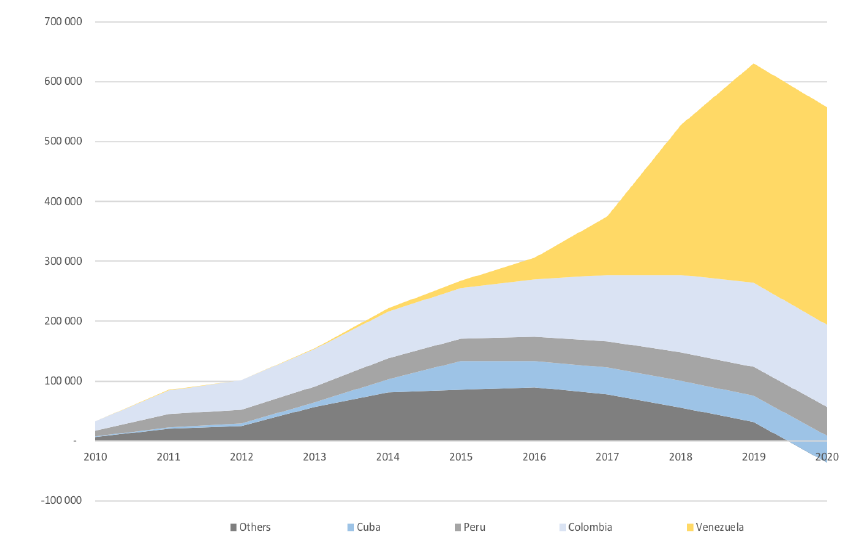
The first waves of Colombians, Cubans and Peruvians who settled in Ecuador until 2015 benefited from the momentum of a growing economy, the expansion of the local middle class and new job opportunities. This was not so for the Venezuelans who arrived in the last five years, fleeing their country in the aftermath of an economic and political crisis triggered by a decline in oil prices and the repressive reaction of its ruling authoritarian regime
This process converged with the arrival in the country of several transnational platforms of the so-called “gig economy”. In such conditions, these platforms became a lifeline for many immigrants and their families, as they offer easy and quick access to daily income. Thus, as immigration consolidated in the country, gig economy platforms were strengthened through the recruitment of foreign workers. However, this convergence is not as convenient as it seems. It hides the existence of a shadow market of profiles that allow immigrants to circumvent the legal or algorithmic limitations imposed on them by the Ecuadorian government or the platforms, and, at the same time, it allows the latter to continue running their businesses in a grey area. This paper aims to unveil the structures of exploitation of immigrant workers created by these legal barriers, informal subcontracting practices and the platforms’ algorithmic management systems.
Therefore, this paper seeks to contribute to the ongoing discussions on the intersection of the gig economy (
METHODOLOGY
This research started with a review of documents and previous studies on immigration in Ecuador, legal opportunities and barriers, mobility, the gig economy, fair work and algorithmic management. Considering these previous works, we decided to use a qualitative approached based on interviews (with platform workers and managers) and ethnographic observation, as follows:
- From March to December 2020, we conducted 46 semi-structured interviews with workers (from six different platforms) and five platform managers.
- In January 2021, we conducted 10 in-depth interviews with workers to complement the literature review.
Workers were contacted either directly through the platform or at well-known worker meeting points. The 2021 in-depth interviews with workers were carried out with the assistance of a Venezuelan Rappi worker who contacted workers on four other platforms: Glovo, Uber Eats, Cabify and Uber.
The worker sample had the following characteristics:
The data analysis considered their nationality, gender, education level, platforms, profile subcontracting, main risks, insurance, contract status, income, and working hours.
In this study, we place particular emphasis on the interviews conducted with immigrants, which constitute 50% of the sample. These interviews provide valuable insights into the experiences and perspectives of immigrant workers in the context of platform employment. Interestingly, our in-depth interviews revealed a noticeable trend among the immigrant participants: a significant proportion of them reported using rented profiles on the platforms they worked for. This finding shed light on the complex strategies employed by migrant workers to navigate the challenges and uncertainties of the gig economy. By uncovering the prevalence of a black market of profiles among migrants, our research underscores the need for further investigation into the motivations and implications of such practices within the platform ecosystem.
Migration, Unemployment, and the Gig Economy in Ecuador
The difficulty immigrants have in finding formal job opportunities is certainly related to their immigration status, but it is also a consequence of a shrinking labour market. Unemployment and informality are structural characteristics of the Ecuadorian economy. Both conditions expose migrants to exploitation and abuse.
The Ecuadorian economy is highly dependent on extractive activities and commodities (
Around the same time, companies such as Cabify, Uber, UberEats, Glovo and Rappi started operations in Ecuador. Under adverse economic conditions, the arrival of these online ride-hailing and delivery service platforms became a lifeline, offering relatively easy and quick access to a daily source of revenue for both Ecuadorians losing their jobs and immigrants trying to find one.
These companies are part of the so-called “gig economy” (
This may explain why, in spite of the lack of infrastructure, limited connectivity and relatively weak demand for online services (
There are no official statistics on the number of people working on these applications or the migrant population involved in such activities. Nonetheless, based on data gathered from public declarations, media reports and the interviews conducted for this study, we estimate that, before the pandemic, there were about 40,000 gig workers nationwide, which represented 1% of the under-employed population (
Legal Framework and Immigration Barriers
The year 2008 became a turning point in Ecuador’s immigration policies. A new Constitution was enacted, the Union of South American Nations (UNASUR in Spanish) was created and the MERCOSUR Agreement regarding travel documents brought about a shift in legal principles and a new sense of identity and nationality in the region.
The 2008 Ecuadorian Constitution introduced the principle of universal citizenship as a new paradigm that sought free human mobility without borders, establishing that no person could be considered illegal because of his or her immigration status. For over ten years, this provision opened the door for Latin American citizens to apply for Ecuadorian nationality (
UNASUR—created with the signing of its Constitutive Treaty in Brasilia by twelve countries
Finally, to consolidate the regional integration process and deepen relations between countries, MERCOSUR Members and Associate Member States
Derived from these principles of universal and South American citizenship, the Ecuadorian Congress enacted the Human Mobility Law in February 2017, which established several types of naturalisation processes to acquire Ecuadorian nationality. However, in August 2018, contrary to the MERCOSUR agreement, the Ecuadorian government announced that all persons entering Ecuador must present their passport (
In July 2019, the then President of Ecuador, Lenín Moreno, issued Executive Order 826 (
To find a job in Ecuador, Venezuelan citizens must have a temporary or permanent resident visa. These visas allow Venezuelans to apply for an Ecuadorian ID card. Thus far, a total of 195,560 visas have been granted to Venezuelan citizens: 128,617 issued up to August 2019 and 67,333 while Executive Order was in force (
Between 2015 and 2019, Peru and Ecuador shifted their position from facilitating the entry and regularisation of the migrant population to a border closure in mid-2019. By drastically slowing down the movement of the migrant population through border checkpoints, both governments increased the number of illegal crossings and human trafficking (
Even though Article 11.2 of the Ecuadorian Constitution grants equal rights to all, including non-citizens, this principle is not always put into practice in real life (
Structured Practices of Informal Subcontracting
There are no official data about the composition or main characteristics of the Venezuelan population in Ecuador. Nonetheless, the studies by
Most immigrant workers interviewed have stated that they knew a friend or family member living in Ecuador who helped them settle in the country. Social capital and network ties were transformed into key resources to gain access to employment (
When delivery and ride-hailing platforms arrived in the country, these activities were not regulated in any way. Therefore, they accepted Venezuelan identity documents to open a worker account, which allowed immigrants to work using their own profiles. However, as the volume of their operations grew, local governments began to push for regulations. Then, the access was restricted for new gig workers, and many immigrants could not apply for a platform account because they did not have any documentation, e.g., a work visa, an Ecuadorian ID card or a driver’s license.
As a result, immigrants started to use subcontracting to secure job opportunities. Nevertheless, this has structured mechanisms for work exploitation by transferring an entire range of risks from employers to workers, increasing the precariousness and unfairness of their working conditions.
Moreover, most immigrant workers do not have a vehicle to work with. This has opened the door for them to rent one from “investors”.
Once I finished my interview at Cabify’s headquarters, investors were standing on the sidewalk, waiting to hire drivers for their cars. I approached one of them and offered him a work system that he liked. A two-driver schedule: one from 4 a.m. to 4 p.m. and another for the remaining twelve hours. Expenses and profits were split 50/50 (In-depth interview No. 9, personal communication, January 2021).
Cabify had a list of car owners looking for drivers. Workers were free to contact them to bargain working conditions. There were two types of arrangement with them: a fixed weekly amount or 50% of the income. Based on the evidence we have gathered, this fixed weekly amount ranged from USD 75 to 100. Interviewed immigrant workers renting a car declared that they work eleven hours a day and earn approximately USD 200 a week. After paying the car rent, they are left with only 50% of their income, approximately USD 400 a month, which is the minimum wage in Ecuador for an eight-hour workday.
When platforms started to require Ecuadorian driver’s licenses and work permits, immigrant workers were forced to rent driver accounts as well. Now, they must pay for the vehicle, as well as someone else’s platform profile. According to most of the delivery workers we interviewed, those who rent profiles pay between USD 15 and 40 per week. If they rent a profile and a motorbike, they may pay up to USD 50 every week. They reported earning a weekly average of USD 190 per week, and, after deducting subcontracting costs, they can make around USD 560 a month.
And I am working with a rented account because I am not naturalized. I don’t have the identity card. I don’t have the Ecuadorian license […]. I have to pay USD 25 weekly, but you have to pay the USD 25 whether you make the money or not. (In-depth interview No. 5, personal communication, January 2021)
In the pandemic, there was an increase in motorbikes because the only steady job was delivery, but now that the pandemic is not so bad, a lot of people have quit, and that’s what they are doing, renting accounts. (In-depth interview No. 4, personal communication, January 2021)
According to Glovo’s data, 65.5% of its workers are Ecuadorian; and 34.5%, Venezuelan. They make an average of USD 3.6 per hour, and they can choose their own schedule on the platform. This is the only company that has incorporated a subcontracting clause into their terms and conditions for workers, although there is no record of this mechanism ever having been used.
The employment status of platform workers is a controversial issue. Gig workers face a difficult situation regarding labour rights, volatile income, a lack of benefits, job insecurity, and exploitation. According to the platforms, workers are considered autonomous entrepreneurs who manage their own hours and have no boss. Thus, platforms are detached from any employment relationship (
Algorithmic Management and the Daily Life of a Gig Worker: How to Deal with a Toxic Relationship
The following is a common picture of the urban “gig economy”: a group of young men with orange, yellow or green square backpacks beside or on their motorbikes parked next to a shop. They talk and tease one another while checking their smartphones to see whether a new order has been placed. Their voices, way of speaking and gestures are out of tune with the monotony that surrounds them. They reveal their foreign origins. They may bother some xenophobic landlords and shopkeepers who are very happy to make money on their backs but are not willing to offer them even a parking place to wait for the next order. They are five or seven in number. Some of them have been waiting for a while; there have been no orders on their phones. Suddenly, another “motorized” (gig worker) arrives out of nowhere, takes not one but three orders and hits the road. Those who have been waiting for a long time grimace as they check their phones once again. They don’t understand. They think it’s unfair. They want to complain, but they don’t know who to complain to or even if there is someone to complain to. The veterans comfort the newcomers by saying that it is like being in a toxic relationship. Sometimes, “she” (the application) treats you well; sometimes, “she” punishes you and gives you nothing. You never know when, how or why.
Besides the questions that this description might raise from a gender perspective, which deserve a specific analysis beyond the scope of this research—this unpredictable behaviour on the part of “la tóxica” (“the toxic one” in Spanish, as some of the male interviewees refer to the application on their phones) is the manifestation of the embedded algorithms that rule these platforms and, through them, the daily lives of gig workers. Opaque and closed by design, these algorithms are the black boxes managing the platforms. They determine who receives an order, when, how, where, how much it costs and how much everyone in the chain will be paid. They also impose penalties and offer rewards in order to guarantee their supply and increase efficiency and quality of service.
But, sometimes, you arrive at a restaurant, and they take one hour, so you [waste] one hour. But Glovo doesn’t care […] at the end, they [rate] us based on what customers say. If a customer doesn’t like it, they low your score. (In-depth interview No. 8, personal communication, January 2021)
However, the complexity of this kind of global operation creates dissonance on a local scale (
So-called “algorithmic management”—a keystone of the gig economy—has been analysed by several authors. These scholars have focused on the trade-offs between (a) flexibility, autonomy and control and (b) the health and social risks associated with the generalisation of these methods of labour management and the intensification of work (
I didn’t know how this thing work, so I asked to a colleague […] He answered, “But, my friend, you are ‘green!’... Even me, as ‘copper,’ I’m not getting any orders.” So, then, I asked: “What do ‘green’ and ‘copper’ mean […]?” He explained to me that, to get a better score, I could not stay there. Rather, I should move somewhere else. […] I had to pay the profile and the motorbike, so I took his advice and moved around the city the whole day, but it didn’t work either. (In-depth interview No. 4, personal communication, January 2021)
As shown in the example above, there is a black market of profiles and accounts among undocumented immigrants, where the incentives of the algorithmic management system are split between two or more individuals with varying backgrounds and behaviours. Hence, out of an 80-cent ride assigned by the algorithm, the actual worker receives only half that amount or less because intermediaries take the rest. Consequently, immigrant workers face the same algorithmic penalties as regular workers but receive smaller rewards. In other words, the rewards are divided among several people, while the penalties and physical effort are not. This system disproportionately affects undocumented workers, whose daily lives are conditioned by the Pavlovian machine.
Most of the interviewees in this study reported using or having used a rented account. The lack of documents such as passport, driver’s license, local residence permit or work permit is a major barrier that leads these individuals to resort to the black market of profiles. This barrier may be an indirect consequence of local authorities’ attempts to regulate these activities and force platforms to comply with local regulations, which shifts the burden of the problem from the platforms to either local governments or regulations. Nonetheless, other accounts from the same interviewees suggest another possibility. Platforms have been blocking access to new members for several months now, thus fuelling the expansion of the black market. This situation benefits platforms because they can continue to change their terms and conditions, while reducing the rate they pay to workers.
We started by creating our own account, but it was impossible […]. In fact, it has been “in process” since March. It is “in process”… Therefore, we had to rent the profile of a young guy […]. He is a good friend […]. Thanks to him, we have done well. (In-depth interview No. 7, personal communication, January 2021)
The migration variable added a new dimension to the problem of algorithmic management. Specifically, the technological black box exceeds the limits of the platform on which it exists. The grey areas created by migration and failed regulations increase the potential for algorithms to discipline not only those in their databases but also those who are not registered.
Under the Apps, Humans! Behind and Beyond the Algorithms
Over the past two decades, the gig economy has been associated with technological development in several fields, including telecommunication networks, mobile phones, big data processing, artificial intelligence, e-commerce and finance. The opacity of the algorithmic management technologies that power these platforms has created an illusion of a highly automated industry. However, many researchers have demonstrated that most of these new industries based on artificial intelligence and other data-driven technologies still rely heavily on non-automated human labour (
Two stories told by immigrant gig workers during the interviews illustrate how the functioning of platforms in peripheral contexts such as Ecuador still depends on social practices and interactions beyond algorithms. Moreover, these immigrant workers have identified glitches in the algorithms and used them to their advantage.
Despite their contrasting perspectives, platforms and immigrants have something in common: they are newcomers taking a chance in a new land. The former will do whatever it takes to start operations: infrastructure investments, legal procedures and shortcuts, advertising, and political lobbying. The latter, with far fewer resources and greater restrictions, will devote their physical and mental effort to move forward. For most of them, looking back is not even an option.
We came to work. We are concentrated. It also happens in Venezuela. The people who worked there are the immigrants […] We came with a mentality to work because we need to grow […], pay our debts and all that. (In-depth interview No. 3, personal communication, January 2021)
These two different but converging wills explain, to some extent, the large number of immigrant workers on online platforms. They provide an easily accessible source of income and allow people to work “as much as they want”. This is precisely what platforms need: cheap and flexible labour willing to work unlimited hours without demanding the same social benefits as other local workers. Nonetheless, before starting this “synergistic” relationship, most recently arrived platforms had to surmount two barriers: the limited access of immigrant workers to means of production (cars, motorbikes, bicycles and mobiles) and the risks associated with operating in a grey, unregulated or even illegal area. In both cases, platforms have had to switch to “manual” mode and do considerable offline and lobbying work to make their algorithms operate properly.
Cabify’s intermediation practices between drivers and “investors” demonstrate that the first online ride-hailing platforms started operating like any agricultural or building contractor: looking for day labourers on the street. Initially, most of these platforms opened offices to recruit potential candidates and provide them with promotional and training talks. They lobbied and reached informal agreements with workers, investors and authorities. All these offline and in-person steps were crucial for the startup processes of these companies. Once the early adopters were established, the platforms conducted less of these activities. However, they continue to be the basis of the black market of profiles. As mentioned above, this black market introduces a glitch into the algorithmic management system, reducing the actual income immigrant workers receive at the end of the chain.
Furthermore, driven by their needs and hopes, immigrants are all but passive subjects in The Wizard of Oz. Working more than ten hours a day, they follow his rules; they try to comply with his algorithmic management; they even pay for his mistakes; but they also try to understand him, learn from him and, when they can, pull back the curtain and fool him.
When I started, a friend of mine had Cabify, [I live near the airport] so my friend and I set up a sort of “centre” […] We made a virtual queue with several phones and I watched them. The others worked with their cars at the airport […] I accepted all the rides that I could on those phones, and I called them. The first one at the transfer point would open the app on another phone and pick up the passenger. […] I know the applications very well because, since I arrived here, I’ve been working with Uber, Cabify, InDriver, all of them. (In-depth interview No. 1, personal communication, February 2021)
A normal Cabify worker in the city can make up to USD 300 per week. However, once I took a ride to the airport (the platform was just starting), and I received a [booking] from Guayaquil—a client who was coming on a flight from Guayaquil. I understood that I might receive a [service] while outside the airport. We didn’t know that at the moment. The next time I took a ride to the airport, I got another [booking]. We made USD 2.000 per month. (In-depth interview No. 5, personal communication, February 2021)
This act of technological appropriation and reinterpretation, of turning the algorithm to their advantage, shows that workers, particularly immigrants, can resist algorithmic management (
DISCUSSION AND CONCLUSIONS
During the last decade, Ecuador has received over 500,000 immigrants from neighbouring countries, especially Colombia and Venezuela. This inflow can be attributed to attractive factors such as flexible immigration policies and a dollarized economy, as well as to negative conditions in the countries of origin, including war, violence, crime, poverty and political persecution. However, the economic recession and political changes over the past five years have attenuated these attractive factors and created more barriers for immigrants who want to settle in Ecuador and engage in their economic activities.
Within the same period, gig economy platforms have emerged as an accessible work and income-generating option for this migrant population. However, gaps in local regulations and the operation of these platforms have created grey areas where undocumented immigrants can secure work and income, but at a high risk of exploitation and exposure. These grey areas are the result of the subcontracting structure established by the black market of profiles and algorithmic mismanagement.
Examined through the lens of the Fairwork Principles (
Fair pay. Even when the platform pay is higher than the local minimum legal wage, once workers start renting a profile, their income is significantly reduced. Most workers are expected to work over 40 hours per week and pay a significant portion of their earnings to the profile owner. Therefore, immigrant workers are paid less than regular Ecuadorian workers for the same amount of work.
Fair conditions. Unlike most platforms, Glovo maintains accident insurance for their workers. However, it cannot be used by workers with rented profiles, which leaves their well-being and safety at stake, without any protection from the platform.
Fair contracts. Many immigrant workers have no access to contracts because they belong to account owners, which prevents them from having any legal status on the platform. They are invisible and have no legal rights, which places them in a situation of vulnerability and job insecurity.
Fair management. Immigrant workers with rented profiles are exposed to an unbalanced and unfair algorithmic management system, where rewards are shared among various individuals, while penalties are incurred only by the actual workers. They must not only keep a high rating for a profile that is not theirs but also recoup or pay for the losses of other profile users. The existence of a black market of profiles creates subcontracting structures that allow platforms to keep labour prices low without any managerial accountability.
Fair representation. Thus far, platforms have avoided creating collective representation and worker voice mechanisms. Therefore, workers lack the ability to collectively bargain, and their demands continue to be resolved on individual terms. However, if a collective organisation were to be created, subcontracted immigrant workers would not be able to formally join it. Nonetheless, as evidenced by several international protests held in 2020 (
The various forms of technological appropriation, reinterpretation and negotiation within the algorithms behind the platforms can be leveraged to benefit workers.
CONFLICTS OF INTEREST
The authors declare that they have no financial, professional, or personal conflicts of interest that could inappropriately influence the results obtained or the interpretations proposed.
AUTHOR'S CONTRIBUTIONS
Both authors, María Belén Albornoz and Henry Chavez, contributed to the conceptualization, design and research, as well as to the draft and final revision of the manuscript.
FOOTNOTE
- arrow_upward* This paper is the result of the research project entitled “Condiciones laborales en la economía de plataformas de Ecuador” [Work conditions in the platform economy in Ecuador] by CTS-Lab, Facultad Latinoamericana de Ciencias Sociales (FLACSO), Ecuador.
- arrow_upward1 Since the death of President Chávez in 2013, more than 7% of the Venezuelan population has left the country (
Alto Comisionado de las Naciones Unidas para los Refugiados [ACNUR], 2020). - arrow_upward2 Adequate employment means working 40 hours a week for a minimum wage of USD 400 per month, having a formal contract and having social security. Underemployment and informality include the jobs that do not meet all these conditions.
- arrow_upward3 Argentina, Bolivia, Brazil, Chile, Colombia, Ecuador, Guyana, Paraguay, Peru, Surinam, Uruguay, and Venezuela.
- arrow_upward4 Argentina, Brazil, Paraguay, Uruguay, Bolivia, Chile, Colombia, Ecuador, and Venezuela.
REFERENCES
- arrow_upward Acosta, A., & Cajas Guijarro, J. (2018). Una década desperdiciada. Las sombras del correismo. Centro Andino de Acción Popular.
- arrow_upward Acosta Arcarazo, D., & Freier, L. F. (2015). Discursos y políticas de inmigración en Sudamérica ¿Hacia un nuevo paradigma o la confirmación de una retórica sin contenido? REMHU: Revista Interdisciplinar da Mobilidade Humana, 23(44), 171-189. https://doi.org/10.1590/1980-85852503880004411
- arrow_upward Adams-Prassl, J. (2019). What if Your Boss Was an Algorithm? Economic Incentives, Legal Challenges, and the Rise of Artificial Intelligence at Work. Comparative Labor Law & Policy Journal, 41(1), 123-146.
- arrow_upward Albornoz, M. B. (2020). Habitar las redes: las controversias sobre la privacidad en Facebook. FLACSO Ecuador. https://doi.org/10.46546/20209atrio
- arrow_upward Altenried, M. (2020). The platform as factory: Crowdwork and the hidden labour behind artificial intelligence. Capital & Class, 44(2), 145-158. https://doi.org/10.1177/0309816819899410
- arrow_upward Altenried, M. (2023). Platforms, labour, and mobility: migration and the gig economy. In I. Ness (Ed.), The Routledge Handbook of the Gig Economy (pp. 180-190). Routledge.
- arrow_upward Alto Comisionado de las Naciones Unidas para los Refugiados. (2020). Situación en Venezuela. https://www.acnur.org/situacion-en-venezuela.html
- arrow_upward Aruj, R. S. (2008). Causas, consecuencias, efectos e impacto de las migraciones en Latinoamérica. Papeles de Población, 14(55), 95-117. https://rppoblacion.uaemex.mx/article/view/8598
- arrow_upward Basukie, J., Wang, Y., & Li, S. (2020). Big data governance and algorithmic management in sharing economy platforms: A case of ridesharing in emerging markets. Technological Forecasting and Social Change, 161, 120310. https://doi.org/10.1016/j.techfore.2020.120310
- arrow_upward Becerra, J. E. (2019, November 11). Ecuador: Rappi ya cuenta con más de 1.300 repartidores. América Retail. https://www.america-retail.com/peru/ecuador-rappi-ya-cuenta-con-mas-de-1-300-repartidores/
- arrow_upward Bijker, W. E. (1995). Of Bicycles, Bakelites, and Bulbs: Toward a Theory of Sociotechnical Change. MIT Press.
- arrow_upward Blouin, C., & Freier, L. F. (2019). Población venezolana en Lima: entre la regularización y la precariedad. In L. Gandini, F. Lozano Ascencio, & V. Prieto (Coords.), Crisis y migración de población venezolana. Entre la desprotección y la seguridad jurídica en Latinoamérica (pp. 157-184). Universidad Nacional Autónoma de México.
- arrow_upward Bouquin, S. (2020). « Il n’y a pas d’automatisation sans micro-travail humain » Grand entretien avec Antonio A. Casilli. Les Mondes du Travail, (24-25), 3-21. https://hal.science/hal-03001265
- arrow_upward Burchardt, H.-J., Domínguez, R., Larrea, C., & Peters, S. (Eds.). (2016). Nada dura para siempre. Neo-extractivismo tras el boom de las materias primas. Ediciones Abya-Yala.
- arrow_upward Casilli, A. A. (2019). En attendant les robots. Enquête sur le travail du clic. Éditions du Seuil.
- arrow_upward Castles, S., de Haas, H., & Miller, M. J. (2013). The Age of Migration. International Population Movements in the Modern World (5th Ed.). The Guilford Press.
- arrow_upward Castles, S., & Vezzoli, S. (2009). The global economic crisis and migration: temporary interruption or structural change? Paradigmes, (2), 67-75. https://raco.cat/index.php/Paradigmes/article/view/223806
- arrow_upward Célleri, D. (2019). Situación laboral y aporte económico de inmigrantes en el norte de Quito-Ecuador: Una primera aproximación cuantitativa para dialogar sobre política pública. http://library.fes.de/pdf-files/bueros/quito/15204.pdf
- arrow_upward Célleri, D. (2020). Situación laboral y aporte económico de inmigrantes en el centro/sur de Quito-Ecuador. http://www.rosalux.org.ec/pdfs/SituacionLaboralYAporteEconomicoDeInmigrantes.pdf
- arrow_upward Chávez, H., & Cardoso, P. (2010). Migrantes ecuatorianos. Vivir la crisis en tierras ajenas. Revista Gestión, (194), 18-24. http://ayhx4ys5-images.s3.amazonaws.com/import/legacy_pdfs/194_002.pdf
- arrow_upward Cherry, M. A. (2016). Beyond Misclassification: The Digital Transformation of Work. Comparative Labour Law & Policy Journal, 37(3). https://ssrn.com/abstract=2734288
- arrow_upward Correa, R., Lacomba, J., & Ochoa, S. (2016). Crisis, retornos y emprendimientos. El caso de los migrantes ecuatorianos y el Fondo Cucayo. Revue Européenne des Migrations Internationales, 32(2), 95-119. https://doi.org/10.4000/remi.7813
- arrow_upward Cuatro factores convierten al país en receptor de inmigrantes. (2019a, August 12). El Telégrafo. https://www.eltelegrafo.com.ec/noticias/politica/1/factores-inmigrantes-asamblea-venezuela
- arrow_upward Decreto 826. (2019, July 26). Otórguese una amnistía migratoria para todas las ciudadanas y ciudadanos venezolanos que no hayan violado las leyes del Ecuador […]. Presidencia de la República del Ecuador. Segundo Suplemento-Registro Oficial N° 5. https://www.cancilleria.gob.ec/wp-content/uploads/2019/09/acuerdo_ministerial_103_medidas_migratorias_a_favor_de_ciudadanos_venezolanos0169571001567716139.pdf
- arrow_upward Ecuador exigirá a venezolanos presentación de pasaporte para ingresar al país. (2018, August 16). El Universo. https://www.eluniverso.com/noticias/2018/08/16/nota/6908318/ecuador-exigira-venezolanos-presentacion-pasaporte-ingresar-pais
- arrow_upward Ecuador perdonará multas a venezolanos en situación irregular. (2019, July 26). El Heraldo. https://www.elheraldo.co/mundo/ecuador-perdonara-multas-venezolanos-en-situacion-irregular-652944
- arrow_upward Friedman, G. (2014). Workers without employers: Shadow corporations and the rise of the gig economy. Review of Keynesian Economics, 2(2), 171-188. https://doi.org/10.4337/roke.2014.02.03
- arrow_upward Friedman, K. E., & Friedman, J. (2008). Global Complexity and the Simplicity of Everyday Life. In Modernities, Class, and the Contradictions of Globalization: The Anthropology of Global Systems (pp. 139-174). AltaMira Press.
- arrow_upward Glovo cumple un año y presenta estudio sobre impacto económico de la APP. (2019a, October 22). El Universo. https://www.eluniverso.com/larevista/2019/10/22/nota/7570457/glovo-cumple-ano-presenta-estudio-sobre-impacto-economico-app
- arrow_upward Graham, M., Woodcock, J., Heeks, R., Mungai, P., Van Belle, J.-P., du Toit, D., Fredman, S., Osiki, A., van der Spuy, A., & Silberman, S. M. (2020). The Fairwork Foundation: Strategies for improving platform work in a global context. Geoforum, 112, 100-103. https://doi.org/10.1016/j.geoforum.2020.01.023
- arrow_upward GSMA. (2021). The State of Mobile Internet Connectivity Report 2021. https://www.gsma.com/r/somic-2021/
- arrow_upward Hayes, M. F. (2013). Una nueva migración económica: el arbitraje geográfico de los jubilados estadounidenses hacia los países Andinos. Andina Migrante, (15), 2-13. http://hdl.handle.net/10469/5076
- arrow_upward Héran, F. (2007). Le Temps des immigrés. Essai sur le destin de la population française. Seuil.
- arrow_upward Herrera, G., Carrillo, M. C., & Torres, A. (Eds.). (2005). La migración ecuatoriana: transnacionalismo, redes e identidades. FLACSO.
- arrow_upward Howson, K., Ustek-Spilda, F., Grohmann, R., Salem, N., Carelli, R., Abs, D., Salvagni, J., Graham, M., Albornoz, M. B., Chavez, H., Arriagada, A., & Bonhomme, M. (2020). ‘Just because you don't see your boss, doesn't mean you don't have a boss’: Covid-19 and Gig Worker Strikes across Latin America. International Union Rights, 27(3), 20-28. https://doi.org/10.1353/iur.2020.a838172
- arrow_upward Instituto Nacional de Estadística y Censos. (2020a). Entradas y Salidas Internacionales 2020. https://www.ecuadorencifras.gob.ec/entradas-y-salidas-internacionales-2020/#:~:text=En%202020%20se%20registr%C3%B3%202.021,es%20el%20encargado%20del%20procesamiento
- arrow_upward Instituto Nacional de Estadística y Censos. (2020b). Estadísticas. https://www.ecuadorencifras.gob.ec/institucional/home/
- arrow_upward Kemp, S. (2020, February 17). Digital 2020: Ecuador. https://datareportal.com/reports/digital-2020-ecuador
- arrow_upward Kritz, M. M., Lim, L. L., & Zlotnik, H. (Eds.). (1992). International Migration Systems: A Global Approach. Clarendon Press, Oxford University Press.
- arrow_upward Lata, L. N., Burdon, J., & Reddel, T. (2022). New tech, old exploitation: Gig economy, algorithmic control and migrant labour. Sociology Compass, 17(1). https://doi.org/10.1111/soc4.13028
- arrow_upward Le Ludec, C., Wahal, E., Casilli, A. A., & Tubaro, P. (2020). Quel statut pour les petits doigts de l’intelligence artificielle ? Présent et perspectives du micro-travail en France. Les Mondes Du Travail, (24-25), 99-110. https://hal.science/hal-02995186
- arrow_upward Lee, M. K., Kusbit, D., Metsky, E., & Dabbish, L. (2015). Working with Machines: The Impact of Algorithmic and Data-Driven Management on Human Workers. In CHI’15: Proceedings of the 33rd Annual ACM Conference on Human Factors in Computing Systems (pp. 1603-1612). https://doi.org/10.1145/2702123.2702548
- arrow_upward Lehdonvirta, V. (2018). Flexibility in the gig economy: managing time on three online piecework platforms. New Technology, Work and Employment, 33(1), 13-29. https://doi.org/10.1111/ntwe.12102
- arrow_upward Malo, M. G. (2020). Access to formal employment and mobility: Colombian and Venezuelan forced migrans in Ecuador. https://sas-space.sas.ac.uk/9328/
- arrow_upward Massey, D. S., Goldring, L., & Durand, J. (1994). Continuities in Transnational Migration: An Analysis of Nineteen Mexican Communities. American Journal of Sociology, 99(6), 1492-1533. https://doi.org/10.1086/230452
- arrow_upward MERCOSUR. (2008). Acuerdo sobre Documentos de Viaje de los Estados Partes del MERCOSUR y Estados Asociados. https://normas.mercosur.int/public/normativas/129
- arrow_upward Ministerio de Gobierno del Ecuador. (2020). Nacionalidad y puerto mes a mes para pagina web del MDI 2010 – 2020(3). https://www.ministeriodegobierno.gob.ec/nacionalidad-y-puerto-mes-a-mes-para-pagina-web-del-mdi-2010-20203/
- arrow_upward Ministerio de Relaciones Exteriores y Movilidad Humana. (2020, August 31). La regularización de venezolanos fue un proceso inédito para el Ecuador. https://www.cancilleria.gob.ec/2020/09/01/la-regularizacion-de-venezolanos-fue-un-proceso-inedito-y-exitoso-para-el-ecuador/
- arrow_upward Moreno-Márquez, G., & Álvarez-Roman, J. (2017). Evidencias empíricas sobre el retorno migratorio España-Ecuador. ¿Discurso, mito o realidad? Papeles de Población, 23(91), 39-64. https://rppoblacion.uaemex.mx/article/view/8246
- arrow_upward Oudshoorn, N., & Pinch, T. (Eds.). (2005). How Users Matter: The Co-Construction of Users and Technology. The MIT Press.
- arrow_upward Palomino, J. M. (2021, February 1). Cubanos entre los extranjeros que más pidieron nacionalidad ecuatoriana. ADV Cuba. https://adncuba.com/noticias-de-cuba/migracion/cubanos-solicitan-nacionalidad-ecuatoriana
- arrow_upward Rogers, B. (2015). The Social Costs of Uber. University of Chicago Law Review Online, 82(1), 85-102. https://chicagounbound.uchicago.edu/uclrev_online/vol82/iss1/6
- arrow_upward Rogers, B. (2016). Employment Rights in the Platform Economy: Getting Back to Basis. Harvard Law & Policy Review, 10(2), 479-520. https://journals.law.harvard.edu/lpr/wp-content/uploads/sites/89/2016/06/10.2_7_Rogers.pdf
- arrow_upward Shapiro, A. (2018). Between autonomy and control: Strategies of arbitrage in the “on-demand” economy. New Media & Society, 20(8), 2954-2971. https://doi.org/10.1177/1461444817738236
- arrow_upward Silverstone, R., & Hirsch, E. (Eds.). (1992). Consuming Technologies: Media and information in domestic spaces. Routledge. https://www.taylorfrancis.com/books/9780203401491
- arrow_upward Speedtest. (2021). Ecuador’s Mobile and Broadband Internet Speeds. https://www.speedtest.net/global-index/ecuador#mobile
- arrow_upward Tandon, A., & Rathi, A. (2022). Sustaining urban labour markets: Situating migration and domestic work in India's ‘gig’ economy. Environment and Planning A: Economy and Space. https://doi.org/10.1177/0308518X221120822
- arrow_upward Tres plataformas generan 4.100 empleos. (2019b, November 9). El Telégrafo. https://www.eltelegrafo.com.ec/noticias/economia/1/plataformas-digitales-repartidores
- arrow_upward Tubaro, P., Casilli, A. A., & Coville, M. (2020). The trainer, the verifier, the imitator: Three ways in which human platform workers support artificial intelligence. Big Data & Society, 7(1). https://doi.org/10.1177/2053951720919776
- arrow_upward Uber ha realizado más de 17 millones de viajes durante dos años de operaciones en Ecuador. (2019b, November 13). El Universo. https://www.eluniverso.com/noticias/2019/11/13/nota/7602665/uber-da-numeros-sus-operaciones-ecuador
- arrow_upward van Doorn, N. (2017). Platform labor: on the gendered and racialized exploitation of low-income service work in the ‘on.demand’ economy. Information, Communication & Society, 20(6), 898-914. https://doi.org/10.1080/1369118X.2017.1294194
- arrow_upward van Doorn, N., Ferrari, F., & Graham, M. (2023). Migration and Migrant Labour in the Gig Economy: An Intervention. Work, Employment and Society, 37(4), 1099-1111. https://doi.org/10.1177/09500170221096581
- arrow_upward Wood, A. J., Graham, M., Lehdonvirta, V., & Hjorth, I. (2019). Good Gig, Bad Gig: Autonomy and Algorithmic Control in the Global Gig Economy. Work, Employment and Society, 33(1), 56-75. https://doi.org/10.1177/0950017018785616
- arrow_upward Woodcock, J., & Graham, M. (2020). The Gig Economy: A Critical Introduction. Polity Press.

 Google