Competency Development in Industrial Engineering and Related Academic Programs Regarding the Optimization of Production and Logistics Processes: The Case of Medellín*
Desarrollo de competencias en ingeniería industrial y programas afines en torno a la optimización de procesos productivos y logísticos: el caso de Medellín
Received: May 16, 2023
Accepted: november 24, 2023
Aguirre-Álvarez, Y. A., Montoya-Peláez, M., Trujillo-Cabezas, R., & Solano Hurtado, C. E. (2023). Competency Development in Industrial Engineering and Related Academic Programs Regarding the Optimization of Production and Logistics Processes: The Case of Medellín , 15(31), e2717. https://doi.org/10.22430/21457778.2717
Abstract
This study examines the correlation between the skills and competencies developed in engineering programs and those required by the most representative economic sectors in Medellín for optimizing their production and logistics processes. In general terms, this paper aims to contribute to the research on higher education institutions and the alignment of their programs with the expectations of businesses in emerging countries. Thus, the proposed research question is as follows: What is the systemic relationship between academia and businesses in Colombia regarding the development of skills and competencies related to the optimization of production and logistics processes? To address this question, the study methodology starts by defining the target population (Industrial Engineering and related academic programs) and the dialogue methods adopted. Subsequently, a morphological space is created to establish systemic interconnections among the study variables and factors. Finally, patterns and qualitative/quantitative relationships are identified and grouped into two drivers that support the optimization of production and logistics processes. These drivers, in turn, consist of five key driving variables: quality defects, work environment, information and communication technology usage, operation traceability, and logistics and planning. The results indicate a correlation of 60% between courses and job competencies, 85.71% between academic skills and job competencies, and 71.88% between courses and academic skills. These findings provide insights to enhance cooperation between the academic and business sectors and foster the development of new local competitive capacities.
Keywords: Academic skills, business sectors, engineering education-Colombia, production and logistics processes, university–industry relationship.
Resumen
This study examines the correlation between the skills and competencies developed in engineering programs and those required by the most representative economic sectors in Medellín for optimizing their production and logistics processes. In general terms, this paper aims to contribute to the research on higher education institutions and the alignment of their programs with the expectations of businesses in emerging countries. Thus, the proposed research question is as follows: What is the systemic relationship between academia and businesses in Colombia regarding the development of skills and competencies related to the optimization of production and logistics processes? To address this question, the study methodology starts by defining the target population (Industrial Engineering and related academic programs) and the dialogue methods adopted. Subsequently, a morphological space is created to establish systemic interconnections among the study variables and factors. Finally, patterns and qualitative/quantitative relationships are identified and grouped into two drivers that support the optimization of production and logistics processes. These drivers, in turn, consist of five key driving variables: quality defects, work environment, information and communication technology usage, operation traceability, and logistics and planning. The results indicate a correlation of 60% between courses and job competencies, 85.71% between academic skills and job competencies, and 71.88% between courses and academic skills. These findings provide insights to enhance cooperation between the academic and business sectors and foster the development of new local competitive capacities.
Palabras clave: competencias académicas, sectores empresariales, formación de ingenieros-Colombia, procesos productivos y logísticos, relación universidad-empresa.
INTRODUCTION
This article provides an overview of the acquisition of engineering competencies related to the optimization of production and logistics processes in the Colombian context. In addition, it adopts a comparative approach to identify and analyze the generic skills of engineering students. In this regard,
THEORETICAL BACKGROUND
The study described in this paper builds upon three theoretical frameworks: a) optimization of production processes, b) optimization of logistics processes, and c) skills as a necessary component of training.
Optimization of production processes
The First Industrial Revolution (1760–1840) and the Second Industrial Revolution (1870–1914) marked the beginning of practices aimed at increasing production capacity, automating processes, developing innovative machinery, implementing large-scale production, using new technologies, and globalizing industry. These changes led to improvements in quality of life and the optimization of manufacturing processes (
Subsequently, between 1946 and 1975, the Toyota production system was created by Toyota’s founder Sakichi Toyoda, his son Kiichiro Toyoda, and the engineer Taiichi Ohno (
Process management did not stop there. Business Process Reengineering (BPR) appeared in 1990 (
In the Colombian context, Alejandro López Restrepo is considered the father of management (
Optimization of logistics processes
Logistics in prehistory arose from the need to store, manage, and control resources. Later, between 500 and 430 BC, the Greeks, Athenians, and Romans began to define logistic profiles for certain people to perform tasks related to management and calculation. The term ‘logistics’ was first used in 1838, when Antoine-Henri Jomini spoke of ‘military logistics’ in Europe (
Identifying optimal systems enabled humanity to discover potential in existing developments. Thus, the World War I (1914–1918) marked the beginning of logistics optimization, as optimization models were applied by the parties in conflict to facilitate transportation, establish routines, manage inventories, and distribute resources. After the World War II (1939–1945), firms became interested in logistics and started to integrate military logistics concepts into industrial logistics, which increased efficiency and productivity. This was later called ‘process optimization’.
In 1956, Malcolm McLean, often referred to as the father of containerization, used the concept of ‘supply chain’ to create an efficient system that reduced both time and costs. By 1960, the concept evolved into ‘supply chain management’.
Authors such as Bonilla and Borroto, Magee, Lalonde, Bowersox, Sahid, Gómez Acosta and Acevedo Suárez, and Lamb et al. (as cited in
The Colombian War of Independence (1810–1824) marked the country’s incursion into logistics. According to
Skills as a necessary component of training
Speaking of competencies is to take up again the thoughts and writings of Western philosophers such as Plato, Aristotle, Parmenides, and Protagoras, who referred to human beings and knowledge, but without a clear definition of their cultural importance. Since then, many authors have proposed definitions and practical notions of competencies. McClelland, Mertens, Boyatzis, Vargas, the Pan American Health Organization (PAHO), the International Labor Organization (ILO), the Spanish National Employment Institute (abbreviated INEM in Spanish), the Colombian National Training Service (abbreviated SENA in Spanish), the Colombian Institute of Technical Standards and Certification (abbreviated ICONTEC in Spanish), and the Colombian Institute for the Promotion of Higher Education (as cited in
According to Bunk, competencies can be classified as technical, methodological, social, or participatory. UNESCO divides them into cognitive, technical, or formative. For his part, Mertens classifies them as behavioral (personal and technical), functional, or constructivist, with a subdivision into basic, generic, or specific. Similarly, the ILO and SENA categorize them as basic, generic or transversal, and specific (
The skills-based approach was first introduced in the United Kingdom in 1986. It was later adopted by Australia in 1990 and Mexico in 1996, seeking to increase the competitiveness of their productive sectors. Likewise, countries such as Germany, France, Spain, Colombia, and Argentina have implemented this concept through different governmental entities. The United States, Canada, Japan, and Brazil have also identified its potential for boosting their economic sectors (
The Colombian Ministry of National Education, through the sectoral plan for Education (2002–2006), promotes the development of competencies in higher education programs. However, it is important for Higher Education Institutions (HEIs) to speed up the transition from the teaching model to competency-based learning, change the organization from structured to flexible systems based on academic credits and the evaluation models to competency-based assessments with a view towards accreditation (
According to
In this sense, as mentioned by
In this way, some background information—which is part of the evolving body of knowledge on competencies—has been gathered regarding their study and applications in various contexts to facilitate the design of an experimental methodology.
METHODOLOGY DESIGN: METHODS AND TOOLS
This paper followed a descriptive method to narrate qualitative and quantitative experimental data. Simple correlational studies were employed to determine the courses offered and the academic skills and job competencies developed in industrial engineering, logistics, productivity, and quality programs in Colombia. They also served to identify the competencies required by the business sector for the optimization of production and logistics processes. The methodology was divided into three stages that are described below.
Stage 1. Target population and dialogue methods
The target population of this study was divided into two groups: HEIs and the business sector. Various methods and techniques were used to collect, classify, and analyze information or findings, following the proposals of
Stage 2. State of the art
To synthesize the findings of the state of the art, a morphological space was elaborated to identify the systemic relationship between (i) the courses offered in HEIs; (ii) the academic skills developed in industrial engineering, logistics, productivity, and quality programs; and (iii) the job competencies required by the business sector in Colombia.
The content analysis started with the collection of information on 257 academic programs from the HEIs’ websites (
As for the second component of the state of the art, a survey was conducted with 34 firms in four study sectors. This sample was drawn from a universe of 7,661 medium-sized firms located in the metropolitan area of Medellín. The probability of occurrence was 0.1 for this finite population, the confidence level was 95%, and the error on the estimate was 10%.
The purpose of the survey was to characterize the sample and measure the optimization of production and logistics processes. To this end, business owners had to select the variables applicable to their business models and rate their degree of dependence and influence on other variables on a strong–moderate–weak scale.
Subsequently, the collected information was validated through an exercise involving experts from the commercial, food, plastics, and textile sectors. A total of 29 experts were invited to participate, but only 19 (66%) accepted the invitation.
Stage 3. Analysis of key or strategic variables
To identify the key or strategic variables, the study employed the Cross-Impact Multiplication Matrix Applied to a Classification (MicMac) technique (
Qualitative analysis
Using the morphological space as a reference, a structural analysis was conducted, which offered the possibility of describing a system with the help of a matrix that interconnected all its elements. This analysis aimed to highlight the main influential and dependent variables and, therefore, the essential variables in the system’s evolution. The relationships between the variables were described using the MicMac technique (
Quantitative analysis
Based on the results of the structural analysis, three quantitative techniques were employed to develop a methodological adjustment framework using analytical tools. This framework focused on the courses, academic skills, and job competencies resulting from the morphological analysis and related to the optimization of production and logistics processes.
This analytical construction was based on a series of relationships that mediated between courses, academic skills, and job competencies. It employed a rating scale from 0 to 1 to indicate the degree to which courses developed the academic skills or job competencies, and the degree to which academic skills met the job competencies. Thus, having built a morphological space, the analysis of key or strategic variables (patterns and relationships) was described using both qualitative and quantitative approaches. The findings and main results are explained in the next section.
ANALYSIS AND RESULTS
The interpretative interview or workshop lasted two hours. During this time, experts randomly rotated every seven minutes through four working tables that grouped the 16 study variables identified from the survey and related to the optimization of production and logistics processes. Based on these variables, 138 academic skills, 64 job competencies required by the business sector, and 154 courses that contribute to the acquisition of these competencies were collected. The competencies’ descriptions were written using the notions of learning objectives, drawing from Bloom’s taxonomy of thinking skills (1956), which evolved into Bloom’s revised taxonomy (
Qualitative analysis
The identification of key variables provided a framework for organizing courses, academic skills, and job competencies related to the optimization of production and logistics processes. The dimensions that make up this construction are detailed below. Table 1 contains the 16 study variables.
Variable | Resulting survey category | Focus group result category | Comparison |
V 1. Work absenteeism | Regulatory | Regulatory | Same |
V 2. Percentage of reprocessing | Unbiased | Regulatory | Change |
V 3. Extra hours | Environment | Result | Change |
V 4. Quality defects | Regulatory | Result | Change |
V 5. ICT usage | Regulatory | Determinant | Change |
V 6. Inventory levels | Secondary handle | Regulatory | Change |
V 7. Refunds | Environment | Regulatory | Change |
V 8. Logistics and planning | ---- | Unbiased | New |
V 9. Inventory turnover | Environment | Regulatory | Change |
V 10. Operation traceability | Regulatory | Regulatory | Same |
V 11. Merchandise transportation | Secondary handle | Password | Change |
V 12. Staff turnover | Secondary handle | Determinant | Change |
V 13. R+D+i | Unbiased | ---- | Rethink |
V 14. Non-quality costs | Regulatory | Result | Change |
V 15. Risks and operational uncertainty | Secondary handle | Secondary handle | Same |
V 16. Work environment | ---- | Environment | New |
The findings from all three stages of the methodology revealed patterns and relationships that help to determine the current state of the system. The MicMac
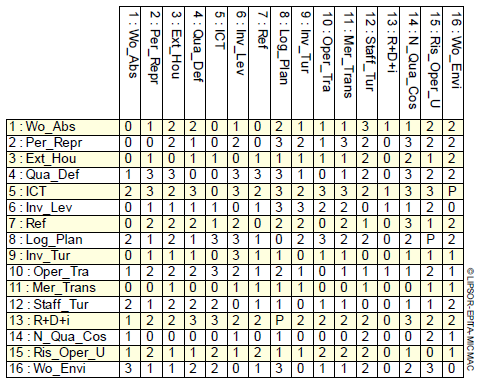
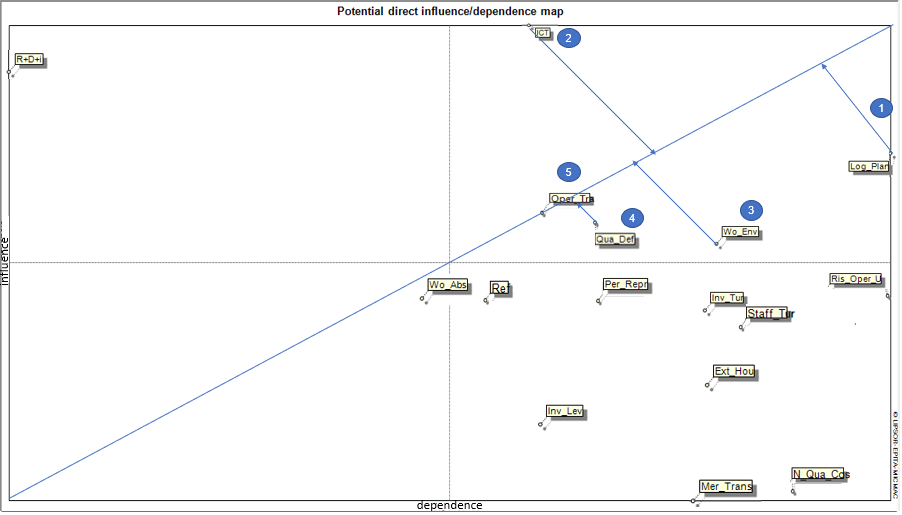
The variables in the upper-right quadrant are the most relevant and those that pose strategic challenges for organizations. Table 3 lists these five key variables, which were used to group the 35 academic skills, the 32 courses that contribute to the achievement of these skills, and the 20 job competencies required by the business sector.
Variable | Full name | Short name | Description |
V4 | Quality defects | Qua_Def | Number of non-conformities affecting product release |
V5 | ICT usage | ICT | Application of technologies in production processes |
V8 | Logistics and planning | Log_Plan | Processes and procedures that the organization uses to optimize the supply chain in order to help fulfil its promise of value |
V10 | Operation traceability | Oper_Tra | The process of tracking a service or product (location, path, history) using the firm’s tools |
V16 | Work environment | Wor_Envi | Adequate physical and psychological conditions that the firm must provide for the proper execution of employees’ tasks |
Quantitative analysis
Using analytical tools such as box plot, Principal Component Analysis (PCA), and clustering, this section describes the findings regarding the relationships between the courses, academic skills, and job competencies considered in this study.
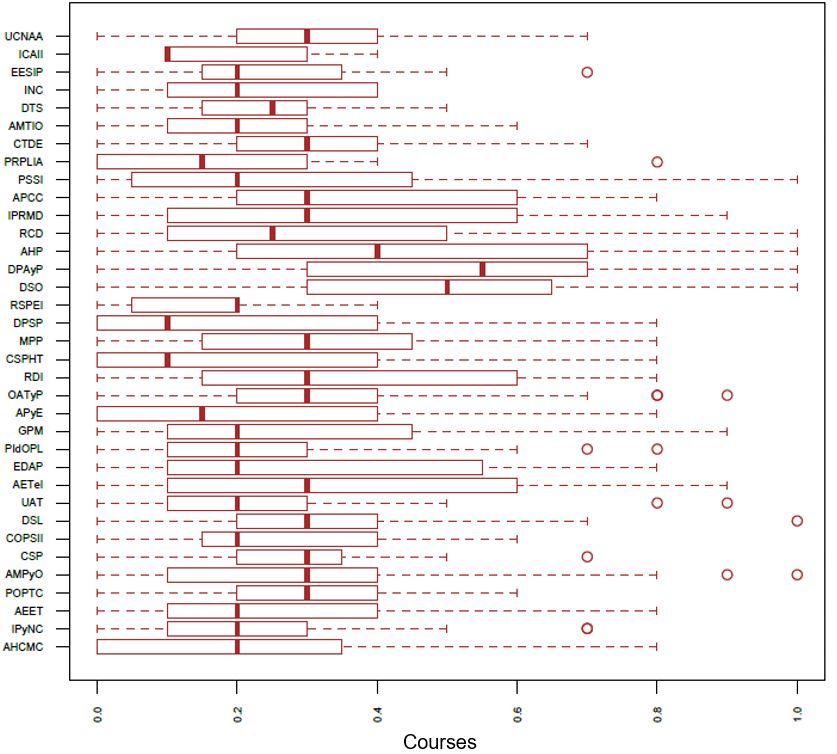
To assess the level of correlation between the courses, academic skills, and job competencies under analysis, the box plot graph tool was used. This tool allows for the identification of outliers and enables comparison of data distributions. The findings revealed a correlation of 71.88% between courses and academic skills. In short, courses such as design of experiments, industrial safety, project formulation and evaluation, planning, programming, and production control were found to greatly contribute to the achievement of academic skills (see Figure 2).
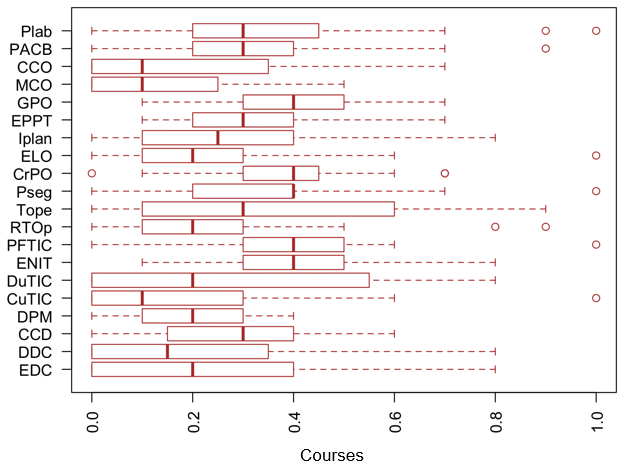
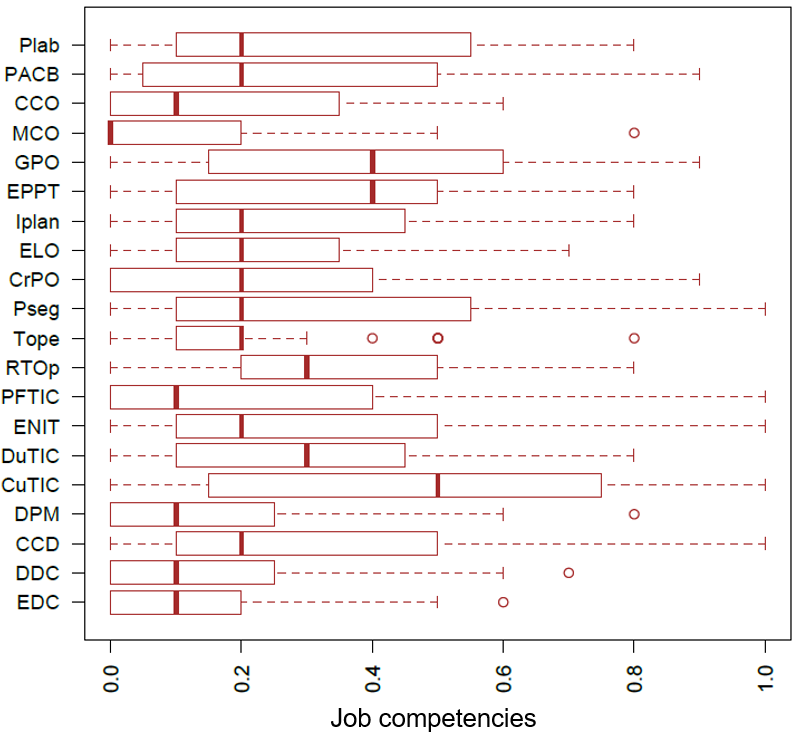
Moreover, the results indicated a correlation of 60% between courses and job competencies. Notably, job competencies related to the control of standardized operational processes, the development of good work practices, and the traceability of operations were here identified as business requirements that still need closer integration with academic content (see Figure 3).
Furthermore, a 85.71% correlation was observed between academic skills and job competencies. The findings demonstrate the importance placed by academia on the application of planning tools for optimizing and controlling production systems, as evidenced by its significant impact on three of the five study variables. To a great extent, this will help to create models that facilitate the management of quality defects, ICT usage, and operation traceability (see Figure 4).
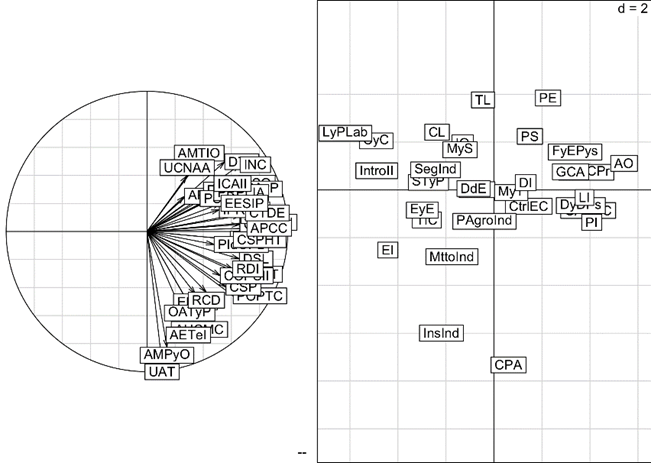
Concerning the data structure described by the quantitative variables, PCA was used to express the key drivers and their components through a set of uncorrelated linear combinations of factors. The findings revealed a high correlation between academic skills and courses (particularly courses that contribute to skill development), albeit in a less proportion with normative courses in the environmental and social areas. Therefore, it can be concluded that the courses are relevant for the development of the academic skills. According to the findings, the competences related to productive operations in integral logistic systems, productive systems – project management and the operation of technological and scientific processes, have a lot of similarity and subjects that strengthen the fulfilment of their objectives (see Figure 5).
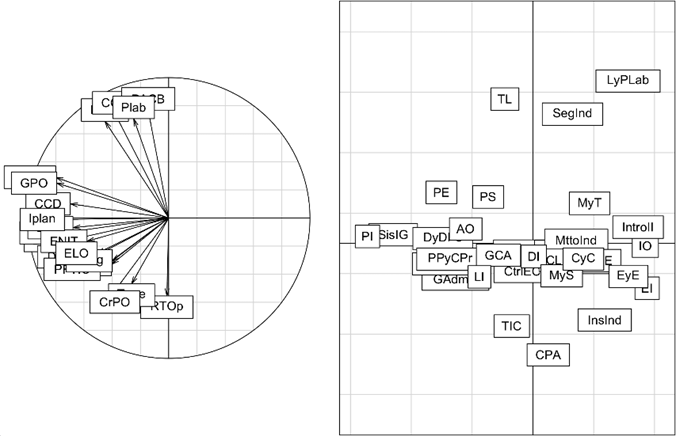
Regarding the relationship between job competencies and courses, organizational process management and tactical planning and scheduling were found to include a wide range of topics for competency development. According to the findings, the necessary follow-up in the different representative areas of the logistics chain and training programs for ICT usage contribute a significant number of courses for competency development. Notably, the thematic content related to the necessary follow-up in the different areas of the logistic chain was found to have a great impact on job performance. Moreover, the findings showed that operation traceability and standardized operational processes encompass courses with very similar thematic intensity (see Figure 6).
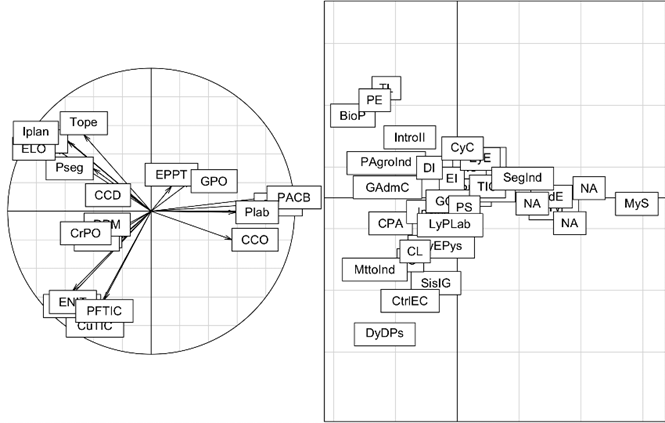
Additionally, a high correlation between academic skills and job competencies was observed. Particularly, the competency related to good work practices was found to have a great impact on academic skills (see Figure 7).
In this study, a clustering technique (dendrograms) was used to classify outcomes into clusters or groups that allowed the hierarchical identification of trends between the study variables and their components.
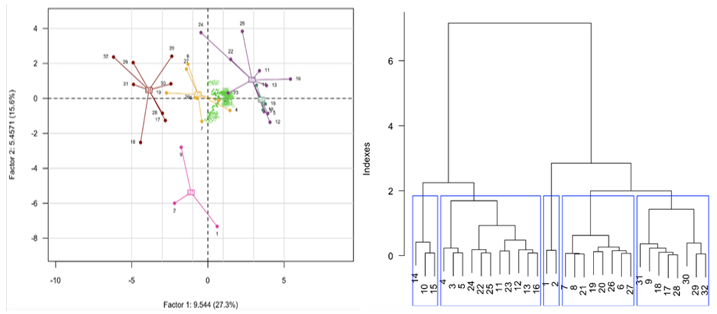
As for the clusters formed between courses and academic skills, five clusters were identified for the 32 courses under study. As observed in Figure 8, clusters 1 and 4 are very far from the academic skills, which means that the courses within these clusters do not contribute to the development of academic skills. Conversely, clusters 2 and 3 are the closest to meeting the requirements for academic skills.
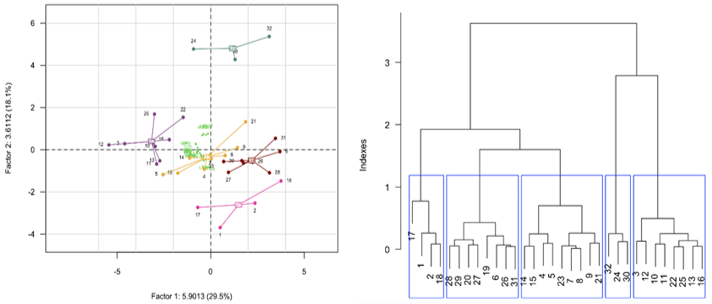
Moving on to the clusters formed between courses and job competencies, five clusters were identified in grouping the 32 courses under analysis. As can be seen in Figure 9, clusters 3 and 2 are close to the job competencies, whereas clusters 4 and 5 are far apart from them. This suggests a mismatch between the courses that are taught and the real needs for job competencies.
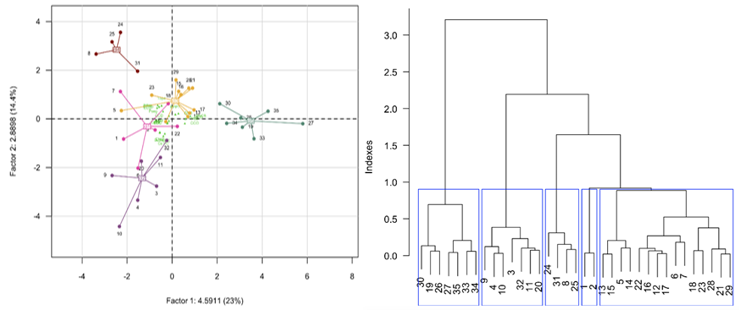
Regarding the clusters formed between academic skills and job competencies, five clusters were identified for the 35 academic skills under study. As shown in Figure 10, clusters 1, 2, and 3 are close to the job competencies, while clusters 4 and 5 are considerably far from them. This indicates potential issues in the alignment between the job competencies, academic skills, and courses considered in this study.
Finally, the methodological design employed in this study made it possible to construct a matrix describing the relationship between the 35 academic skills, the 20 job competencies required by the business sector, and the resulting five driving variables. By defining and grouping the driving variables, it was possible to propose two prospective drivers that, according to the findings, give insights into the current scenario and alternative scenarios regarding affinity between the topics under study. Table 4 shows how the five driving variables were grouped into the two proposed prospective drivers.
| Drivers | Name | Associated variables |
1 | Strategic operational and logistics model: It entails integrating soft skills and the ability to perform activities that are broadly applicable to the optimization process. | V 4 (quality defects) |
| V 16 (work environment) | ||
2 | Traceability platform for quality assurance: It entails applying highly technical skills focused on the operation and implementation of new technologies to cultivate job competencies demanded by the productive sector. | V 5 (ICT usage) |
| V 10 (operation traceability) | ||
| V 8 (logistics and planning) |
Connection to engineering education
Despite the changes in business environments and the rapidly advancing society, there is still a reciprocal relationship between soft and technical skills, both essential for future professionals. This study demonstrates how the identified drivers may improve the interaction between the academic and business sectors to support the development of new local competitive capabilities. Disciplines such as engineering, for example, significantly contribute to production dynamics and to the optimization of critical factors that influence an organization’s competitiveness.
Study limitations
One limitation encountered in this study was the difficulty in establishing connections with companies in the productive sectors under analysis. Additionally, difficulties arose during the extraction of the academic skills from the programs that were examined. This introduced content ambiguities, as some HEIs did not record competencies, and others lacked the appropriate structure for their wording.
DISCUSSION
According to research by
Together with an understanding of students’ potential abilities, academic skills should serve as a guide for structuring the micro-curriculum of courses in professional programs, thus leading the teaching process to the desired learning outcomes.
For their part,
Educational proficiency, as described by
As mentioned by
CONCLUSIONS
Concerning the question motivating this research—What is the systemic relationship between academia and businesses in Colombia regarding the development of skills and competencies related to the optimization of production and logistics processes?—it is concluded that the key drivers in terms of optimization of production and logistics processes are quality defects, work environment, ICT usage, operation traceability, and logistics and planning.
When grouped, these driving variables give rise to two prospective drivers (see Table 4) that allow for the creation of a baseline scenario. This scenario aims to describe the systemic relationship between courses, academic skills, and job competencies, as demonstrated by this study’s findings.
Regarding the first driver—strategic operational and logistics model—the variables are centered on human relations and improvement plans within production processes. The courses that were found to greatly contribute to strengthening academic skills, primarily focused on improving production processes and planning tools, included project formulation, industrial design, bioprocesses, planning, programming and production control, and design of experiments.
Concerning the academic skills oriented toward industrial safety systems and employee skill development, the key courses included operations management and industrial safety, which greatly contribute to competitiveness. Other courses, although related, were found to have a very low impact compared to the previous ones; hence, it is recommended to strengthen or redesign their contents. These courses included quality management and administration, operations research, supply chain management, industrial logistics, system thinking, industrial design, human talent, and strategic planning.
For their part, the academic skills that were found to substantially contribute to the development of the variables within this axis focused primarily on enhancing production processes, planning tools, industrial safety systems, and employee skill development. Their aim is to provide better customer service and strengthen the organization’s promise of value.
Lastly, the job competencies that were found to contribute the most to the associated variables were those related to documenting quality defects, handling non-conformities, managing organizational processes, measuring the work environment, providing technical training for employees, and implementing good practices.
Based on the above, it is clear that job competencies motivate the development of an academic proposal, leading to the belief that there is a proper alignment with employers’ demands. However, the evidence shows that many of these demands for job competencies are met without deepening much in the academic skills mentioned here. To put it in other words, “much is done with very little.”
As for the second driver—traceability platform for quality assurance—the variables are centered on technical skills and technological components. The courses that were found to have a greater influence on the development of ICT-related skills included automated process control, industrial design, bioprocesses, project formulation and evaluation, planning, programming and production control, and design of experiments. Those that were found to have the greatest influence on the development of skills related to planning and logistics were statistical quality control, quality management and administration, supply chain management, plant design and distribution, project formulation and evaluation, simulation models, logistics costs, and packaging. Finally, those that were found to have a major influence on the development of skills related to operation traceability were plant design and distribution, production planning, programming and control, design of experiments, operations research, systems thinking, industrial design, strategic planning, and simulation models.
Furthermore, the academic skills that were found to contribute to the alignment between supply and demand were mainly focused on employability, including technology and production systems, integrated logistics systems and planning, as well as simulation and process optimization techniques. Currently, there is great awareness of the need to better align academic skills with the adoption of new technologies. Nonetheless, in most fields, this is done superficially, with the primary goal of covering a broad spectrum of training.
In terms of job competencies, these were found to be oriented toward understanding planning within the logistic chain—a key aspect of the planning and logistics variable. According to the results, there was an average alignment with the academic skills, being robust with those related to operations, inventories, and integral management systems and poor with those oriented towards the inclusion of technologies. The job competencies within this axis are clearly supported by ICTs in terms of operational logistics, management systems, operations, and follow-up in the logistics chain. The operation traceability variable, for its part, was found to be the one requiring the greatest amount of effort when compared to the other variables on this axis. It primarily focuses on establishing the most important academic skills for the advancement of the profession. It is evident that these can be the areas with more emphasis on the development of improvement actions. Yet, it is important to assess whether the content used in the courses is actually the most updated, given the predominant and fundamental nature of this competency in academic programs. In this context, the motricity of the environment and the availability of partnerships with productive sectors are deemed vital.
In light of the above, and regarding the relationship between job competencies and the most relevant academic skills within the ICT usage variable, a low correlation was observed between firms’ demands and their alignment with academia. This could be considered too optimistic when compared to the reality, as it could lead to the belief that these skills are significantly developed and deepened. However, this can be contested given the wide range of possibilities and tools available in the environment.
In conducting a prospective analysis, it becomes imperative to advance the construction of future scenarios regarding the optimization of production and logistics processes, starting from a base scenario and the system’s driving variables. This could help propose strategies (from both academic and production perspectives) that contribute to the strengthening of the university–industry relationship and the development of educational models closely aligned with the business context.
This Colombian case study aims to assist in identifying the factors that can guide training programs in HEIs, specifically in the field of optimizing production and logistics processes in emerging countries. The responsibility of HEIs will be to develop curriculum proposals for Industrial Engineering and related programs that are in line with industry demands. To achieve this, they ought to promote strategies such as classroom projects, business challenges, targeted internships, and collaborative consultancies. These strategies, in addition to involving all stakeholders in the educational model, should create relevant roadmaps, from graduate profiles and academic skills to relevant job competencies.
ACKNOWLEDGMENTS
A very special acknowledgement goes to Juan Esteban Pareja Pulgarín, Andrés Ortega Gómez, and Andrés Camilo Jiménez Guerra from the SEMPRO research group of the Industrial Engineering program at the Institución Universitaria Salazar y Herrera, and to Edison Arley Usma from the Productivity and Quality Engineering program at Politécnico Colombiano Jaime Isaza Cadavid for their dedication and commitment to this research project. Gratitude extends to the people and firms who participated in the exploration phases, anonymously contributing their experiences at various points in the study.
CONFLICTS OF INTEREST
The authors declare that they have no financial, professional, or personal conflicts of interest that could inappropriately influence the obtained results or the interpretations proposed in the manuscript.
AUTHORS' CONTRIBUTIONS
Yenny Alejandra Aguirre-Álvarez participated in the conceptualization, design, and development of the research (including baseline data collection, analysis, and interpretation), as well as in the drafting and final revision of the manuscript.
Mauricio Montoya-Peláez participated in the conceptualization, design, and development of the research (including baseline data collection, analysis, and interpretation), as well as in the drafting and final revision of the manuscript.
Raúl Trujillo-Cabezas participated in the development of the research (including prospective studies, principal component analysis, descriptive analysis, statistical analysis, and interpretation), as well as in the drafting and final revision of the manuscript.
Camilo Esteban Solano Hurtado participated in the development of the research (including prospective studies, principal component analysis, descriptive analysis, statistical analysis, and interpretation), as well as in the drafting and final revision of the manuscript.
FOOTNOTES
- arrow_upward * The project is the result of independent research and has no external source of funding.
- arrow_upward 1 MicMac is an open-source photogrammetry software developed by the French National Geographic Institute.
- arrow_upward 2 RStudio is a free, open-source integrated development environment.
REFERENCES
- arrow_upward Abarca Rodríguez, A., Alpízar Rodríguez, F., Sibaja Quesada, G., & Rojas Benavides, C. (2013). Técnicas cualitativas de investigación. Editorial UCR.
- arrow_upward Adams, R. S., & Felder, R. M. (2008). Reframing Professional Development: A Systems Approach to Preparing Engineering Educators to Educate Tomorrow's Engineers. Journal of Engineering Education, 97(3), 239–240. https://doi.org/10.1002/j.2168-9830.2008.tb00975.x
- arrow_upward Anderson, L. W., & Krathwohl, D. R. (Eds.). (2001). A Taxonomy for Learning, Teaching, and Assessing: A Revision of Bloom's Taxonomy of Educational Objectives. Longman.
- arrow_upward Betancour, O. A. (2012). Logística. Conceptualización y tendencias actuales. https://www.eumed.net/cursecon/ecolat/cu/2012/oab.html
- arrow_upward Cárdenas, A., & Navas, A. (2012). Normalización de competencias laborales en Colombia. Revista Vanguardia Psicológica, 3(1), 103–121. https://dialnet.unirioja.es/servlet/articulo?codigo=4815144
- arrow_upward Castrillón, J., Cabeza, L., & Lombana, J. (2015). Competencias más importantes para la disciplina administrativa en Colombia. Contaduría y Administración, 60(4), 776–795. https://doi.org/10.1016/j.cya.2015.07.009
- arrow_upward Contreras-Germán, J., Piedrahita-Ospina, A., & Ramírez-Velásquez, I. (2019). Competencias digitales, desarrollo y validación de un instrumento para su valoración en el contexto colombiano. Trilogía Ciencia Tecnología Sociedad, 11(20), 205–232. https://doi.org/10.22430/21457778.1083
- arrow_upward Cote, D. A. (2018). Ciudad y educación: persistencias, transformaciones y correspondencias de un vínculo inmanente. Praxis & Saber, 9(20), 119–141. https://doi.org/10.19053/22160159.v9.n20.2018.8300
- arrow_upward Dantzing, G. (1963). Linear Programming and Extensions. Princeton University Press.
- arrow_upward Davis, E. A., Jannsen, F. J. J. M., & Van Driel, J. H. (2016). Teachers and science curriculum materials: where we are and where we need to go. Studies in Science Education, 52(2), 127–160. https://doi.org/10.1080/03057267.2016.1161701
- arrow_upward Ferrer, M., Ariza, Y., Martínez, J., Garizao, J., & Pulido-Rojano, A. (2019). Modelo de optimización colaborativo para la minimización de los costos variables de transporte de carga por carretera en Colombia. Investigación y Desarrollo en TIC, 10(1), 26–36. http://revistas.unisimon.edu.co/index.php/identic/article/view/3487
- arrow_upward Godet, M. (1993). De la anticipación a la acción. Manual de prospectiva estratégica. Marcombo.
- arrow_upward Godet, M., Monti, R., Meunier, F., & Roubelat, F. (2000). La caja de herramientas de la prospectiva estratégica (4th Ed.). Cuadernos de LIPS.
- arrow_upward Gutiérrez Ossa, J. A. (2015). Modelo de competencias investigativas empresariales desde la universidad, empresa y estado en Colombia. Praxis & Saber, 6(12), 241–267. https://revistas.uptc.edu.co/index.php/praxis_saber/article/view/3771
- arrow_upward Jomini, A. H. (1840). Compendio del arte de la guerra ó Nuevo cuadro analítico de las principales combinaciones de la estrategia, de la táctica sublime, y de la política militar. Imp. de D. M. de Burgos, y Librería de D. A. Perez.
- arrow_upward Levander, S., Forsberg, E., & Elmgren, M. (2020). The meaning-making of educational proficiency in academic hiring: a blind spot in the black box. Teaching in Higher Education, 25(5), 541–559. https://doi.org/10.1080/13562517.2019.1576605
- arrow_upward López Gallego, F. (2001). El surgimiento de EAFIT en el contexto del desarrollo de la Educación en administración y la práctica administrativa en Colombia. A propósito de la celebración de los 40 años. Revista Universidad EAFIT, 37(121), 9–18. https://publicaciones.eafit.edu.co/index.php/revista-universidad-eafit/article/view/1013
- arrow_upward Martínez Fajardo, C. E. (1999). Administración de organizaciones. Productividad y eficacia (2nd Ed.). Universidad Nacional de Colombia.
- arrow_upward Mayor Mora, A. (1988). Alejandro López, padre de la Administración. Revista Escuela de Administración de Negocios, (4), 64-65. https://journal.universidadean.edu.co/index.php/Revista/article/view/958
- arrow_upward McNeil, I. (2002). An Encyclopedia of the History of Technology. Routledge.
- arrow_upward Millunchick, J. M., Brennan‐Wydra, E., Henderson, T., Johnson, A., & Finelli, C. J. (2021). The role of college knowledge and proactive behavior on participation in cocurricular activities. Journal of Engineering Education, 110(1), 114–142. https://doi.org/10.1002/jee.20380
- arrow_upward Ochoa-Duarte, A., & Reina-Rozo, J. D. (2022). Engaged Engineering: A Preliminary Review of University Practices on Engineering and Society in Colombia. Trilogía Ciencia Tecnología Sociedad, 14(27), e2247. https://doi.org/10.22430/21457778.2247
- arrow_upward Olano García, H. A. (2011). Breve revisión de la logística militar en Colombia: el caso del General Santander. Revista Prolegómenos, 14(28), 203–215. https://doi.org/10.18359/prole.2387
- arrow_upward Rodríguez Zambrano, H. (2007). El paradigma de las competencias hacia la educación superior. Revista Facultad de Ciencias Económicas, 15(1), 145–165. https://revistas.unimilitar.edu.co/index.php/rfce/article/view/4554
- arrow_upward Rozwell, C., & Olding, E. (2009). Social BPM: Techniques to Uncover Process Patterns. Gartner.
- arrow_upward Ruiz de Vargas, M., Jaraba Barrios, B., & Romero Santiago, L. (2005). Competencias laborales y la formación universitaria. Psicología desde el Caribe, (16), 64–91. https://rcientificas.uninorte.edu.co/index.php/psicologia/article/view/1996
- arrow_upward Sautu, R., Boniolo, P., Dalle, P., & Elbert, R. (2005). Manual de metodología: construcción del marco teórico, formulación de los objetivos y elección de la metodología. Consejo Latinoamericano de Ciencias Sociales.
- arrow_upward Sistema Nacional de Información de Educación Superior. (2020). Consulta de Programas. https://hecaa.mineducacion.gov.co/consultaspublicas/programas
- arrow_upward Stocklmayer, S. M., Rennie, L. J., & Gilbert, J. K. (2010). The roles of the formal and informal sectors in the provision of effective science education. Studies in Science Education, 46(1), 1–44. https://doi.org/10.1080/03057260903562284
- arrow_upward Tobón Tobón, S., Pimienta Prieto, J. H., & García Fraile, J. A. (2010). Secuencias didácticas: Aprendizaje y evaluación de competencias. Pearson Educación.
- arrow_upward Toyota Industries Corporation. (2024). History. https://www.toyota-industries.com/company/history/
- arrow_upward Zairi, M., & Sinclair, D. (1995). Business process re‐engineering and process management: a survey of current practice and future trends in integrated management. Management Decision, 33(3), 3–16. https://doi.org/10.1108/00251749510085021

 Google