Green Hydrogen in Uruguay: An Analysis of Actors and Relationships from a Science, Technology, and Society Perspective*
Hidrógeno verde en Uruguay: análisis de actores y relaciones desde la ciencia, la tecnología y la sociedad
 PDF
Received: March 11,2025
Accepted: July 02, 2025
Waiter, A., Cohanoff, C., & Contreras, S. (2025). Green Hydrogen in Uruguay: An Analysis of Actors and Relationships from a Science, Technology, and Society Perspective. Trilogía Ciencia Tecnología Sociedad , 17(36), e3429. https://doi.org/10.22430/21457778.3429
Abstract
In 2018, Uruguay began exploring the use of green hydrogen as a means to decarbonize heavy and long-distance transport. By 2020, the arrival of a new government brought a shift in policy priorities regarding production destinations, marked by the development of a green hydrogen roadmap that emphasizes exports to countries in the Global North. In this context, the present article analyzes Uruguay’s green hydrogen integration process between 2018 and 2024 through the lens of national innovation systems. Specifically, it examines the relationships among stakeholders from academia, government, the production sector, and civil society, centering on the country’s first green hydrogen project: the Tambor Project–ENERTRAG. Methodologically, the study draws on the analysis of documents spanning the entire period, as well as interviews with key informants. The findings reveal limited collaboration among several actors—especially between the production sector and government with academia—and a notable lack of mechanisms for civil society engagement. Nevertheless, the early stage of green hydrogen development in Uruguay presents an opportunity to overcome these fragmented and non-synergistic relationships among stakeholders.
Keywords: green hydrogen, technological innovation, energy policy, energy transition.
Resumen
En 2018, en Uruguay, aparece el interés en la incorporación del hidrógeno verde para la descarbonización del transporte pesado y de larga distancia. En 2020, al asumir un nuevo gobierno se produce un viraje en los objetivos de la política en cuanto al destino de la producción, elaborando una hoja de ruta del hidrógeno verde que destaca su exportación a países del norte global. En este contexto, el presente artículo tiene como objetivo analizar el proceso de incorporación del hidrógeno verde en el Uruguay entre los años 2018 y 2024 desde la perspectiva de los sistemas nacionales de innovación. Para ello, se analizan los vínculos entre actores involucrados de la academia, el Estado, el sector productivo y la sociedad civil en torno al primer proyecto de hidrógeno verde en el país: Proyecto Tambor-Enertrag. La metodología se basó en el análisis de documentos de todo el período en estudio y en la realización de entrevistas a informantes clave. Como principal hallazgo, se destaca la débil vinculación entre buena parte de los actores involucrados, concretamente entre el sector productivo y el gobierno con el sector académico, y la ausencia de mecanismos de participación que incluyan de forma activa a la sociedad civil. Sin embargo, el desarrollo de hidrógeno verde en Uruguay es un proceso en ciernes y, por lo tanto, constituye una oportunidad para romper con relaciones poco sistémicas y virtuosas entre los actores.
Palabras clave: hidrógeno verde, innovación tecnológica, política energética, transición energética.
INTRODUCTION
The use of fossil fuels is the main cause of climate change and the greenhouse effect; however, more than 80% of global energy production still relies on oil and gas (
Uruguay has also advanced in this process. Since 2005, it has diversified its electricity matrix by incorporating renewable and indigenous energy sources, primarily wind power. In 2018, interest emerged in integrating green hydrogen (GH) into the national energy matrix to decarbonize sectors still dependent on fossil fuels, such as heavy and long-distance transport. After the change of government in 2020
According to
The approach of the National Systems of Innovation (NSI) offers a useful framework for studying energy transitions (
According to
These relationships vary by region. In countries of the Global South, they are generally weak and less virtuous, whereas in the Global North, coordination is stronger. Consequently, Southern countries face difficulties in connecting knowledge supply and demand, which leads to a limited incorporation of new knowledge into production and marketing processes. As a result, there are few opportunities for innovation and learning (
Energy transitions involve not only technological innovation but also social, economic, distributive, environmental, and cultural changes (
This paper adopts the NSI approach while incorporating elements of just energy transitions. On the one hand, energy transitions represent an innovation process that, as the NSI approach suggests, requires coordination among academia, business, and government. On the other hand, broadening the dialogue to include other social actors is essential for ensuring inclusivity and sustainability. This perspective calls for moving beyond
This paper analyzes the emerging process of incorporating GH in Uruguay between 2018 and 2024. Specifically, it examines the relationship among academia, the state, the productive industry, and civil society in the country’s first GH initiative, the Tambor—Enertrag Project. It explores the roles of these actors and their interactions, offering insights into Uruguay’s strengths and weaknesses in turning this recent technology into a development opportunity.
METHODOLOGY
The methodological design adopted was qualitative and based on an exploratory case study (
To address these dimensions, both primary (interviews) and secondary (documents, surveys, press) sources were consulted and analyzed. The interviews focused on the three pillars identified by
For dimensions 1, 2, and 3, secondary sources published between 2018 and 2024 were analyzed. These consisted mainly of government documents on national energy policy, reports from international organizations, and consulting studies, complemented by press articles. In addition, survey results from civil society actors in the project area were reviewed to incorporate their perspectives into the study.
Table 1 summarizes the sources consulted according to the dimensions analyzed.
| Dimensions | Sources | |
| 1. International Context | Secondary sources | |
| 2. Uruguayan Energy Transition | Secondary sources: | |
| Primary sources: semi-structured interviews | ||
| 3. Characterization of Actors | Secondary sources: | |
| Primary sources: semi-structured interviews | ||
| 4. Interactions Between Actors | Primary sources: semi-structured interviews | |
RESULTS
The Development of GH as an Opportunity to Deepen Energy Transition
International Context
In recent years, the debate on the energy transition, particularly hydrogen production, has centered on Europe, where the war between Russia and Ukraine and Western sanctions have increased the desire to reduce dependence on imported fossil fuels. This context has generated oil price instability, stimulating investment in renewable energies (
GH and its derivatives can play a central role in energy transition in two ways: (i) by providing flexibility to the energy supply from difficult-to-store sources such as solar and wind power, since surplus production can be used to generate GH, and (ii) by replacing fossil fuels to decarbonize material production, such as steel and cement, as well as heavy-duty transport through fuel cells (
Several countries are already planning, and in some cases beginning, GH production. In Latin America, the incentive lies in the abundance of renewable energy sources; however, by 2024, only 4% of GH projects had been confirmed (
The Uruguayan Energy Transition Case
Although Uruguay lacks fossil fuel reserves, it has renewable primary energy sources. Hydroelectric power was introduced in the first half of the 20th century, and until the 2000s electricity generation combined hydro with imported fossil fuels. More recently, wind, biomass, and solar energy have been incorporated (
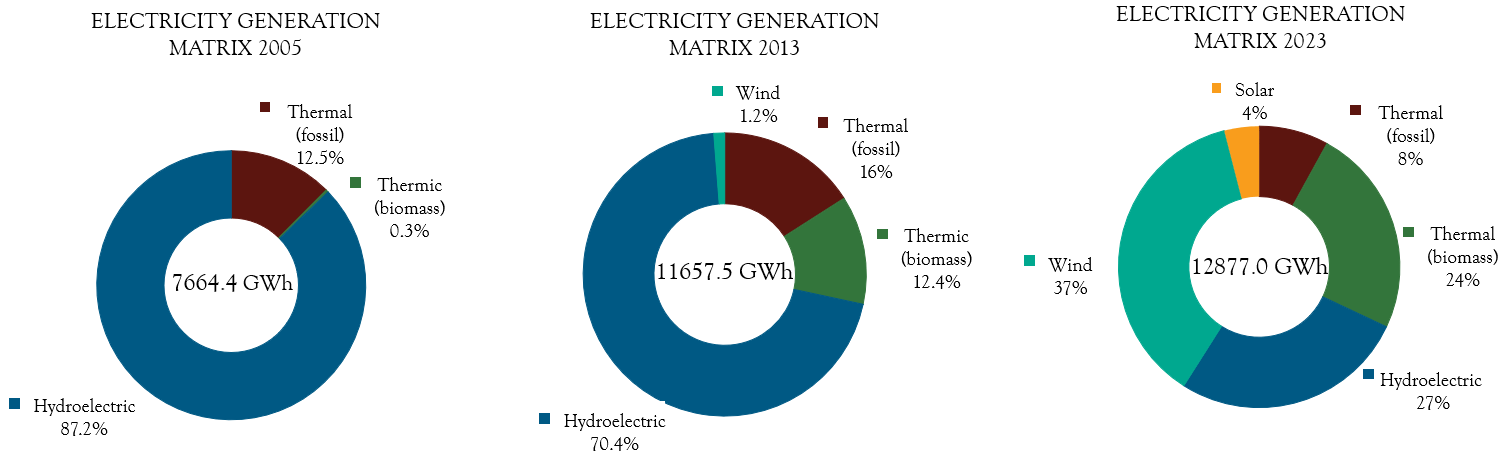
This transformation took place within the framework of a state energy policy designed to address the structural deficiencies of the industry (
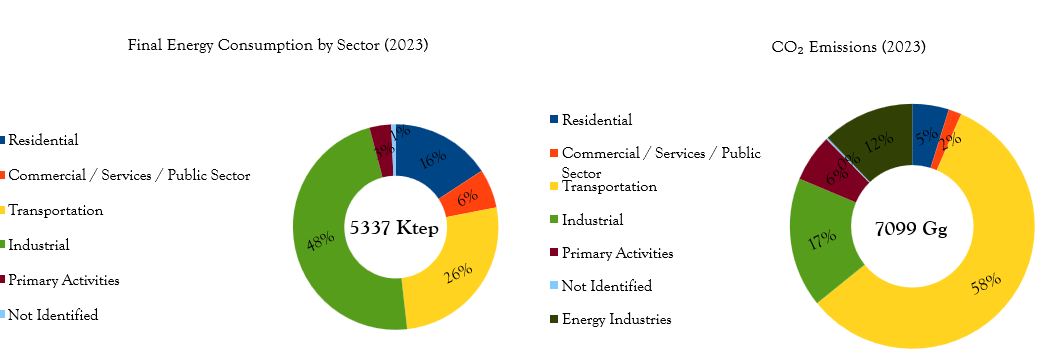
In 2018, interest in incorporating GH into the energy mix emerged, with the goal of decarbonizing heavy-duty and long-distance transportation. Two public companies drove this initiative—the National Administration of Power Stations and Electric Transmissions (abbreviated UTE
With the change of government in 2020, the group expanded to include additional state actors, and production targets shifted toward prioritizing exports to countries in the Global North (
In 2021, also with IDB support, Uruguay began preparing a GH roadmap, commissioning McKinsey & Company to conduct technical studies. The roadmap defines national priorities and sets specific goals through the “H2U Program,” organized into five components: (i) capacity building, especially training personnel in renewable energy; (ii) adaptation and development of a regulatory framework; (iii) creation of investment incentives; (iv) development and adaptation of infrastructure; and (v) citizen access to information and spaces for dialogue (
To date, four GH production projects have been announced in Uruguay: the Tambor—Enertrag Project, the HIF Global Project, the H24U Project (Hydrogen Sector Fund), and the Kahirós Project (
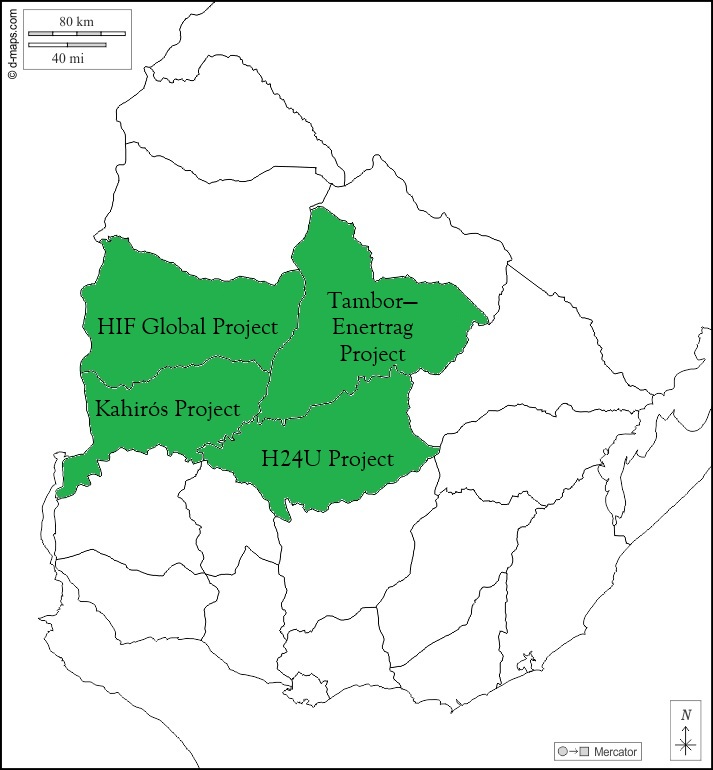
The following section analyzes the Tambor—Enertrag Project, located in the town of Tambores, Tacuarembó. The project aims to produce 13,000 tons of GH per year and export methanol as the final product. Launched in 2022, the project is designed to use wind and solar energy to produce hydrogen. It includes an on-site water electrolysis plant and facilities to refine the obtained hydrogen. The initiative is led by the German company Enertrag and the Uruguayan firm SEG Ingeniería (
Green Hydrogen in Uruguay: Relationships and Disconnections Between Actors
Sectors Involved
The incorporation of GH into Uruguay’s energy matrix can be understood from the perspective of the NSI as a social and interactive process involving multiple actors. It is therefore essential to analyze these actors and, above all, to describe their relationships. Systemic and virtuous links among them can foster interaction between the scientific-technological sphere, the government, and the productive sector, promoting new knowledge, learning processes, and greater awareness of productive and civil society issues.
Actors in Uruguay’s GH development can be grouped into five sectors: productive, public, academic, civil society, and international organizations (Figure 4). Taking into account the purpose of
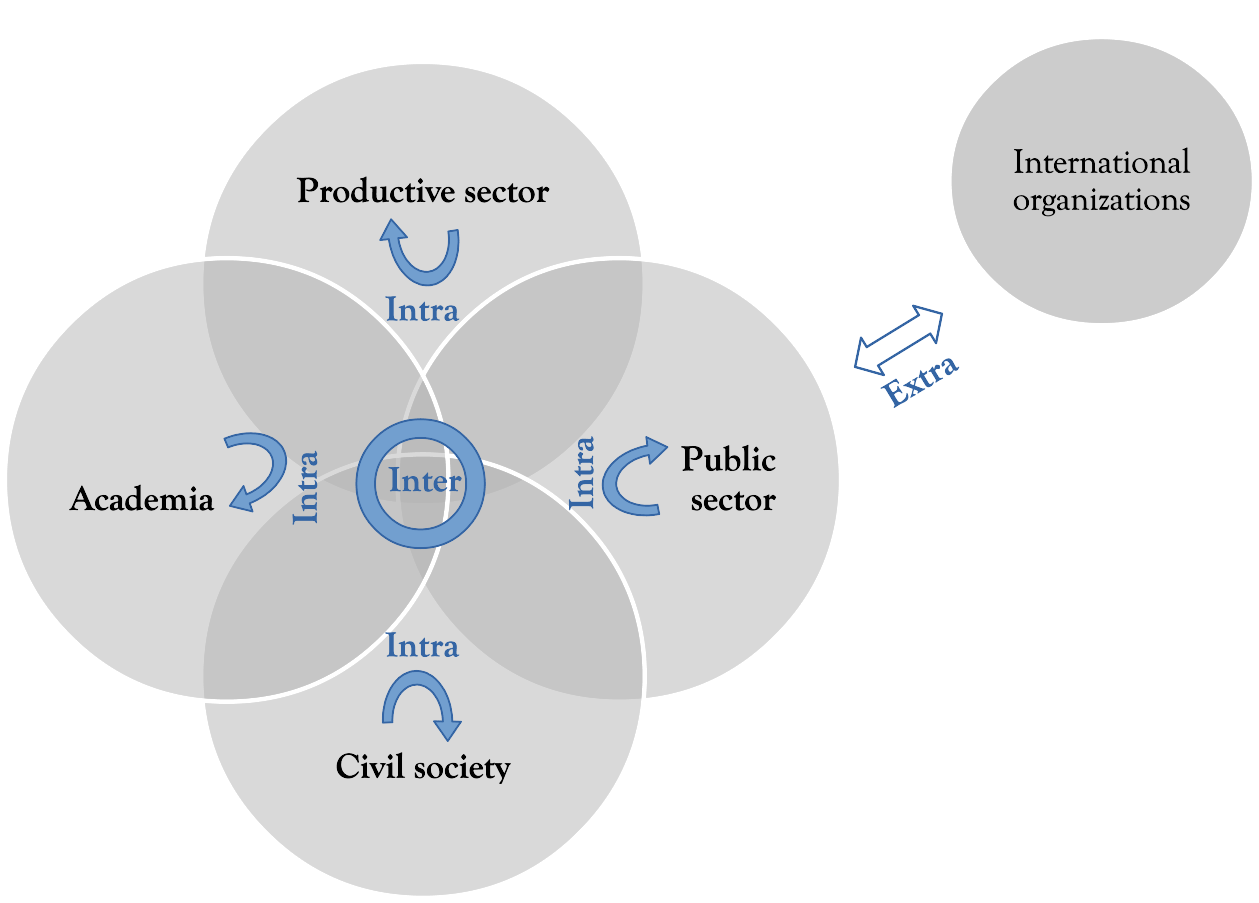
Note. Each circle represents a sector. Intersections reflect interactions within the same sector (intrarelations), between different sectors (interrelations), and between national and foreign actors (extrarelations).
Analysis of the Actors Involved in the Development of GH in Uruguay and Their Interactions
The following section presents the actors involved, describes their activities, and analyzes their interactions:
- Productive sector: Composed of public and private business actors engaged in GH projects, including the public companies Ancap and UTE (as energy producers), along with national and foreign private firms.
- Public sector: Includes actors involved in policies and instruments related to the development of GH technology for its incorporation into the energy matrix and for export.
- Civil society: Includes actors active in the territories affected, such as private users, local communities near wind farms, solar plants, and electrolysis facilities, as well as a national trade union organization currently addressing the issue.
- Academic sector: Comprises higher education institutions, technical and vocational training centers, public research institutes, and academic groups.
- International organizations: Have contributed by conducting preliminary studies to evaluate the feasibility of hydrogen production in Uruguay.
Productive Sector
The role of productive sector actors in GH development is linked to their ability to invest in and commercialize this technology. As an engineer from a private energy technology company explained:
… they use their knowledge to sell a service to local, regional, or global companies, so that, if the project is successful, they obtain significant income. They obtain the land, conduct the technical analysis, design the wind farm, and deliver the completed project. (Private sector entrepreneur, personal communication, September 13, 2022).
Given the high investment required, national companies must partner with foreign firms to develop GH projects (
The establishment of companies in the territory also generates demands on government institutions, such as adapting laws and decrees to project needs. For example, in Tambores, one company established connections with the departmental government to modify land-use regulations for water extraction and electrolyzer installation.
Regarding human resource training on producing GH, the Universidad Tecnológica (UTEC) is a key ally as it offers a degree in renewable energy engineering. Nevertheless, interviewees from academia noted a lack of collaboration between companies and researchers. One private sector representative argued that academia should be more proactive in showcasing its capabilities (Private sector entrepreneur, personal communication, September 13, 2022).
Ancap continues to pursue GH development through two main lines of action: onshore and offshore production. Onshore, the company seeks to leverage its industrial and logistical assets for new projects. Offshore, it plays a more active role, aiming to replicate its experience in hydrocarbon exploration with the installation of an offshore hydrogen platform powered by wind energy.
Public Sector
As a key public actor, Ancap—responsible for implementing fuel-related energy policies—participates in drafting bidding guidelines and specifications for open calls aimed at attracting private investment, with companies assuming the risks of GH production. Ancap also engages with other public stakeholders through the Interinstitutional Hydrogen Group, which currently includes seven ministries (MIEM, Foreign Affairs, Economy and Finance, National Defense, Transport and Public Works, Housing and Territorial Planning, and MA), as well as the Office of Planning and Budget, the Energy and Water Services Regulatory Unit, the two public energy companies (Ancap and UTE), the National Port Administration, ANII, the National Development Agency, Uruguay XXI (the agency for the promotion of exports, investments, and country branding), the Technological Laboratory of Uruguay (abbreviated LATU in Spanish), and the National Council for Science and Technology (Conicyt)
In the Tambor—Enertrag Project, the Uruguayan company worked with public institutions—MIEM, MA, and the Departmental Government of Tacuarembó—on land-use authorization and the environmental impact assessment (
Currently, Ancap’s involvement in GH development is through the Interinstitutional Group. Company interviewees emphasized that projects are conducted with the understanding that the government does not invest directly; rather, private firms provide capital, know-how, and technology (Ancap technicians, personal communication, August 29, 2022).
ANII also participates through the management of the Green Hydrogen Sector Fund to support STI, created with MIEM and financed by LATU (
In parallel, the Energy Sector Fund—also managed by ANII with contributions from ANII, UTE, Ancap, and the National Energy Directorate of MIEM—received additional support in 2023 from the Renewable Energy Innovation Fund, financed by the UN Joint SDG Fund. Among its proposed challenges was GH and its derivatives, with the aim of supporting research, development, and innovation projects that strengthen national energy capacities either directly or indirectly. Through this call, the company Clerk was funded for a project on producing sustainable aviation fuel (
Civil Society
Civil society actors are convened by MA and private companies in public hearings to validate project installations in the territory. However, these hearings are not binding. In this context, some actors have expressed concern about freshwater extraction for GH production, which could compete with other productive or domestic uses. In 2023, a group of residents of Tacuarembó, organized through the Native and Creole Seed network and the Water and Life collective, filed a constitutional appeal before the Supreme Court of Justice to overturn the reclassification of 100 hectares for Enertrag’s GH and methanol plant. The land had been converted from “rural productive” to “suburban industrial” use, and the plaintiffs argued that water is legally a public resource in Uruguay. The Court, however, dismissed the claim (
Public participation opportunities in evaluating potential environmental and social impacts are paramount. A survey conducted by professors from the Universidad de la República in Tambores revealed that most residents know little or nothing about the project, and many are unaware of what an GH plant is. Once informed, respondents raised concerns about job quality, water use and its source, and the impacts water use may have on other activities. They also emphasized the need for more sources of information (
Academia
Academic stakeholders were included only at the final stage of developing Uruguay’s Green Hydrogen and Derivatives Roadmap, and the invitation was extended not to GH researchers but to members of Conicyt. In response to the lack of engagement by political and productive actors, the Academic Network for the Promotion, Research, and Development of Hydrogen and Decarbonization (abbreviated RedH2uy in Spanish) was created in 2021 in Uruguay. This ad hoc group brings together scientists from Udelar, UTEC, and the Clemente Estable Institute of Biological Research (abbreviated IIBCE in Spanish) to promote exchanges on hydrogen production and use, its role in decarbonization, and the dissemination of knowledge to stakeholders in the hydrogen economy.
A RedH2uy member noted that sector funds are not designed for academics. Although a consulting firm was hired to identify gaps in human resource capabilities, incentives to develop knowledge through research generally lack. The person interviewed argued that since 2019 energy sector funds have shifted toward consulting rather than academic research, emphasizing applied development to attract companies. As a result, proposals from academics have been rejected, and the short timelines hinder postgraduate training within project frameworks (RedH2uy member, personal communication, September 2, 2022).
Another member of the network offered a different perspective, downplaying these concerns and stressing the urgency of the project. He argued that building local capacities to produce GHs within the required timeframe is difficult, making it necessary to combine existing and potential domestic capacities with foreign knowledge and technology.
The Executive Branch (MIEM) also emphasized that academia should independently address the challenge of developing the necessary capacities. While it is working with Conicyt to identify needs, it considers the academic sector responsible for defining the required profiles. The Executive Branch will promote studies, but universities and the Technical and Professional Education Directorate (abbreviated UTU in Spanish) are expected to design the relevant training programs (Representative of the Executive Branch, personal communication, October 25, 2022).
Finally, the Executive Branch does not foresee developing national technological capacities in this field, citing a lack of competitiveness. It argues that Uruguay will be unable to compete with markets such as China and Germany, even if domestic scientific capabilities are developed (Representative of the Executive Branch, personal communication, October 25, 2022).
International Organizations
International organizations have primarily engaged with the Executive Branch (MIEM), contributing to preliminary studies on the feasibility of hydrogen production in Uruguay. Given their role in the process, this sector consists of two main types of categories: advisory institutions and development banks. Both the IDB and the Port of Rotterdam supported the preparation of information that informed the Green Hydrogen Roadmap to 2040. Table 2 summarizes the activities and interactions of the actors across all sectors.
Actors | Activities | Interactions | |
Productive Sector | |||
| Ancap and UTE | Participate in energy transitions toward renewable energy sources | Part of the Inter-Institutional Green Hydrogen Group | |
| National Private Companies | Invest in, develop, and market GH products | Engage with foreign companies, UTEC, the government (MIEM and MA), and the Tacuarembó Municipality | |
| Foreign Private Companies | Export GH | Engage with national companies and government actors | |
| Public Sector | |||
| Ancap | Prepares bidding guidelines and specifications to attract private investment | Interact with private companies, member of the Inter-Institutional Green Hydrogen Group | |
| MIEM and MA | Lead the process | Interact with national companies; members of the Inter-Institutional Green Hydrogen Group | |
| IDT | Adapt land use regulations | Engage with national companies, MIEM, MA, and civil society | |
| ANII | Manage public funds to support STI | Member of the Inter-Institutional Green Hydrogen Group | |
| LATU | Provides public funds to support STI | Member of the Inter-Institutional Green Hydrogen Group | |
| Conicyt | Give advice on STI policies | Member of the Inter-Institutional Green Hydrogen Group | |
| Civil Society | |||
| Private users and local communities | Participate in project hearings; engage in organizations focused on environmental sustainability | Interact with academia and other civil society actors | |
| PIT-CNT | Analyze proposals to promote GH development | Interact with civil society actors and academia | |
| Academia | |||
| Udelar, UTEC and IIBCE | Provide GH training and research | Formed RedH2uy; interact with education and civil society actors | |
| UTU | Interact with education and civil society actors | ||
| International Organizations | |||
| IDB | Supported the preparation of information for the Green Hydrogen Roadmap to 2040 | Interact with MIEM | |
| Puerto de Rotterdam | |||
Figure 5 presents a diagram summarizing the interactions among actors in the four sectors.
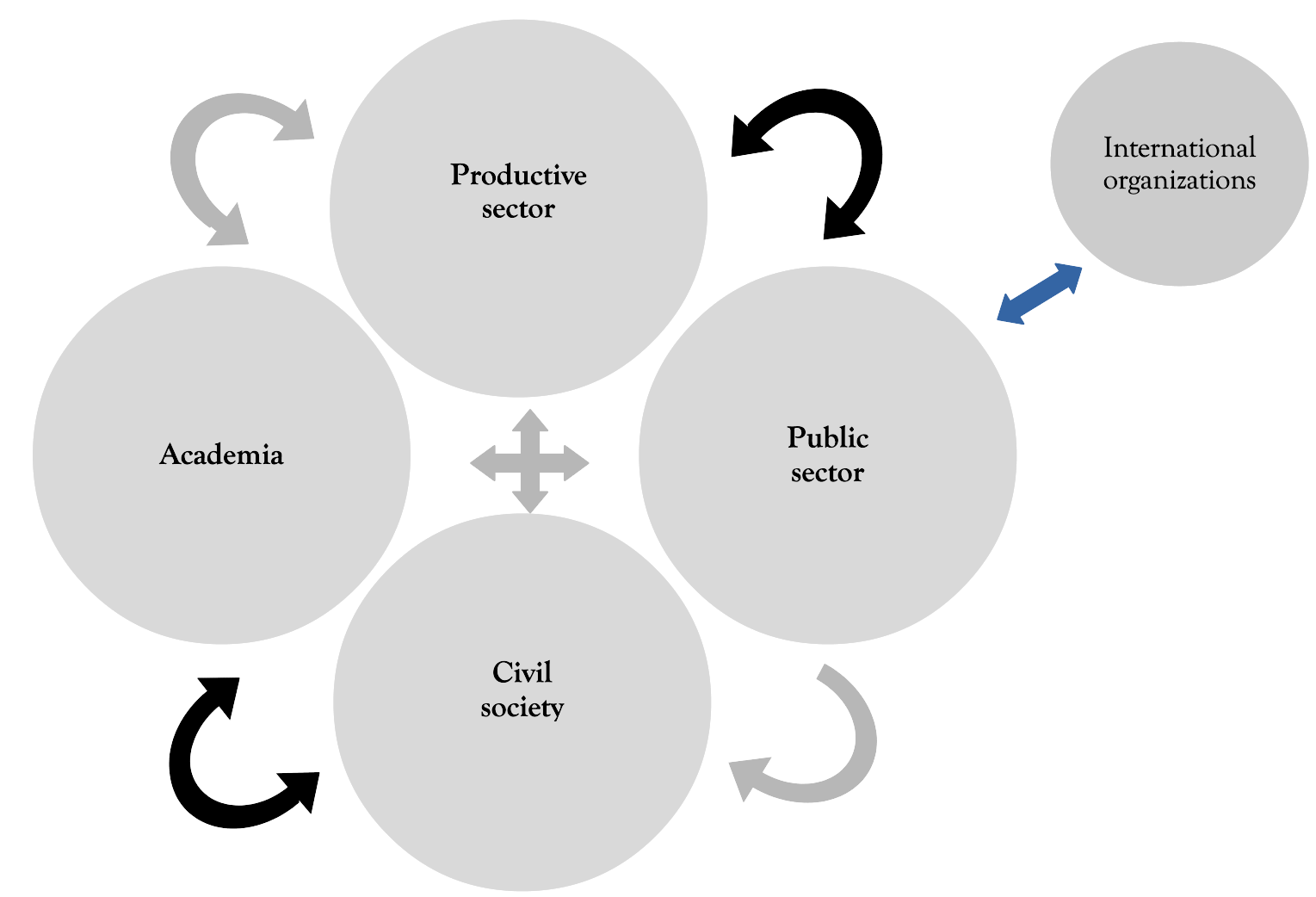
Note. Each circle represents the actors within a sector. Arrows indicate the direction and intensity of interactions between sectors, with dark arrows showing stronger engagement and lighter arrows representing weaker engagement.
Ancap, a public company, initiated the hydrogen debate in Uruguay by convening a 2018 workshop focused on decarbonizing heavy and long-distance transport. With the change of government in 2020, the objective shifted toward hydrogen exports, and MIEM assumed leadership. In this new scenario, private companies play a vital role, due to the high costs of GH development. Interviews and secondary sources highlight strong ties between private companies and leading public actors, particularly MIEM and MA. This reflects close, synchronous relationships within and between political and productive sectors.
By contrast, academic actors interact among themselves, as seen in the creation of RedH2uy, but maintain weak connections with other sectors due to limited coordination. Lacking clear demands from political and productive actors, they pursue research collaboratively yet in relative isolation. This differs notably from the earlier wind energy experience, where coordination between Udelar researchers, UTE technicians, and later DNE technicians fostered broader interaction that eventually included the business sector (
Although civil society and academic actors have been the least engaged by those leading the process, limited dialogue has emerged between them on the GH issue. Similar to the earlier sand current stage of the energy transition, organized civil society appears relatively weak and primarily linked to academia (
While coordination is evident within each sector, cross-sector collaboration is scarce, except for the productive sector and government from 2020 to 2024. This lack of intersectoral action has hindered the creation of learning spaces that could strengthen the capacity of all actors in the GH incorporation process.
Interviews show broad recognition that hydrogen represents an opportunity for Uruguay, with actors across academia, government, business, and civil society expressing interest in contributing to the debate. Exchanges and dialogue sessions—such as the first Academic Conference on Green Hydrogen in 2024—have addressed concerns, often with academia driving these initiatives. Stakeholders also agree on the need for coordination to ensure hydrogen benefits all sectors and supports national development. However, expectations differ: the government (MIEM) anticipates a proactive role from academia, while academia perceives limited demand or guidance from the public and productive sectors.
Finally, although the importance of knowledge is widely recognized, particularly with regard to training and building the capacity of human resources, the interviews also show that tensions persist. The government focuses on providing short-term consulting services and international expertise, while academia prioritizes research and medium- to long-term local capacity building.
CONCLUSIONS
Although Uruguay began its transition to renewable energy in the early 21st century, it now faces a global scenario that raises new questions, such as: What is the appropriate path for incorporating new technology in a peripheral country so that it fosters endogenous development and contributes to decarbonizing its energy matrix?
In this context, STI policies for socially inclusive and environmentally sustainable development must begin with the recognition of economic, social, and environmental inequalities (
Building systemic STI capacities requires coordination and dialogue among all actors. In GH, actors work independently, pursuing their own interests, with minimal systemic connections (apart from those between the productive sector and the government), especially in developing STI capacities. This disconnection may stem from i) differences between the timelines of academic research and those of politics and business—where consultancy is favored over research—and ii) the limited inclusion of academia in decision-making processes.
These findings align with broader Latin American studies highlighting the absence of strong, systemic relationships necessary for development. Strengthening connections between knowledge supply and demand can create opportunities for innovation and learning. Moreover, civil society should be recognized as a fourth sector in energy transition processes, expanding the traditional
Despite these shortcomings, GH development in Uruguay remains incipient, which offers an opportunity to overcome weak, non-systemic relationships among actors. With a new government taking office, there is still time to link knowledge supply and demand, foster social participation, and reverse this historical trend in peripheral countries.
CONFLICTS OF INTEREST
The authors declare no financial, professional, or personal conflicts of interest that could have influenced the results or interpretations presented.
AUTHORSHIP CONTRIBUTION
All authors contributed equally to the research and writing of this paper.
FOOTNOTES
- arrow_upward * This study is situated within the framework of the research carried out by the PCTI-LALICS thematic network.
- arrow_upward 1 Government period that ended on March 1, 2025.
- arrow_upward 2 UTE is the public company that provides electricity services in Uruguay.
- arrow_upward 3 Ancap is the public company in charge of refining and importing hydrocarbons and petroleum derivatives.
- arrow_upward 4 Conicyt is the advisory body to the Executive and Legislative branches on STI in Uruguay l
- arrow_upward 5 The Inter-Union Plenary of Workers – National Workers' Convention (abbreviated PIT-CNT in Spanish) is the country’s main trade union federation, responsible for representing, organizing, and training workers.
REFERENCES
- arrow_upward Agencia Nacional de Investigación e Innovación. (2022). Convocatoria a proyectos de hidrógeno verde. https://www.anii.org.uy/apoyos/innovacion/303/convocatoria-a-proyectos-de-hidrogeno-verde
- arrow_upward Agencia Nacional de Investigación e Innovación. (2023a). Fondo Sectorial de Energía 2023. https://www.anii.org.uy/apoyos/investigacion/57/fondo-sectorial-de-energia
- arrow_upward Agencia Nacional de Investigación e Innovación. (2023b). Uruguay da importante paso hacia el desarrollo del hidrógeno verde con la concreción del primer proyecto piloto. https://www.anii.org.uy/noticias/288/uruguay-da-importante-paso-hacia-el-desarrollo-del-hidrogeno-verde-con-la-concrecion-del-primer-proyecto-piloto
- arrow_upward Ardanche, M., Bianco, M., Cohanoff, C., Contreras, S., Goñi, M., Simón, L., y Sutz, J. (2017). Diálogo entre comunidades para la construcción de políticas CTI: la energía eólica en Uruguay. En G. Dutrénit, y J. Natera (eds.), Procesos de diálogo para la formulación de políticas de CTI en América Latina y España (pp. 335-366). CLACSO. https://doi.org/10.2307/j.ctv253f57x.14
- arrow_upward Ardanche, M., Bianco, M., Cohanoff, C., Contreras, S., Goñi, M., Simón, L., y Sutz, J. (2018). The power of wind: an analysis of a Uruguayan dialogue regarding an energy policy. Science and Public Policy, 45(3), 351-360. https://doi.org/10.1093/scipol/scx041
- arrow_upward Arocena, R., y Sutz, J. (2003). Subdesarrollo e Innovación. Navegando contra el viento. Cambridge University Press.
- arrow_upward Arocena, R., y Sutz, J. (2020). The need for new theoretical conceptualizations on National Systems of Innovation, based on the experience of Latin America. Economics of Innovation and New Technology, 29(7), 814-829. https://doi.org/10.1080/10438599.2020.1719640
- arrow_upward CAF-banco de desarrollo de América Latina y el Caribe. (2024). Energías Renovadas: Transición energética justa para el desarrollo sostenible. https://scioteca.caf.com/handle/123456789/2248
- arrow_upward Climatewatch. (2024). Historical GHG Emissions. https://www.climatewatchdata.org/ghg-emissions?breakBy=sector&chartType=line&end_year=2022&gases=co2§ors=total-including-lucf&start_year=2014
- arrow_upward Cohanoff, C., Contreras, S., y Waiter, A. (2020). Aportes del campo de la ciencia, tecnología e innovación al estudio de las transiciones energéticas. Documentos de Trabajo Número 2 - 2020. Udelar-Comisión Sectorial de Investigación Científica. https://hdl.handle.net/20.500.12008/32016
- arrow_upward Cont, W., y Juncosa, F. (2024). Promoción de los combustibles limpios. En Energías Renovadas: Transición energética justa para el desarrollo sostenible (pp. 153-185). CAF-banco de desarrollo de América Latina y el Caribe. https://scioteca.caf.com/handle/123456789/2260
- arrow_upward Contreras, S., Waiter, A., y Cohanoff, C. (2024). Energía y desarrollo en Uruguay: contribución a los estudios sobre el desarrollo a partir del análisis de las transiciones energéticas. En J. Sutz, e I. Bortagaray (comps.), Desarrollo, ciencia, tecnología, innovación y sus interacciones. Perspectivas y propuestas diversas (pp. 197-233). Fin de Siglo. https://citinde.ei.udelar.edu.uy/bibliografia/desarrollo-ciencia-tecnologia-innovacion-y-sus-interacciones-perspectivas-y-propuestas-diversas
- arrow_upward Ferragut, P., Goldenberg, F., Correa, C., y Gischler, C. (2022). Hidrógeno verde y el potencial para Uruguay: Insumos para la elaboración de la Hoja de Ruta de Hidrógeno Verde de Uruguay. Banco Interamericano de Desarrollo. https://doi.org/10.18235/0004615
- arrow_upward García Bernal, N. (2021). Industria del hidrógeno verde: costos de producción. Biblioteca del Congreso Nacional de Chile. https://obtienearchivo.bcn.cl/obtienearchivo?id=repositorio/10221/32538/1/BCN___Hidrogeno_verde_Costos_de_produccion_Sept21.pdf
- arrow_upward Geels, F. (2006). Multi-Level Perspective on System Innovation: Relevance for Industrial Transformation. En X. Olsthoorn, y A. J. Wieczorek (eds.), Understanding Industrial Transformation. Views from Different Disciplines (pp. 163-186). Springer. https://doi.org/10.1007/1-4020-4418-6_9
- arrow_upward H2LAC. (2022, 31 de mayo). Tambor Green Hydrogen Hub: el nuevo proyecto uruguayo de hidrógeno verde. Plataforma para el desarrollo del hidrógeno verde en Latinoamérica y el Caribe. https://h2lac.org/noticias/tambor-green-hydrogen-hub-el-nuevo-proyecto-uruguayo-de-hidrogeno-verde
- arrow_upward Heffron, R. J., McCauley, D., y Sovacool, B. K. (2015). Resolving society's energy trilemma through the Energy Justice Metric. Energy Policy, 87, 168-176. https://doi.org/10.1016/j.enpol.2015.08.033
- arrow_upward Hinicio. (2022). Guía sobre Movilidad Urbana Eléctrica en Uruguay. https://www.euroclima.org/seccion-publicaciones/tipo-de-documentos/boletines/gu-a-sobre-movilidad-urbana-el-ctrica-en-uruguay/viewdocument/444
- arrow_upward Intergovernmental Panel on Climate Change. (2023a). Summary for Policymakers. En Core Writing Team, H. Lee, y J. Romero (eds.), Climate Change 2023: Synthesis Report. Contribution of Working Groups I, II and III to the Sixth Assessment Report of the Intergovernmental Panel on Climate Change (pp. 1-34). https://doi.org/10.59327/IPCC/AR6-9789291691647.001
- arrow_upward Intergovernmental Panel on Climate Change. (2023b). Technical Summary. En Climate Change 2022: Impacts, Adaptation and Vulnerability. Contribution of Working Group II to the Sixth Assessment Report of the Intergovernmental Panel on Climate Change (pp. 37-118). Cambridge University Press. https://doi.org/10.1017/9781009325844.002
- arrow_upward International Energy Agency. (2024). Global Hydrogen Review 2024. https://www.iea.org/reports/global-hydrogen-review-2024
- arrow_upward Johnson, B., y Lundvall, B-Å. (1994). Sistemas Nacionales de Innovación y aprendizaje institucional. Comercio Exterior, 44(8), 695-704.
- arrow_upward Kalt, T., y Tunn, J. (2022). Shipping the sunshine? A critical research agenda on the global hydrogen transition. GAIA-Ecological Perspectives for Science and Society, 31(2), 72-76. https://doi.org/10.14512/gaia.31.2.2
- arrow_upward Lundvall, B.-Å. (ed.). (1992). National Systems of Innovation: Towards a Theory of Innovation and Interactive Learning. Pinter.
- arrow_upward Méndez, C. (2024, 25 de marzo). Desestimaron acción de inconstitucionalidad presentada por vecinos contra decreto que permite la instalación de planta de hidrógeno verde y metanol. La Diaria. https://ladiaria.com.uy/ambiente/articulo/2024/3/desestimaron-accion-de-inconstitucionalidad-presentada-por-vecinos-contra-decreto-que-permite-la-instalacion-de-planta-de-hidrogeno-verde-y-metanol
- arrow_upward Ministerio de Ambiente. (2024). Estado del proceso de Evaluación de Impacto Ambiental. Observatorio Ambiental Nacional. https://www.ambiente.gub.uy/oan/proyectos/proyecto-tambor-planta-de-produccion-de-e-metanol-a-partir-de-h2verde
- arrow_upward Ministerio de Industria, Energía y Minería. (2023). H2U. Hoja de ruta del hidrógeno verde y derivados en Uruguay. https://www.gub.uy/ministerio-industria-energia-mineria/sites/ministerio-industria-energia-mineria/files/documentos/noticias/Hoja%20de%20ruta%20H2%20Uruguay_final.pdf
- arrow_upward Ministerio de Industria, Energía y Minería. (2024a). Balance Energético 2023. https://ben.miem.gub.uy/balance.php
- arrow_upward Ministerio de Industria, Energía y Minería. (2024b). Proyectos de hidrógeno verde y derivados en Uruguay. https://www.gub.uy/ministerio-industria-energia-mineria/politicas-y-gestion/proyectos-hidrogeno-verde-derivados-uruguay
- arrow_upward Ministerio de Industria, Energía y Minería. (s.f.). Política Energética 2005- 2030. https://www.gub.uy/ministerio-industria-energia-mineria/sites/ministerio-industria-energia-mineria/files/2025-06/Pol%C3%ADtica%20Energ%C3%A9tica%202005-2030.pdf
- arrow_upward Sabato, J., y Botana, N. (2021). La ciencia y la tecnología en el desarrollo futuro de América Latina. Documento de Trabajo de Nº 1. CiTINDe-Universidad de la República Uruguay. https://citinde.ei.udelar.edu.uy/publicacion/documento-de-trabajo-n-1-la-ciencia-y-la-tecnologia-en-el-desarrollo-futuro-de-america-latina
- arrow_upward Schneegans, S., Lewis, J., y Straza, T. (eds.). (2021). Informe de La UNESCO sobre la Ciencia: La Carrera contra el Reloj para un Desarrollo más Inteligente – Resumen Ejecutivo. Unesco. https://unesdoc.unesco.org/ark:/48223/pf0000377250_spa.locale=e
- arrow_upward SEG Ingeniería, y Enertrag. (2021). TAMBOR Green Hydrogen Hub. Comunicación de proyecto BELASAY S.A. Planta de producción de hidrógeno verde y derivados. https://www.ambiente.gub.uy/bir/manifiestos/attachments/VAL_Planta_H2_Tambor_con_anexo_enero_2022.pdf
- arrow_upward Smil, V. (2011). Global Energy: The Latest Infatuations. American Scientist, 99(3), 212-219. https://www.americanscientist.org/article/global-energy-the-latest-infatuations
- arrow_upward Sovacool, B. K., y Dworkin, M. H. (2015). Energy justice: Conceptual insights and practical applications. Applied Energy, 142, 435-444. https://doi.org/10.1016/j.apenergy.2015.01.002
- arrow_upward Torres, A. I., Ferreiro, J., y Schaich, F. (2021). Hidrógeno verde: ¿Qué potencial tiene Uruguay en ese mercado? [entrevista]. Perspectiva- Radiomundo 1170. https://enperspectiva.uy/en-perspectiva-programa/la-mesa/hidrogeno-verde-que-potencial-tiene-uruguay-en-ese-mercado
- arrow_upward Universidad de la República Uruguay. (2024). Resumen Ejecutivo: Encuesta “Hidrógeno Verde y Proyecto Tambor, percepción e información de los habitantes de la zona de influencia”. https://www.gub.uy/ministerio-ambiente/sites/ministerio-ambiente/files/2024-11/Anexo%205.pdf
- arrow_upward Villagra de Biedermann, S. (2022). Informe de evaluación Proyecto: Energía Asequible y Sustentable para el Paraguay: Implementando la política energética nacional. Triangulando Energía Sostenible TRES Paraguay – Uruguay – Alemania. Centro de Estudios y Proyectos S.R.L. https://fondo-cooperacion-triangular.net/wp-content/uploads/2023/04/Evaluacion_Proy.-URU-PAR-ALE_TRES.pdf
- arrow_upward Wyczykier, G. (2023). Las controversias sobre el Hidrógeno Verde: interrogantes para la descarbonización vía des fosilización. Revista Pilquen. Sección Ciencias Sociales, 26(3), 120-142. https://revele.uncoma.edu.ar/index.php/Sociales/article/view/4960
- arrow_upward Yin, R. K. (2018). Case study research and applications (Vol. 6). Sage.
ANNEX
Questionnaires for Semi-Structured Interviews with Stakeholders
I. Questionnaire for Government Stakeholders
-
- How was the decision made to prioritize GH development? (Influence of regional and international context)
- What advantages does Uruguay offer for hydrogen development?
- What limitations does the country face?
- What are the main objectives of hydrogen development?
- What role does hydrogen play in the energy mix?
- How does it integrate with other energy sources?
- Are there negative externalities (economic, social, or environmental)
-
- What is the background of GH in Uruguay?
- What stage is it currently?
- What are the prospects?
-
- What science and technology knowledge are required for hydrogen development in Uruguay?
- Is this knowledge available in Uruguay? In which institutions? Must it be imported?
- Are there training needs at the technical and/or academic level?
-
- What regulations currently exist?
- Do existing regulations and rules need to be adapted?
-
- Which actors or institutions are involved in hydrogen development?
- What role does each play? Should others be included?
-
- How and since when has ANCAP been involved in green hydrogen development?
- What role will ANCAP play when fossil fuels decline? Potential adaptations from an institutional, infrastructure, and human resource perspectives.
- How does ANCAP interact with other stakeholders (state, academia, private sector, civil society)?
- 1) Objectives and Importance of GH Development
2) Hydrogen Development
3) Knowledge Needs
4) Regulations:
5) Actors Involved
6) Specific Questions for ANCAP
II. Questionnaire for the Academic Sector
-
- Please describe your academic trajectory. How long have you studied green hydrogen, and in what areas?
- Is your research conducted within a group? What is its profile (interdisciplinary, multi-service, etc.)?
- Have you collaborated with the productive sector or other national/international academic groups?
-
- What is the network’s origin and its objectives?
- Which institutions are part of it, and how do they coordinate?
- Which other institutions or topics could be integrated?
- Which actors or institutions do you collaborate with? What mechanisms are in place?
-
- What advantages does Uruguay offer for hydrogen development?
- What limitations exist?
- What role does hydrogen play in the energy mix, and how does it complement other sources?
- Are there any negative externalities (economic, social, or environmental)?
-
- What science and technology knowledge are required for developing green hydrogen in the country?
- Is this knowledge available in Uruguay? In which institutions? Must it be imported?
- Have public or private institutions requested knowledge from academia?
- What applications could be given to this knowledge?
- Has green hydrogen development generated new research topics or reoriented the agenda?
- What constraints limit knowledge development in Uruguay?
- Have new training opportunities (courses, postgraduate programs, etc.) been created?
-
- Which institutions or stakeholders are involved, and what roles do they play?
- What opportunities exist for coordination with political or business actors?
- How has this engagement unfolded, and what constraints exist?
- Are civil society organizations involved? What has the interaction been like?
- 1) Academic Background
2) Academic Network
3) Objectives and Importance of Hydrogen Development
4) Knowledge Needs
5) Engagement with Non-Academic Stakeholders
III. Questionnaire for the Productive Sector
-
- What is the company’s main activity?
- When did it begin working on green hydrogen?
-
- What advantages does Uruguay offer for hydrogen development?
- What limitations does the country face?
- What are the company’s main objectives of hydrogen development?
- What is the importance of hydrogen in the energy mix?
- ¿ How does it integrate with and complement other energy sources?
- Are there any negative externalities (economic, social, or environmental)?
-
- Which institutions or actors participate in green hydrogen development?
- What role do private companies play?
- What roles do other actors assume?
- Should additional actors or institutions be included?
-
- What is the company’s background in green hydrogen?
- What stages of development has it reached (current and future)?
- What are the main challenges in advancing green hydrogen?
- What institutional, political, or legal conditions are required for success?
-
- What science and technology knowledge is required for green hydrogen development in Uruguay?
- Is this knowledge available in Uruguay, and in which institutions?
- Is it developed by companies or must it be imported? Must it be imported?
- What technical and/or academic training is needed?
-
- What adaptations to existing regulations and standards may be necessary?
- 1) Company Profile
2) Objectives and Importance of Hydrogen Development
3) Actors Involved
4) Green Hydrogen Development in the Company
5) Knowledge Needs
6) Regulations

 Google