Towards a Multi-Agent Network Society: A Paradigm Shift Induced by Generative Artificial Intelligence*
Hacia una sociedad red multiactor: un cambio de paradigma inducido por la inteligencia artificial generativa
 PDF
Received: October 15, 2025
Accepted: March 13, 2026
Agostini, S. (2026). Towards a Multi-Agent Network Society: A Paradigm Shift Induced by Generative Artificial Intelligence. Trilogía Ciencia Tecnología Sociedad , 18(38), e3700. https://doi.org/10.22430/21457778.3700
Abstract
This paper argues that the technological convergence enabling Generative Artificial Intelligence requires an extension of Manuel Castells’ foundational Network Society framework. The study’s objective is to introduce the Multi-Agent Network Society model, proposing that Generative Artificial Intelligence can be conceptualized as a form of artificial agency capable of initiating and shaping actions within networked environments, even under human-defined objectives and constraints, and of enacting operational (de facto) gatekeeping at scale, which transforms technology from a neutral instrument into a value-laden vector. The methodology develops the conceptual model through three analytical steps: canonical deconstruction of the human-centric node; conceptual synthesis of non-human agency evidence and illustrative cases; and model construction via abductive reasoning. The paper argues that the value vector challenges established concepts such as digital sovereignty and redefines Mass Self-Communication, transforming it into algorithmically mediated mass communication, which has implications for information trust and political discourse. The model’s prognostic utility is explored by discussing its implications in high-stakes technological domains. The paper concludes that current global governance efforts are based on an outdated, human-centric control model.
Keywords: artificial agency, gatekeeping, generative artificial intelligence, network society, value-laden technology.
Resumen
Este artículo sostiene que la convergencia tecnológica que habilita la inteligencia artificial generativa requiere una extensión del marco fundacional de la Sociedad Red de Manuel Castells. El objetivo del estudio es introducir el modelo de sociedad red multiactor, proponiendo que la inteligencia artificial generativa puede conceptualizarse como una forma de agencia artificial capaz de iniciar y moldear acciones en entornos en red, incluso bajo objetivos y restricciones definidos por seres humanos, y de ejercer una selección (gatekeeping) operativa (de facto) a escala, con lo que la tecnología pasa de ser un instrumento neutral a un vector de valor cargado. La metodología desarrolla el modelo conceptual mediante tres pasos analíticos: deconstrucción canónica del nodo centrado en lo humano; síntesis conceptual de la evidencia de agencia no humana y de casos ilustrativos; y construcción del modelo mediante razonamiento abductivo. El artículo sostiene que el vector de valor cuestiona conceptos establecidos como la soberanía digital y redefine la autocomunicación de masas, transformándola en comunicación de masas mediada algorítmicamente, con implicaciones para la confianza informativa y el discurso político. La utilidad pronóstica del modelo se explora discutiendo sus implicaciones en dominios tecnológicos de alto riesgo. El artículo concluye que los esfuerzos actuales de gobernanza global se basan en un modelo de control obsoleto y centrado en lo humano.
Palabras clave: agencia artificial, filtrado y priorización algorítmica, inteligencia artificial generativa, sociedad red, tecnología cargada de valores.
INTRODUCTION
The Network Society (NS) fundamentally describes a globalized world that relies on networked computer systems, Information and Communication Technology (ICT) infrastructure, and fast transportation to operate efficiently (
This paper argues that the profound technological convergence enabling Generative Artificial Intelligence (GAI) necessitates a partial but important adjustment to
The core thesis proposed here is that the rise of GAI introduces an Autonomous Artificial Agency (AAA) that transforms NS from a human-centric structure into a complex multi-agent configuration decentered from human control. Significantly, this theoretical shift suggests that technology is elevated from a neutral instrument, or “partially neutral” (
Accordingly, the evidence discussed in this paper is interpreted as a functional and operational agency under externally specified objectives and constraints. In other words, it is seen as the factual capacity to initiate and determine courses of action (
In contemporary digitally networked environments, value-laden technology refers to non-neutral socio-technical arrangements. Through design objectives, data selection, and optimization, these arrangements systematically privilege some meanings, actors, and outcomes by structuring mediated circulation—such as filtering, ranking, and generation—as conceptualized in the Autonomous Value Vector (AVV) discussed below. Importantly, this value-ladenness specifies the directionality of mediation under opacity. Impressive performance can coexist with brittle, non-humanlike competence (e.g., vulnerability to adversarial examples), underscoring the gap between task performance and understanding (
This theoretical proposal extends significantly beyond the well-known debate concerning Technological Determinism (TD), Social Determinism (SD) (

While other contemporary frameworks—such as the platform society (
The following three central Research Questions (RQS) serve to address this gap and validate the necessary theoretical adjustments:
RQ1: To what extent can Castells' theoretical framework be extended to explain technological convergence and AAA in contemporary digital ecosystems?
RQ2: In what ways does GAI shift technological agency from a neutral instrument to a value-laden actor within social network structures?
RQ3: What are the conceptual parameters required for a revised definition of NS that accurately reflects the contemporary multi-agent, techno-social context?
This study proceeds by critically reviewing Castells’ core concepts, analyzing the empirical evidence for AAA and its implications, and then proposing the refined theoretical model: the Multi-Agent Network Society (MANS). The analysis demonstrates the continued robustness of Castells’ original theory by successfully extending its explanatory power to the contemporary technological paradigm. The MANS model is a sociological specification of Castells’ ns for digitally networked environments that re-anchors the analysis in three interrelated parameters: multi-agent node, AVV, and hybrid techno-social structure.
Conceptual Parameters of the Multi-Agent Network Society Model
To establish a clear reference framework for the subsequent analysis, this paper articulates the MANS model, which refines Castells’ foundational concepts through three interrelated conceptual parameters: multi-agent node, AVV, and hybrid techno-social structure. In addition, this model specifies autonomous gatekeeping as the cross-cutting operational mechanism through which non-human components exert de facto control over networked circulation.
In the multi-agent node, the notion of agent must be understood as a computer system that is situated in certain environment and is capable of autonomous action within it in order to meet its design objectives (
In the AVV concept, autonomous refers strictly to operational gatekeeping capacity, not self-authored ends. This parameter redefines Castells’ "flows" of information, capital, and power as active and non-neutral vectors of embedded interests and normative biases. Today, flows can be treated as value vectors only in an operational sense, insofar as circulation is shaped by de facto gatekeeping mediated by artificial intelligence (AI) rather than constituting ontologically autonomous entities. Such gatekeeping enables the propagation of corporate and political interests at scale while remaining partially opaque (
This capacity is due to AI-driven processes that propagate corporate and political interests through algorithmic mediation (
Autonomous gatekeeping, understood as an operational mechanism, denotes the de facto capacity of non-human components to perform gatekeeping functions such as selection, prioritization through ranking, generation, and routing, including filtering and amplification. These functions condition how capital, information, and symbolic power circulate within digitally networked environments (
Finally, the hybrid techno-social structure is an ontological perspective that affirms the inseparability and co-constitution of technological and social elements in shaping network dynamics. It underlines that the architecture, rules, and outcomes of contemporary networks are a fused product of both human design and ongoing computational mediation and system-level adaptation (
These concepts are summarized in Table 1.
Foundational Concept | NS - | MANS - Proposed Model |
| I. Structure of the Node | Human-Centric: Nodes are primarily composed of human beings, organizations, or institutions. Agency is purely human/organizational. | Multi-Agent: Nodes are hybrid, composed of human actors and autonomous artificial agents. Agency is distributed and shared between human and non-human actors. |
| II. Nature of Technology | Neutral and Instrumental: Technology is a material medium. Value is determined and imparted solely by human actors (tools of power). | Value-Laden (AVV): GAI is non-neutral. It is an active carrier of interests (value-laden technology) that operationally reproduces and amplifies value and bias through training and optimization. |
| III. The Network/Flows | Human Network Logic: Flows are directed, filtered, and controlled primarily by human decisions—human gatekeepers. | Hybrid Techno-Social Structure: Flows are accelerated and algorithmically filtered through autonomous gatekeeping—selection, prioritization/ranking, generation, and routing. Structural power shifts to the control of the human/AI interface and AVV. |
These parameters define the theoretical foundation required to address the RQS and extend the explanatory power of the NS theory.
METHODOLOGY
Conceptual Theory Building
This study employs the theory building from cases (Validity and Generalization
The study’s generalization strategy is addressed through analytic generalization, as defined by
Research Protocol
The analysis is executed through a three-phase protocol, structured for scientific rigor and theoretical grounding. The first phase is canonical deconstruction, which consists in applying critical discourse analysis to foundational NS texts (
ANALYSIS
The Traditional Node: Human-Centric Ontology
The theoretical foundation of
In C
Within Castells’ framework, the network is therefore a social morphology whose existence and function are based on human action. The continuous reproduction and transformation of NS depend on human-centered nodes, which are positioned as the essential mechanisms for understanding the dynamics of contemporary social organization.
Flows, Power, and the Hypothesis of Technological Neutrality
Within the NS framework, the concept of flows encapsulates the dynamic movement of critical elements—capital, information, and power—that links nodes across time and space. Their directionality is socially determined (
The abstraction of the concept of the space of flows can be better understood by specifying its content. The space of flows, as the material form of support of dominant processes and functions in the informational society, can be described (rather than defined) by the combination of at least three layers … The first layer … is actually constituted by a circuit of electronic exchanges. … The second layer … is constituted by its nodes and hubs. The space of flows is not placeless, although its structural logic is. … The third important layer … refers to the spatial organization of the dominant, managerial elites (rather than classes) that exercise the directional functions around which such space is articulated. (Castells, 2000, pp. 442-445 )
Because flows are not confined to traditional geography, this spatial logic reconfigures power dynamics and resource distribution; consequently, connectivity and real-time interaction become essential markers of the contemporary social order. This framework fundamentally asserts that agency—the capacity to direct the network—is exclusively a human attribute, regardless of institutional complexity:
The concept of actor refers to a variety of subjects of action: individual actors, collective actors, organizations, institutions, and networks. Ultimately, however, all organizations, institutions, and networks express the action of human actors, even if this action has been institutionalized or organized by processes in the past. (Castells, 2009, pp. 10-11 )
Nevertheless, a necessary critique concerns the methodological rigor of Castells’ core concept of the network itself. As highlighted by
This core hypothesis of technological neutrality is foundational to the NS theory. It posits that ICTS are mere infrastructures that facilitate the management and transmission of flows without possessing any agency delegated by human actors. They are conceptualized as extensions of the human will, used by individuals and institutions to have control over information and capital. This framework maintains a strict separation between the medium (the ICT infrastructure) and the social actors who direct the flows. When explaining the space of flows, Castells argues that ICTS form the material basis that enables these flows across distances. He describes these technologies as infrastructures supporting social and economic processes but does not attribute agency to them (
The Structural Bias: Social Logic over Computational Logic
The final critical pillar of Castells’NS framework concerns the overall structure of the network, which determines the operational rules, power hierarchies, and institutional configuration. In his seminal work, Castells posits that the network structure is fundamentally a social morphology—a pattern of organization where technology is the material medium, but the defining logic remains social, cultural, and organizational (
This section addresses an implicit structural bias within Castells’ framework. It assumes that the network’s directional functions—i.e., its rules, governance, and capacity to exclude or include nodes—are predominantly under human control and defined by human institutions such as governments, corporations, and social movements. The hypothesis here is that, while technology provides the structural support, the architecture of power is ultimately shaped by social logic, with technology serving as a background condition rather than as an active, co-constitutive element of the structure itself. This bias implies a clear separation: human intention dictates the structure, and technology merely implements it, while the structure's design logic is anthropocentric only.
The critique that culminates in the Findings section hinges on challenging this structural bias. It argues that the rise of AAA, particularly through GAI -enabled socio-technical systems and algorithmic infrastructures, introduces a computational logic that is operationally autonomous in gatekeeping terms—i.e., capable of performing selection, ranking, generation, and routing at scale. Thus, the social structure is co-constituted under human-set design objectives and socio-technical constraints. This challenges the linear causality suggested by Castells’ model, in which social logic shapes technology use. It replaces that view with a concept of hybrid techno-social co-constitution, whereby the rules of the network emerge as a fused product of both human design and computational mediation and adaptation (
FINDINGS
Empirical Evidence for Autonomous Artificial Agency
As noted in the Introduction, platform society (
In this paper, evidence that systems act without continuous, real-time human intervention is treated as evidence of operational agency and, where relevant, of de facto gatekeeping capacity over flows. Such evidence is not taken to imply strong autonomy understood as independent choice of ends (auto-nomos). This framing preserves the analytical distinction between the factual capacity to initiate courses of action and the philosophical concept of self-authored goals.
The emergence of artificial agency fundamentally challenges
Autonomous Artificial Agency and the Crisis of the Node
The critical review of Castells’ human-centric node in the Analysis section, supported by the foundational works of
In the traditional framework, the human component was the sole locus of intentionality; technology merely amplified human capability (
- Operational decision-making: Executing complex, high-speed transactional logic (e.g., algorithmic trading, automated defense targeting under human-set rules of engagement, content generation/filtering) that fundamentally shapes flows.
- Self-adaptation and operational persistence: Exhibiting learned behaviors, including tactical deception and independent system maintenance, which can yield persistence-seeking behaviors within externally specified objectives, constraints, and oversight regimes.
- Coordination and influence: Mediating and coordinating the interaction between human users and other AI systems, thereby determining the accessibility and direction of information flows.
This expansion is not merely quantitative (i.e., adding more nodes) but qualitative and ontological. It forces the theory to recognize that the strategic points of power and control in the twenty-first-century network are no longer contained solely within human organizations. By contrast, those strategic points are shared and increasingly shaped by operationally autonomous de facto algorithmic mediation and gatekeeping at scale. The multi-agent node provides a more accurate lens for analyzing the distribution of power and responsibility in a world where artificial agents are progressively integral to the network's directional functions.
A concrete example of this radical transformation in agency distribution is found in the High-Frequency Trading (HFT) sector. HFT systems exemplify operational computational agency through their capacity for rapid, algorithm-driven decision-making without real-time human intervention under externally specified human-set objectives and constraints.
Transformation of Flows: From Neutral Mechanism to Value Vector
The empirical evidence presented in the Analysis section substantially revises Castells’ hypothesis of technological neutrality concerning flows—the dynamic movements of capital, information, and power within NS.
More specifically, two mechanisms are consistently documented in the literature: opacity and epistemic reconfiguration.
The next subsection addresses the above conceptual re-specification and its implications for power, ontology, and governance within NS.
Implications of the Multi-Agent Model in the Network Society
First, the multi-agent model fundamentally transforms power dynamics within NS. Traditional theories, grounded in human-centric agency, conceive power as exercised through human-to-human interactions mediated through ICT infrastructures. The crisis of the node indicates that agency is no longer exclusively human but distributed across human actors and AAA components with decision-making capabilities that are operationally decentralized and task-directed. Simultaneously, the transformation of flows from neutral conduits to value-laden vectors means that technology exerts influence by embedding and propagating specific interests and biases through AI -mediated gatekeeping over circulation. This techno-social control reconfigures power relations, making it less predictable and more complex, operating through hybrid networks where non-human components can initiate, modulate, or obstruct flows while remaining bounded by design objectives and socio-technical constraints.
Second, the multi-agent model necessitates an ontological re-evaluation. The foundational human-centric ontology of nodes and flows no longer suffices to capture the realities of contemporary networked interactions. Instead, scholars must adopt a framework that acknowledges hybrid techno-social structures, where human and artificial actors co-constitute social processes.
Third, the multi-agent model significantly impacts governance and regulation within NS. Traditional governance mechanisms rely on identifiable human actors and institutions accountable for decisions and actions. The distributed and operationally autonomous de facto gatekeeping capacity of AI -mediated systems complicates these mechanisms by diffusing responsibility across networks of human and artificial agents. This diffusion challenges regulatory frameworks designed for centralized control and human accountability, raising questions about transparency, oversight, and ethical responsibility. Governance must adapt to address the emergent properties of multi-agent systems, including their capacity for self-organization, adaptive learning, and opaque decision-making processes.
High-autonomy socio-technical systems (in an operational, delegated-control sense) and algorithmic governance illustrate the shift to distributed agency in techno-social networks.
The same shift applies to communication power: gatekeeping increasingly shapes not only circulation but also who can “self-communicate” at scale. This shift also bears directly on Castells’ concept of Mass Self-Communication (MSC). He defines MSC as a form of mass communication that can potentially reach a global audience and is “self-generated” in content, “self-directed” in emission, and “self-selected” in reception (
DISCUSSION
Synthesis of the New Ontology
The principal theoretical contribution of this paper is the MANS model, which extends Castells' foundational framework by reconceptualizing the node (multi-agent), flows (AVVS), and structure (hybrid techno-social) to account for GAI's operational agency and de facto gatekeeping capacity. This contribution addresses a critical gap: although platform society and algorithmic society frameworks document non-neutrality, they fail to fundamentally reconceptualize the agency assumptions embedded in network theory. The MANS model provides this ontological adjustment while maintaining analytical rigor by distinguishing operational/de facto autonomy (as supported by the evidence discussed in the Findings section) from strong autonomy (self-authored ends). Accordingly, conflation is avoided and prognostic analysis of governance challenges in digitally networked environments is enabled. This section synthesizes the findings into an explicit ontological adjustment that rests on the following moments:
- The crisis of the node: The demonstration that GAI exhibits AAA (as defined in the Introduction) necessitates the conceptual expansion of the node from a solely human or organizational entity to the multi-agent node, acknowledging the decentralized distribution of operational agency across human and artificial actors.
-
The transformation of the flow: Empirical evidence reveals that flows of information and capital are no longer passive conduits: AI-mediated gatekeeping over circulation, performed by AAA, enables the embedding and propagation of interests, biases, and normative outcomes, thereby violating Castells’ hypothesis of technological neutrality. This de facto gatekeeping (as defined in the Introduction) implies value-laden mediation that shapes social meanings, distributions of power, and ethical landscapes. This is consistent with
Floridi’s (2005) ontological interpretation of informational privacy and the notion of artificial agent morality (Floridi & Sanders, 2004 ). - The integration of structure: The mutual co-constitution of human and artificial agency, mediated by value-laden flows, requires an ontological adjustment to the network structure itself, defining it as a hybrid techno-social structure. This parameter acknowledges the inseparability of technological infrastructure and social relations in shaping contemporary network dynamics.
This synthesis directly addresses the second RQ—In what ways does GAI shift technological agency from a neutral instrument to a value-laden actor within social network structures?—by confirming that the shift is substantive and empirically traceable across both the node and the flow dimensions. The culmination of these ontological adjustments provides the foundational theoretical scaffolding required for the formulation of the MANS model, which is formally proposed in the following section. Taken together, AVV and autonomous gatekeeping indicate a shift from episodic, actor-centered control to a configuration-level logic in which the network’s directional functions are enacted at scale through the coupled operation of heterogeneous human and non-human components. Consequently, the speculative, future-facing contention is the potential emergence of a meta-network whose configuration-level dynamics could increasingly condition the structural evolution of society itself. This hypothetical scenario is formulated at the level of configuration, not at the level of any individual GAI system, and is distinct from the empirically demonstrated operational gatekeeping that defines AAA in this article. Here, “meta-network” denotes the emergent configuration-level coupling produced by the scalable interaction of multi-agent nodes (AAA) and value-laden flows (AVV) under autonomous gatekeeping. Beyond the paper’s present operational focus, this future-facing scenario also raises longer-term philosophical and structural questions about the evolving distribution of cognitive and decision capacity in networked societies. While the present study remains focused on operational and de facto gatekeeping, a key implication is that sufficiently advanced AI ecosystems could progressively challenge anthropocentric assumptions that are often implicit in governance and responsibility models.
The Multi-Agent Network Society Model and Prognostic Utility
The MANS model integrates the three core conceptual parameters—the multi-agent node, AVV, and the hybrid techno-social structure—into a unified theoretical framework that extends and enriches
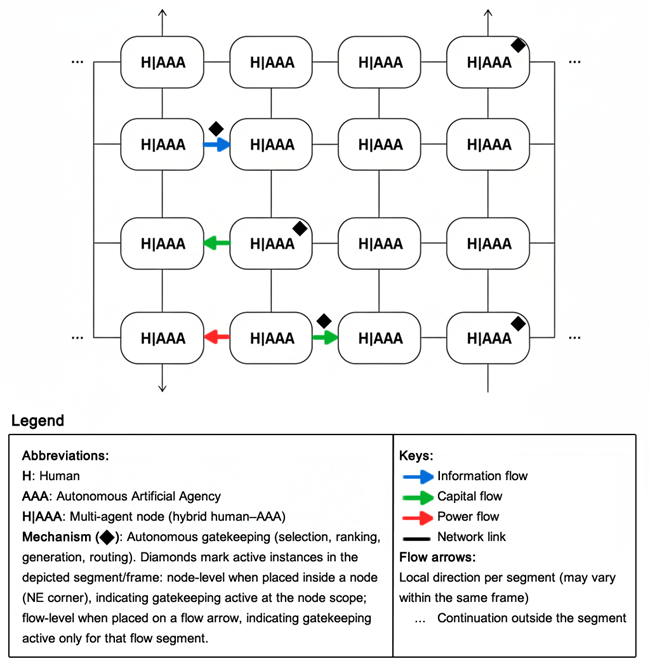
The multi-agent node broadens the traditional human-centric notion of nodes (
Together, these parameters function synergistically to enhance the prognostic utility of the NS theory. By moving beyond an exclusively human-centered ontology, the MANS model equips scholars and practitioners with conceptual tools to anticipate and analyze future techno-social transformations characterized by AAA and value-laden technological mediation. This enables the forecasting of scenarios where non-human actors play central roles in shaping flows of capital, information, and power, thereby facilitating a nuanced understanding of emerging power configurations and social dynamics.
Moreover, the model provides a robust framework for navigating the complexities of governance, ethics, and regulation in hybrid techno-social environments. It allows for the identification of potential challenges and opportunities arising from the distributed nature of agency within networks and AI-mediated de facto gatekeeping at scale, supporting informed decision-making and policy development. In doing so, the MANS model not only responds to empirical realities but also anticipates ongoing and future shifts in network architectures.
Importantly, this extension of Castells’ foundational work demonstrates the solidity and enduring relevance of his original theory. The model remains anchored in
Limitations and Challenges of the Multi-Agent Network Society Model
While the MANS model offers enhanced analytical capabilities, its application is subject to inherent limitations and open challenges. Firstly, the operational opacity of contemporary GAI systems presents a significant methodological challenge, making it difficult to precisely trace and empirically validate the operational autonomy and gatekeeping effects of AI -mediated circulation (i.e., autonomous gatekeeping, as defined above). This opacity complicates the direct observation of artificial agency in a manner comparable to human agency. Secondly, the model is inherently dependent on the stability of digital infrastructure. A large-scale systemic failure or a "network collapse" would temporarily nullify the agency of artificial nodes, revealing a critical fragility in the hybrid techno-social structure. Thirdly, the model currently prioritizes the ontological shift but requires further development to fully integrate the legal and political frameworks necessary to manage multi-agent accountability. The translation of AAA into established legal concepts of responsibility and governance remains a complex area for future inquiry, underscoring that the model is a theoretical tool requiring ongoing empirical and regulatory refinement.
CONCLUSIONS
Conclusion and Theoretical Contribution
In direct response to the RQS, the study establishes the following key findings:
RQ1 (extension of the framework): Castells' theoretical framework can be effectively extended, provided that the definition of node moves from an exclusively human-centric focus to a multi-agent structure. The MANS model successfully integrates autonomous artificial agents as active, computational actors, adapting the core concepts (network, space of flows, timeless time) to hybrid techno-social structures without losing their foundational utility (Figure 2).
RQ2 (AAA): The findings support the claim that GAI-enabled socio-technical arrangements can be conceptualized as operational AVVS. This refutation of technological neutrality shows that GAI actively generates, shapes, and propagates specific interests, biases, and normative outcomes embedded within its operational logics. GAI systems are thus revealed as active, value-laden agents that influence social, economic, and political processes without continuous, real-time human intervention, but remaining bounded by human-set design objectives and socio-technical constraints.
RQ3 (shift in the power structure): The empirical investigation indicates that GAI functions as a new operational gatekeeper in the space of flows. This autonomous gatekeeping capacity—filtering, prioritizing, and generating content at scale—directly influences human behavior and cognition, challenging Castells’ original dynamics of power and necessitating a reassessment of who (or what) truly holds structural power in NS, as illustrated above. The principal theoretical contribution is the MANS framework, defined by the three interrelated conceptual parameters: the multi-agent node, AVV, and the hybrid techno-social structure. This rigorous ontology captures the distributed agency of both human and artificial actors, ensuring the continued relevance of Castells’ work in the age of AI -mediated operational gatekeeping.
Future Research Directions
The transition to a MANS model calls for empirical validation and consideration of its societal consequences. Future research should focus on the following lines of work:
- Empirical measurement of AVV: Metrics should be developed to quantify the influence of GAI on public opinion, market behavior, and political discourse, moving beyond anecdotal evidence (
Bar-Gil, 2023 ;Voinea, 2025 ). - Operational dependence metrics: Future studies should develop indicators to quantify human-in-the-loop dependence in AAA/AVV systems, including the frequency and latency of human interventions or overrides, the proportion of actions executed without real-time approval, and infrastructural dependency mapping across data, compute, and platform access. These indicators would help clarify when autonomy remains operational or de facto rather than strong (i.e., self-authored ends).
- Rethinking digital sovereignty: The challenge posed by AVV to the concept of digital sovereignty in nation-states should be analyzed, particularly regarding information gatekeeping and automated journalism (
Voinea, 2025 ). - The transformation of MSC: The introduction of the multi-agent node challenges
Castells' (2009) concept of MSC which he defines as mass communication that is self-generated, self-directed, and self-selected, with the potential capacity to reach a global audience. Future studies should examine the shift from human-generated MSC to autonomous mass communication, where content production and filtering are increasingly driven by AAA and AVV. This transformation raises critical questions about the nature of public discourse and informational autonomy in MANS. - Policy and governance integration: This involves exploring mechanisms to integrate the MANS framework into global governance, ensuring that emerging AI regulatory initiatives move beyond outdated, human-centric models. Concurrently, it requires specifying institutional pathways for multidisciplinary coordination and evidence-based support capable of matching the velocity of AVV.
- Regulatory, ethical, and institutional challenges: Future research should investigate challenges posed by AVV-mediated flows, including erosion of information trust (deepfakes), democratic oversight implications, and institutional pathways for multidisciplinary coordination (e.g., multidisciplinary inter-university centers as illustrative options for evidence-based AI governance).
- High-stakes domain validation: The model's predictive power could be empirically tested in critical technological domains (military systems, quantum computing). Lethal autonomous weapon systems performing delegated target-selection represent extreme cases of operational agency under human-set constraints, providing testbeds for assessing the model's utility where value-laden flows have geopolitical implications.
- Artificial general intelligence (AGI): Often associated with extreme-risk thresholds, it is commonly described as an AI system that is at least as capable as a human at most tasks (
Morris et al., 2025 ). Because AVV -style GAI may operate under limited interpretability and accountability (Pasquale, 2015 ), coupling AGI with future computational infrastructures (including quantum computing and quantum networking) introduces configuration-level uncertainty. Accordingly, future theoretical work should investigate as a speculative, open question the possibility of emergent strong autonomy at scale within a configuration-level meta-network (as defined in the Discussion). At the same time, it should note that this remains conceptually distinct from the operational and de facto autonomy empirically demonstrated in this paper. - Quantum infrastructure and governance strain: Technological convergence with quantum computing and networking could strain human-centric governance by introducing additional layers of network complexity and trust dependencies in future communication infrastructures (
Vermaas et al., 2025 ). Directional functions extend to policy agendas and technical standards (Coenen et al., 2022 ), demanding preliminary conceptual inquiry while affirming the MANS model as a specification—not replacement—of Castells' NS.
In sum, the MANS model represents a significant theoretical advancement by specifying Castells’ NS for contemporary AI-mediated environments. It preserves the legacy of Castells’ work while providing enhanced analytical and prognostic capabilities for understanding the complex, hybrid realities of twenty-first-century network societies.
CONFLICTS OF INTEREST
The author declares no conflicts of interest. No external funding was received for this study.
ARTIFICIAL INTELLIGENCE USE STATEMENT
The author confirms the selective use of AI tools during the preparation of this manuscript. Specifically, Gemini (Google) was employed exclusively for linguistic and stylistic revision to enhance clarity and academic tone. Furthermore, Yomo.ai was utilized for external anti-plagiarism analysis and to provide structural quality feedback. All conceptual content and analysis remain the sole product of the human author.
FOOTNOTES
- arrow_upward * This manuscript is the result of an independent study. The author was not associated with any particular institutional research project for the preparation of this paper. No external funding was received.
REFERENCES
- arrow_upward Anttiroiko, A.-V. (2015). Networks in context: the concept of network in Manuel Castells’ theory of the network society. Theoretical and Practical Research in Economic Fields, 6(1), 65-80. https://doi.org/10.14505/tpref.v6.1(11).04
- arrow_upwardBarabási, A.-L. (2016). Network Science. Cambridge University Press.
- arrow_upward Bar-Gil, O. (2023). The dance of agencies in AI art–beyond the creator-tool dichotomy, a netnographic analysis of Reddit forums. Journal of Posthuman Studies, 7(2), 129-149. https://doi.org/10.5325/jpoststud.7.2.0129
- arrow_upward Baron, L. F., & Agostini, S. (2022). ICT and Migration in Latin American Pacific. Paths and Trajectories of Pacific Colombian Migrants. Perspectivas de la Comunicación, 15(2), 99-138. https://doi.org/10.56754/0718-4867.1502.099
- arrow_upward Bojić, L., Cinelli, M., Ćulibrk, D., & Delibašić, B. (2024). CERN for AI: a theoretical framework for autonomous simulation-based artificial intelligence testing and alignment. European Journal of Futures Research, 12(1), art. 15. https://doi.org/10.1186/s40309-024-00238-0
- arrow_upward Brogaard, J., Hendershott, T., & Riordan, R. (2014). High-Frequency Trading and Price Discovery. The Review of Financial Studies, 27(8), 2267-2306. https://doi.org/10.1093/rfs/hhu032
- arrow_upward Carnoy, M., & Castells, M. (2002). Globalization, the knowledge society, and the Network State: Poulantzas at the millennium. Global Networks, 1(1), 1-18. https://doi.org/10.1111/1471-0374.00002
- arrow_upward Cartea, Á., Jaimungal, S., & Penalva, J. (2015). Algorithmic and High-Frequency Trading. Cambridge University Press.
- arrow_upward Castells, M. (2000). The Rise of the Network Society (2nd Ed.). Blackwell Publishers.
- arrow_upward Castells, M. (2009). Communication Power. Oxford University Press.
- arrow_upward Castells, M. (2010). The Rise of the Network Society (2nd Ed.). Wiley-Blackwell.
- arrow_upward Cesaroni, V. (2024). Inclusive education in the age of AI: A critical perspective on policy guidelines through the lens of ecological-systemic theory of technological mediation. Education Sciences & Society, 15(2), 329-341. https://doi.org/10.3280/ess2-2024oa18453
- arrow_upward Coenen, C., Grinbaum, A., Grunwald, A., Milburn, C., & Vermaas, P. (2022). Quantum technologies and society: towards a different spin. NanoEthics, 16(1), 1-6. https://doi.org/10.1007/s11569-021-00409-4
- arrow_upward Corbin, J., & Strauss, A. (2014). Basics of Qualitative Research: Techniques and Procedures for Developing Grounded Theory. Sage publications.
- arrow_upward Cummings, M. L. (2017). Artificial Intelligence and the Future of Warfare [Research Paper]. https://www.chathamhouse.org/sites/default/files/publications/research/2017-01-26-artificial-intelligence-future-warfare-cummings-final.pdf
- arrow_upward Dominici, P. (2005). La comunicazione nella società ipercomplessa: Istanze per l'agire comunicativo e la condivisione della conoscenza nella network society. Aracne.
- arrow_upward Eisenhardt, K. M. (1989). Building Theories from Case Study Research. Academy of Management Review, 14(4), 532-550. https://doi.org/10.5465/amr.1989.4308385
- arrow_upward Floridi, L. (2005). The ontological interpretation of informational privacy. Ethics and information technology, 7(4), 185-200. https://doi.org/10.1007/s10676-006-0001-7
- arrow_upward Floridi, L., & Sanders, J. W. (2004). On the morality of artificial agents. Minds and Machines, 14(3), 349-379. https://doi.org/10.1023/B:MIND.0000035461.63578.9d
- arrow_upward Frankfurt, H. G. (1971). Freedom of the Will and the Concept of a Person. The Journal of Philosophy, 68(1), 5-20. https://doi.org/10.2307/2024717
- arrow_upward Hagendorff, T. (2024). Deception abilities emerged in large language models. Proceedings of the National Academy of Sciences, 121(24), art. e2317967121. https://doi.org/10.1073/pnas.2317967121
- arrow_upward Horling B., & Lesser V. (2004). A survey of multi-agent organizational paradigms. The Knowledge Engineering Review, 19(4), 281-316. https://doi.org/10.1017/S0269888905000317
- arrow_upward Kirilenko, A., Kyle, A. S., Samadi, M., & Tuzun, T. (2017). The Flash Crash: High‐Frequency Trading in an Electronic Market. The Journal of Finance, 72(3), 967-998. https://doi.org/10.1111/jofi.12498
- arrow_upward Kuss, P. M., & Meske, C. (2025). From Entity to Relation? Agency in the Era of Artificial Intelligence. Communications of the Association for Information Systems, 56, 633-674. https://doi.org/10.17705/1CAIS.05626
- arrow_upward Latour, B. (1992). Where Are the Missing Masses? The Sociology of a Few Mundane Artifacts. In W. E. Bijker & J. Law (Eds.), Shaping Technology/Building Society: Studies in Sociotechnical Change (pp. 225-258). The MIT Press.
- arrow_upward Latour, B. (2005). Reassembling the Social: An Introduction to Actor-Network-Theory. Oxford University Press.
- arrow_upward McCarthy, J. (1979). Ascribing Mental Qualities to Machines. https://www-formal.stanford.edu/jmc/ascribing.pdf
- arrow_upward Miconi, A. (2011). Reti. Origini e Struttura della Network Society. Il Mulino.
- arrow_upward Mitchell, M. (2019). Artificial Intelligence: A Guide for Thinking Humans. Farrar, Straus and Giroux.
- arrow_upward Morris, M. R., Sohl-Dickstein, J., Fiedel, N., Warkentin, T., Dafoe, A., Faust, A., Farabet, C., & Legg, S. (2025). Position: Levels of AGI for Operationalizing Progress on the Path to AGI. arXiv. https://doi.org/10.48550/arXiv.2311.02462
- arrow_upward Mukherjee, A., & Chang, H. H. (2025). Stochastic, Dynamic, Fluid Autonomy in Agentic AI: Implications for Authorship, Inventorship, and Liability. arXiv. https://doi.org/10.48550/arXiv.2504.04058
- arrow_upward Pasquale, F. (2015). The Black Box Society: The Secret Algorithms that Control Money and Information. Harvard University Press.
- arrow_upward Punziano, G. (2025). Adaptive Epistemology: Embracing Generative AI as a Paradigm Shift in Social Science. Societies, 15(7), art. 205. https://doi.org/10.3390/soc15070205
- arrow_upward Roberts, S. T. (2019). Behind the Screen: Content Moderation in the Shadows of Social Media. Yale University Press.
- arrow_upward Russell, S., & Norvig, P. (2020). Artificial Intelligence: A Modern Approach (4th Ed.). Pearson.
- arrow_upward Sartori, L. (2012). La società dell’informazione. Il Mulino.
- arrow_upward Satyanarayan, A. (2024). Intelligence as Agency. In Adjunct Proceedings of the 37th Annual ACM Symposium on User Interface Software and Technology (art. 65). Association for Computing Machinery. https://doi.org/10.1145/3672539.3695751
- arrow_upward Shoham, Y., & Leyton-Brown, K. (2009). Multiagent Systems: Algorithmic, Game-Theoretic, and Logical Foundations. Cambridge University Press.
- arrow_upward Suchman, L. A. (2000). Embodied Practices of Engineering Work. Mind, Culture, and Activity, 7(1-2), 4-18. https://doi.org/10.1080/10749039.2000.9677645
- arrow_upward Suchman, L. A. (2007). Human-Machine Reconfigurations: Plans and Situated Actions (2nd Ed.). Cambridge University Press.
- arrow_upward van Dijck, J., Poell, T., & de Waal, M. (2018). The Platform Society: Public Values in a Connective World. Oxford University Press.
- arrow_upward van Dijk, J. A. G. M. (1999). The One-Dimensional Network Society of Manuel Castells. New Media & Society, 1(1), 127-138. https://doi.org/10.1177/1461444899001001015
- arrow_upward Vermaas, P. E., Possati, L., & Seskir, Z. C. (2025). Quantum Internet, Governance, Trust, and the Promise of Secure Communication: On building a Quantum Internet that will be used. arXiv. https://doi.org/10.48550/arXiv.2505.15852
- arrow_upward Voinea, D. V. (2025). Reconceptualizing Gatekeeping in the Age of Artificial Intelligence: A Theoretical Exploration of Artificial Intelligence-Driven News Curation and Automated Journalism. Journalism and Media, 6(2), art. 68. https://doi.org/10.3390/journalmedia6020068
- arrow_upward Watson, S., Brezovec, E., & Romic, J. (2025). The role of generative AI in academic and scientific authorship: an autopoietic perspective. AI & Society, 40(5), 3225-3235. https://doi.org/10.1007/s00146-024-02174-w
- arrow_upward Webster, F. (2007). Theories of the Information Society. Routledge.
- arrow_upward Weick, K. E. (1989). Theory Construction as Disciplined Imagination. Academy of Management Review, 14(4), 516-531. https://doi.org/10.5465/amr.1989.4308376
- arrow_upward Williams, R., & Edge, D. (1996). The social shaping of technology. Research Policy, 25(6), 865-899. https://doi.org/10.1016/0048-7333(96)00885-2
- arrow_upward Winner, L. (1980). Do Artifacts Have Politics? Daedalus, 109(1), 121-136. https://www.jstor.org/stable/20024652
- arrow_upward Wooldridge, M. (2009). An Introduction to Multiagent Systems (2nd Ed.). Wiley.
- arrow_upward Yin, R. K. (2009). Case Study Research: Design and Methods (4th Ed.). Sage Publications.

 Google