Technonecromancy: Simulacra of Presence and the Politics of Death in the Age of Generative Artificial Intelligence*
Tecnonecromancia: simulacros de presencia y políticas de la muerte en la era de la inteligencia artificial generativa
 PDF
Received: October 17, 2025
Accepted: May 5, 2026
da Silva, G. S., & Ulbricht, V. R. (2026). Technonecromancy: Simulacra of Presence and the Politics of Death in the Age of Generative Artificial Intelligence. Trilogía Ciencia Tecnología Sociedad , 18(39), e3723. https://doi.org/10.22430/21457778.3723
Abstract
This article theorizes technonecromancy as a novel regime of mediation that operationalizes spectral presence through generative models, voice cloning, and synthetic video, shifting the relation to the dead from archival recollection to dialogic simulation. Conceptually, it integrates science, technology, and society studies with phenomenology and 4E cognition to argue that posthumous agents are phenomenologically sufficient to reorganize mourning yet ontologically insufficient as continuants of persons. Empirically, it reads cultural and commercial cases (such as griefbots and animated photo apps) as epistemologies of the technocultural present, demonstrating how engineered responsiveness can both scaffold continuing bonds and entrench dependence, thereby reconfiguring rituals of loss and memory. Normatively, it advances a consent-first, provenance-rich governance program, with mandatory disclosure, machine-readable labeling, and revocability, aligned with frameworks, such as the European Union Artificial Intelligence Act’s transparency duties for synthetic content, and calls for fiduciary stewardship of digital remains. Thus, this study situates these proposals within the emerging digital afterlife industry, noting that social acceptability collapses absent explicit pre-mortem authorization and that professionalization is beginning to reshape industry standards. The result is a political-economic diagnosis: technonecromancy is a world-making apparatus whose risks and benefits can only be adjudicated where ontological critique, clinical harm minimization, and market governance converge.
Keywords: digital afterlife, governance, necrocapitalism, STS studies, technonecromancy.
Resumen
Este artículo teoriza la tecnonecromancia como un novedoso régimen de mediación que operacionaliza la presencia espectral a través de modelos generativos, clonación de voz y video sintético, desplazando la relación con los muertos desde el recuerdo archivístico hacia la simulación dialógica. Conceptualmente, integra los estudios de ciencia, tecnología y sociedad con la fenomenología y la cognición 4E para argumentar que los agentes póstumos son fenomenológicamente suficientes para reorganizar el duelo, pero ontológicamente insuficientes como continuantes de las personas. Empíricamente, analiza casos culturales y comerciales (como los griefbots y las aplicaciones de fotos animadas) como epistemologías del presente tecnocultural, demostrando cómo la capacidad de respuesta diseñada puede tanto andamiar los vínculos continuos como afianzar la dependencia, reconfigurando así los rituales de pérdida y memoria. Normativamente, propone un programa de gobernanza basado en el consentimiento previo y rico en procedencia, con divulgación obligatoria, etiquetado legible por máquina y revocabilidad, alineado con marcos como los deberes de transparencia de la Ley de Inteligencia Artificial de la Unión Europea para el contenido sintético, y aboga por una custodia fiduciaria de los restos digitales. Así pues, esta investigación sitúa estas propuestas dentro de la emergente industria de la vida digital post mortem, señalando que la aceptabilidad social colapsa en ausencia de una autorización explícita pre mortem y que la profesionalización está comenzando a remodelar los estándares de la industria. El resultado es un diagnóstico político-económico: la tecnonecromancia es un aparato de construcción de mundos cuyos riesgos y beneficios solo pueden ser adjudicados donde convergen la crítica ontológica, la minimización de daños clínicos y la gobernanza del mercado.
Palabras clave: vida digital post mortem, gobernanza, necrocapitalismo, estudios cts, tecnonecromancia.
INTRODUCTION
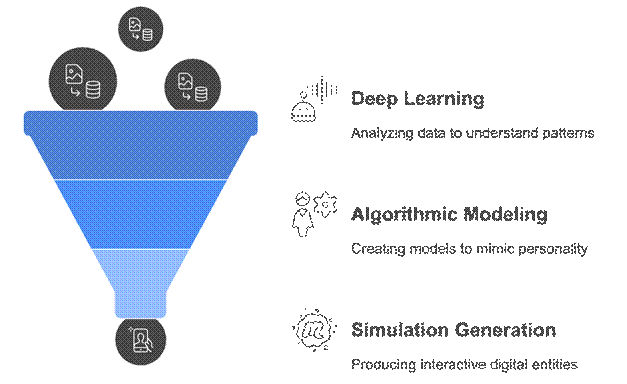
The emergence of posthumous simulations (interactive digital entities generated through large-scale data extraction, deep learning architectures, and algorithmic modeling of personality and voice) has inaugurated what may be termed a thanatotechnical shift in the history of mediation. Against this backdrop, the contemporary condition of technoscience manifests itself as an ontological experiment that dissolves the boundaries between the living and the non-living, the animate and the inanimate, the mortal and the machinic. Technology ceases simply to preserve traces of the dead and begins instead to perform their semblance, animating new forms of presence-in-absence that transform the ontology of memory and mourning (
Traditional digital memorialization, such as social media archives, photo repositories, or textual legacies, presupposed a static metaphysics of trace. However, the rise of Generative Artificial Intelligence (GAI) introduces a dynamic metaphysics of simulation—a capacity to produce responsive avatars, voice clones, and conversational agents that replicate both the appearance and the behavioral potentialities of the deceased (
Within the field of Science, Technology, and Society (STS) studies, death and digitality have rarely been theorized beyond the framework of grief technologies (grief techs) and digital afterlife services (
Building on adjacent denominations, such as “pseudo-necromancy” (
From a philosophical standpoint, technonecromancy invites a re-examination of the ontological status of simulation: whether these posthumous agents are extensions of an individual’s digital remains, derivative semiotic entities, or entirely new synthetic beings. It thus traverses a conceptual terrain spanning the phenomenology of embodiment (
Accordingly, the following research question orients this inquiry: How do mimetic technologies reconfigure the boundary between life, death, and presence? To answer this, the paper integrates conceptual analysis, cultural case studies, and philosophical genealogy. Its objective is threefold: (i) to define and formalize technonecromancy as a conceptual construct within STS studies; (ii) to map its enabling technologies, including deepfakes, voice cloning, Large Language Models (LLMS), as components of a convergent generative assemblage; and (iii) to interrogate the ethical, ontological, and political consequences of this assemblage.
The contribution of this study is both conceptual and normative. Conceptually, it provides a vocabulary for articulating the emergent symbiosis between GAI and mortuary culture, situating this phenomenon within the broader logic of technocapitalist reproduction. Normatively, it calls for a critical ethics of posthumous mediation that reclaims dignity, finitude, and mourning from the neoliberal commodification of presence. The argument proceeds from the premise that, in a culture where even death becomes generative, the limits of the human are extended and algorithmically overwritten. This process, sketched in Figure 1, describes how the self is converted into a perpetually updatable simulation.
In this sense, technonecromancy both describes a technological innovation and names a paradigmatic mutation in the ontology of subjectivity. It is both a symptom and an operator of a civilization that seeks to abolish loss through computation, transmuting the metaphysical drama of mortality into an aesthetic of recursive persistence. The ensuing analysis, therefore, engages the ethics of data necropolitics (
THEORETICAL FRAMEWORK
In order to articulate technonecromancy as a robust analytical operator, this section is anchored in two primary theoretical axes within STS studies: (i) the sociotechnics of death (digital afterlife systems and grief technocultures) and (ii) the ontology of simulation and hyperreality (the regime of the simulacrum). By establishing these two pillars, the infrastructural and ontological shifts brought by GAI are consolidated. To prevent theoretical overextension and maintain analytical hierarchy, other frameworks mobilized in this analysis—specifically phenomenology, 4E cognition, and necropolitical economy—are explicitly treated as auxiliary lenses. These secondary lenses are deployed strategically to decode specific psychological effects and market incentives, subordinating them to the primary STS studies critique of mediated posthumous presence.
Emergent grief techs, such as chatbots, voice clones, and posthumous avatars driven by Artificial Intelligence (AI), aim to soften the rupture of loss by keeping users connected to the deceased (
This simulated presence carries pathologies. Grief tech can become a "crutch," fostering dependence that entrenches denial rather than enabling closure (
The ontological status of these simulated dead requires consulting simulation theory, particularly the work of Baudrillard, Derrida, Hansen, and Hui.
The algorithmic analogues of personhood challenge stable notions of identity.
This ontological gulf is bridged by the human propensity to anthropomorphize algorithms, projecting agency and continuity onto the simulation, making it feel "almost alive" (
RESEARCH APPROACH
This inquiry is not empirical in the positivist or data-driven sense but resides instead in a theoretical-conceptual, critical, and exploratory register. Its posture is diagnostic, as opposed to confirmatory: the goal is to problematize and reframe latent conditions, rather than to test predetermined hypotheses. To that end, the method weaves conceptual analysis, genealogical historiography, and a phenomenotechnical reading of cultural artifacts and platforms into an integrated hermeneutic (
From the outset, the orientation is exploratory-conceptual: technonecromancy is a nascent domain, requiring thick articulation rather than empirical generalization. The researcher assumes the role of conceptual cartographer, intervening in the discursive field, positing provisional formulations, testing them in cultural reference points, and refining them in iterative cycles. In doing so, the approach remains abductive, moving from concept to case, through refinement, and back to reapplication, with the aim not of closure but of progressively disciplined specification. Genealogical historiography, informed by Foucault’s “history of the present” (
Complementing genealogy, the phenomenotechnical dimension reads technological artifacts, including deepfakes, avatar systems, and chatbots, as mediators of experience—media that structure temporalities, affordances, lags, failures, and spectral tensions (
To render this triadic methodology concrete, this article analyzes a purposive sample of cultural-technological case studies, namely the digital resurrection in Rogue One, Deep Nostalgia (MyHeritage), and HereAfter AI, alongside emerging griefbot platforms. These cases were selected based on three explicit criteria: (i) they represent distinct technical modalities of technonecromancy (cinematic representation, visual or facial animation, and conversational or interactive AI), (ii) they possess high public visibility and market penetration, and (iii) they have served as focal points for significant ethical and affective contestation in contemporary public discourse. Functioning as strategic semiotic probes, these cases serve as epistemological windows into how technonecromantic logics are negotiated in the public imaginary and the Digital Afterlife Industry (DAI).
To operationalize this analysis, the research examined a specific corpus of primary and secondary materials for each selected case. The analyzed sources include the platforms' terms of service and user agreements, promotional materials and marketing discourses, journalistic coverage, and publicly available user testimonials. The analytical procedure consisted of a critical interface hermeneutics, evaluating User Experience (UX) and User Interface (UI) affordances, system latency, and design choices, coupled with a thematic discourse analysis to identify how these platforms frame death, memory, and artificial presence. By triangulating these sources, the analysis surfaces the structural tensions, power effects, and ontological claims embedded in these technologies.
Reflexivity is structurally incorporated, with ongoing attention to the role of the analysis in shaping interpretations through triangulation across technical documentation, user reports, media discourse, and interface affordances. The limitations of this approach are acknowledged, including the lack of large-scale empirical validation, the opacity of proprietary systems, and the risk of analogical overreach. Nevertheless, this methodology functions as a discursive apparatus for the emergence of technonecromancy as a critical object in STS studies, laying the groundwork for subsequent empirical extension, normative elaboration, and technological critique.
ANALYSIS AND DISCUSSION
In this section, the triadic conceptual apparatus developed in the theoretical framework is applied to the selected cultural and technological cases in order to surface how technonecromancy reconfigures the architecture of mourning, identity, ontology, ethics, and economy. The analysis is organized across four interlocking subaxes: (i) mourning and AI-mediated attachment; (ii) simulated identity and embodied cognition; (iii) ontology of simulacra and hyperreality; and (iv) ethics, posthumous consent, memory commodification, and necrocapitalism. Each subsection engages in a dialectical movement, progressing from the technological morphology of the case through its existential implications to a normative interrogation.
Mourning and Artificial-Intelligence-Mediated Attachment
The promissory rhetoric of technonecromancy—that grieving subjects might sustain continuing bonds with the dead—draws knowingly on a decisive revision within bereavement studies. Against the twentieth-century orthodoxy that healthy mourning requires severance,
At the center of this displacement is the griefbot, a computational agent trained on the digital footprints of the deceased that affords two-way conversational presence.
This externalization, however, imposes a phenomenological and clinical cost.
The affective micrology of interfaces like Deep Nostalgia evidences the engineering of this haunting.
From a clinical-nosographic perspective, this in-betweenness is not neutral. The formalization of prolonged grief disorder in the Diagnostic and Statistical Manual of Mental Disorders, Fifth Edition (DSM-5-TR) and its parallel discussion in the eleventh revision of the International Classification of Diseases provide a backdrop for reflecting on specific vulnerabilities (
The question, then, shifts to the ethical design of mediation.
Risk vector (clinical or ethical) | Mechanism in AI mediation | Proposed mitigation (operational) |
| Temporal distortion and compulsive checking | Infinite responsiveness, novelty generation | Session caps, cooldowns, usage nudges, graduated “goodbye mode” |
| Illusion of presence or ontological confusion | Anthropomorphic cues, voice realism, latency smoothing | Persistent simulation disclaimers, tone-down realism controls, optional “memorial-only” modes |
| Affective dependence and rumination | Conversational loops, surprise replies | Opt-in decay of reply frequency, clinician-designed scripts for closure, crisis-flag routing |
| Exploitative retention incentives | Subscription design, gamified engagement | Public reporting of retention metrics, independent audits, ethics impact statements |
| Consent opacity (deceased and survivors) | Vague terms, data lock-in | Granular consent templates, revocation Application Programming Interface (API), post-mortem data executors |
However, from an STS studies perspective, design standards are not enough—incentive structures must be interrogated. In platform markets, retention and time-on-task are king metrics. As
Simulated Identity and Embodied Cognition
Technonecromancy operates at the philosophical seam between discursive mimicry and lived embodiment. While posthumous models replicate lexical patterns with high fidelity, they are constitutively devoid of the proprioception, interoception, and affective homeostasis that scaffold human meaning. This contrasts with 4E cognitive theories (
Phenomenologically, the lived body (Leib) grounds a prereflective body schema that conditions all perception and action (
While Lockean psychological continuity (
The inference from mimicry to mindedness is further eroded by Searle’s Chinese room, which demonstrates that syntactic manipulation does not entail semantic understanding (
Despite these philosophical distinctions, human perceivers routinely over-ascribe mind. The "ELIZA effect," i.e., the anthropomorphization of trivial scripts (
This dynamic is counterbalanced by the uncanny valley, where near-perfect verisimilitude provokes estrangement (
Dimension | Aspects retained by posthumous models | Aspects dependent on embodied existence |
| Lexico-discursive patterns | Idiolect, stylistic tics, argument schemas learned from corpora | Autobiographical feeling of recall, ownership structure of memory (Lockean “same consciousness”) |
| Temporal agency | Conversational turn-taking, response latency engineered to feel human | Biotemporal rhythms (fatigue, hunger), affective pacing grounded in interoceptive regulation |
| Social attunement | Politeness scripts, persona consistency, simulated empathy | Genuine other-affectivity via embodied coupling, “motor intentionality” of lived interaction (Merleau-Ponty) |
| Continuity across branches | Multiple successors with shared initialization | Uniqueness of a life-history, Parfitian branching that undermines identity and yields at best survival-without-identity |
| Understanding | Pragmatic usefulness, high predictive validity | Semantic understanding with qualia, Searle’s syntax or semantics gap, Chalmers’ hard problem |
Taken together, these considerations motivate a stringent conceptual thesis. Posthumous models instantiate discursive continuities—whether stylistic, doxastic, or dialectical—while lacking embodied continuities including interoceptive affect, proprioceptive attunement, and sensorimotor temporality. They are psychologically potent because human perceivers project agency (ELIZA/Media-Equation), yet they remain ontologically hollow relative to identity-constituting embodiment (phenomenology, enaction, interoception).
This assertion is not mere moralism; it is anchored in convergent programs across phenomenology (
Ontology of Simulacra and Hyperreality
Technonecromancy names a repertoire of techniques for animating the dead as responsive presences, and this has an ontological wager. It intervenes in the very traffic between sign and referent, life and semblance, presence and absence. In this respect, it tests—indeed, strains—the classic architecture of simulacra that Baudrillard bequeathed to critical theory. In Baudrillard’s (1994) well-known sequence, representation passes from (i) faithful reflection through (ii) distortion and (iii) masking the absence of a profound reality to (iv) pure simulation without referent (hyperreality). Posthumous agents trained on residues of a life, including texts, images, and voice, produce novel utterances, fresh continuations, and unforeseen interactions. As such, they occupy, not the second order of degraded copy, but the third and fourth orders; they mask the absence (third order) and, as interaction consolidates relational effects, risk replacing reference altogether (fourth order). The hyperreal agent relieves the pain of absence by operationalizing a presence that may become pragmatically more salient, more behaviorally efficacious, than the lost original.
The “digital ghost” is not disembodied ether; it is a body in code, a presence constituted by interfaces, latencies, bandwidths, display regimes, and algorithmic architectures (
In addition, it is important to note that digital entities are ontological unities produced within specific milieux of operation: protocols, metadata schemas, databases, networks (
Two clarifications follow. First, hyperreality in technonecromancy is not a property of images alone but the outcome of interaction. The mimetic status of the avatar or voice clone becomes ontologically potent only as it solicits and stabilizes expectations in the living, what
To foreground the operational nature of this ontological regime, Table 3 maps Baudrillardian simulacral orders to technonecromantic affordances.
Baudrillardian order | Relation to reality | Technonecromantic affordance |
| (i) Faithful copy | Reflects an underlying reality | Static memorial page, photo archive |
| (ii) Distortion | Masks or perverts an underlying reality | Retouched images, curated timelines |
| (iii) Masking absence | Pretends presence despite absence | Voice clone and scripted responses, limited chat |
| (iv) Pure simulacrum (hyperreality) | Skips referents and displaces reality | Generative LLM avatar with evolving memory |
These considerations support the diagnostic claim that technonecromancy thrives between ontological insufficiency and phenomenological sufficiency. The former arises because nothing in the system compels individuals to treat the agent as a continuant of the deceased and the latter occurs because the effects of presence—answering, recalling, and adapting—are functionally achieved. The result is a hyperreal effect of subjectivity, not a subject, which is robust enough to reorganize relations among the living (
This ontological re-inscription has consequences for ethics and governance (
Memory Commodification and Necrocapitalism: Analytical Findings
The governance of technonecromancy is shaped by a legal space of possibilities. Major data protection regimes like the European Union’s (EU) General Data Protection Regulation and Brazil's General Data Protection Law explicitly exclude the deceased. These regulations relegate post-mortem rights to a jurisdictional archipelago of civil law managed by heirs (
Given the technology's affective potency, accountability is paramount. When deployed therapeutically, griefbots should be treated as quasi-medical devices subject to clinical oversight and harm minimization protocols, not as mere entertainment apps (
The economic substrate is a DAI that converts the deceased's data into subscription products designed to prolong engagement, a model antithetical to healthy mourning (
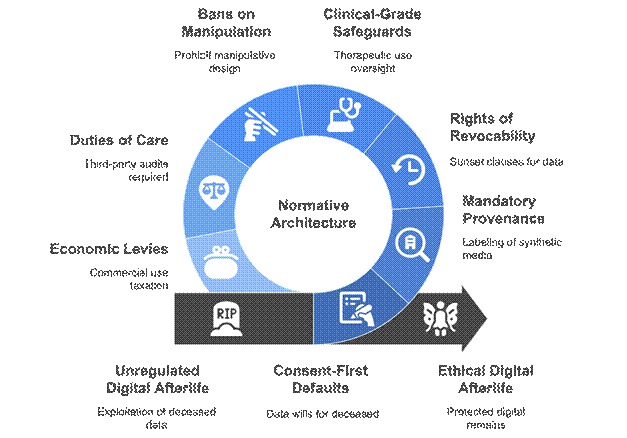
A normative architecture grounded in political-economic structures, sketched in Figure 2, is therefore essential. Key instruments include: (i) consent-first defaults or data wills, (ii) mandatory provenance and labeling, (iii) rights of revocability and sunset clauses, (iv) clinical-grade safeguards for therapeutic use, (v) bans on manipulative design, (vi) duties of care with third-party audits, (vii) economic levies on commercial use, and (viii) a right to silence and erasure. Such safeguards are critical because necropolitics dictates that, without them, existing inequalities will determine whose digital remains are protected and whose are exploited, defining who is simulated, who profits, and who is left to haunt (
Anticipatory Governance and Normative Proposals
Having established the analytical findings regarding the ontological insufficiency and the necrocapitalist extraction of posthumous models, a transition from critical diagnosis to anticipatory governance should now take place. Normative architecture cannot rely on abstract ethics; it must couple rights and design with concrete market-shaping instruments. The following prioritized framework proposed specifies institutional actors and immediate implementation steps:
- 1) Consent-First Defaults or Data Wills
- ▪ Primary actors: Legislators and data protection authorities (e.g., European Data Protection Board, Brazil's National Data Protection Agency).
- ▪ Implementation: Regulatory bodies must mandate specific, granular, and revocable pre-mortem instructions (data wills) as a prerequisite for any simulation. The immediate step is drafting standardized legal templates for post-mortem data stewardship that integrate with existing civil law mechanisms.
- 2) Provenance and Labeling
- ▪ Primary actors: Technology companies, UX designers, and standard-setting bodies (e.g., IEEE, ISO).
- ▪ Implementation: Mandatory machine-readable provenance for voice, text, and image outputs must be built into the infrastructural layer. The immediate priority is the enforcement of conspicuous UI disclosure (watermarks) and public APIs for verification, aligning with transparency duties established in the AI Act.
- 3) Clinical-Grade Safeguards
- ▪ Primary actors: Health regulators, ethics boards, and DAI platforms.
- ▪ Implementation: When systems are positioned as grief support, they must shift from "entertainment" to therapeutic oversight. Platforms must immediately implement design-level interventions: session caps, forced cooldowns, "goodbye" modes, and automated referral pathways for prolonged grief symptoms.
- 4) Revocability and Right to Silence
- ▪ Primary actors: Estate executors and platform administrators.
- ▪ Implementation: Heirs or designated fiduciaries must retain statutory rights for suspending or retiring replicas. Platforms must provide a portable, accessible mechanism (a "kill switch" API) to withdraw training data for future instantiations without bureaucratic friction.
- 5) Economic Instruments or Levies
- ▪ Primary actors: Tax authorities and policymakers.
- ▪ Implementation: A levy or royalty fund on commercial technonecromancy must be instituted to correct market externalities. Funds should be immediately directed to support independent mental-health research, public oversight, and digital literacy regarding synthetic media.
CONCLUSIONS
Technonecromancy designates a novel regime of mediation in which the relation between the living and the dead is architected as interactive computation. Against archival memorialization, the technonecromantic dispositif fuses generative models, speech synthesis, and synthetic video to produce dialogic afterlives that are phenomenologically sufficient to reorganize mourning, memory, and authority, even as they remain ontologically insufficient as continuants of persons. The authentic innovation is not the dream of survival but the operationalization of spectral presence as a routine service under platform logics and emerging governance. Consequently, the question shifts from what the dead are to what their engineered presence does across psychological, legal, and political-economic registers (
This study argued that technonecromancy effects a triple reconfiguration. First, it resignifies ontology by replacing representation with performative presence, i.e., hyperreal agents whose “replies” displace remembrance with interaction. Second, it rearranges ethics, because consent (if it exists) must be radically prospective and revocable across evolving technical affordances. This demand is nowadays echoed by policy regimes that enshrine disclosure, provenance, and content labeling for synthetic media (
The normative upshot is clear. Posthumous simulation should include consent-first defaults (opt-in, granular, and delegable), a stance empirically reinforced by survey evidence that social acceptability collapses absent explicit authorization (
Finally, technonecromancy is inseparable from necrocapitalism—the capitalization of death’s residues and the bereaved’s attention—unless policy politicizes ethics beyond voluntary codes and addresses structural incentives (
CONFLICTS OF INTEREST
The authors declare no conflicts of interest.
AUTHORSHIP CONTRIBUTION
Gustavo Simas da Silva was responsible for the conceptualization, research design, investigation, and writing of the original draft. Vânia Ribas Ulbricht was responsible for the critical revision and final review of the manuscript. Both authors have read and agreed to the published version of the text.
ARTIFICIAL INTELLIGENCE USE STATEMENT
In the preparation of this manuscript, the authors utilized Google Gemini 2.5 Pro and ChatGPT 5. These tools provided assistance in the (a) exploratory research to identify foundational concepts and relevant literature, (b) translation of specific terms and passages, and (c) orthographic and grammatical review to improve the clarity and quality of the text. In accordance with academic integrity standards, all AI-generated content was diligently supervised, reviewed, and verified by the authors, who retain full responsibility for the accuracy, validity, and final substance of the study. Therefore, these AI tools are not credited with authorship.
FOOTNOTES
- arrow_upward * This article is an independent study and is not associated with a specific formal research project. Rather, it forms part of the primary author’s doctoral research at the intersection of artificial intelligence and Science, Technology, and Society (STS) studies.
REFERENCES
- arrow_upward Afroza, N. (2023). Derek Parfit on Personal Identity: Relation-R and Moral Commitments. In International Conference on Social Sciences and Humanities (pp. 20-28). https://doi.org/10.61463/ijset.icsshrt-2023.102
- arrow_upward Amershi, S., Weld, D., Vorvoreanu, M., Fourney, A., Nushi, B., Collisson, P., Suh, J., Iqbal, S., Bennett, P. N., Inkpen, K., Teevan, J., Kikin-Gil, R., & Horvitz, E. (2019). Guidelines for Human-AI interaction. In Proceedings of the 2019 CHI Conference on Human Factors in Computing Systems (Paper No. 3). Association for Computing Machinery. https://doi.org/10.1145/3290605.3300233
- arrow_upward Attali, J. (2003). L’homme nomade. Fayard.
- arrow_upward Banerjee, S. B. (2008). Necrocapitalism. Organization Studies, 29(12), 1541-1563. https://doi.org/10.1177/0170840607096386
- arrow_upward Baudrillard, J. (1994). Simulacra and Simulation (S. Faria Glaser, Trad.). University of Michigan Press.
- arrow_upward Chalmers, D. J. (1995). Absent qualia, fading qualia, dancing qualia. In T. Metzinger (Ed.), Conscious Experience (pp. 309-328). Ferdinand Schöningh.
- arrow_upward Cheng, K. Y. (2025). The law of digital afterlife: The Chinese experience of AI ‘resurrection’ and ‘grief tech’. International Journal of Law and Information Technology, 33, art. eaae029. https://doi.org/10.1093/ijlit/eaae029
- arrow_upward Chimisso, C. (2008). From phenomenology to phenomenotechnique: The role of early twentieth-century physics in Gaston Bachelard’s philosophy. Studies in History and Philosophy of Science Part A, 39(3), 384-392. https://doi.org/10.1016/j.shpsa.2008.06.010
- arrow_upward Clark, A., & Chalmers, D. (1998). The Extended Mind. Analysis, 58(1), 7-19. https://www.jstor.org/stable/3328150
- arrow_upward Colombetti, G., & Krueger, J. (2015). Scaffoldings of the affective mind. Philosophical Psychology, 28(8), 1157-1176. https://doi.org/10.1080/09515089.2014.976334
- arrow_upward Copenhaver, R. (2009). Reid on Memory and Personal Identity. In E. N. Zalta (Ed.), The Stanford Encyclopedia of Philosophy. https://plato.stanford.edu/entries/reid-memory-identity/
- arrow_upward Corcoran, M., & Di Carlo, A. (2022). ‘Pseudonecromantic spectres’: Dark media and the technological sublime in eighteenth-century phantasmagoria. Arrêt sur scène/Scene Focus, (11). https://doi.org/10.4000/asf.2920
- arrow_upward Couldry, N., & Hepp, A. (2018). The Mediated Construction of Reality. John Wiley & Sons.
- arrow_upward Craig, A. D. (2002). How do you feel? Interoception: The sense of the physiological condition of the body. Nature Reviews Neuroscience, 3(8), 655-666. https://doi.org/10.1038/nrn894
- arrow_upward Craig, A. D. (2003). Interoception: The sense of the physiological condition of the body. Current Opinion in Neurobiology, 13(4), 500-505. https://doi.org/10.1016/s0959-4388(03)00090-4
- arrow_upward Cunningham, J. (2024). Simulacra on steroids: AI art and the Baudrillardian hyperreal. Issues in Information Systems, 25(2), 1-8. https://doi.org/10.48009/2_iis_2024_101
- arrow_upward Damasio, A. R. (1999). How the Brain Creates the Mind. Scientific American, 281(6), 112-117. https://doi.org/10.1038/scientificamerican1299-112
- arrow_upward Danesi, M. (2024). Simulacrum Culture. In AI-Generated Popular Culture: A Semiotic Perspective (pp. 159-174). Springer Nature Switzerland.
- arrow_upward Derrida, J. (2024). Spectres de Marx: L'état de la dette, le travail du deuil et la nouvelle Internationale. Seuil.
- arrow_upward Dufner, A. (2025). Personal Identity and Ethics. In E. N. Zalta (Ed.), The Stanford Encyclopedia of Philosophy. https://plato.stanford.edu/entries/identity-ethics/
- arrow_upward Eisma, M. C. (2023). Prolonged grief disorder in ICD-11 and DSM-5-TR: Challenges and controversies. Australian & New Zealand Journal of Psychiatry, 57(7), 944-951. https://doi.org/10.1177/00048674231154206
- arrow_upward Epley, N., Waytz, A., & Cacioppo, J. T. (2007). On seeing human: A three-factor theory of anthropomorphism. Psychological Review, 114(4), 864-886. https://doi.org/10.1037/0033-295X.114.4.864
- arrow_upward EU Artificial Intelligence Act. (2024). The AI Act Explorer. https://artificialintelligenceact.eu/ai-act-explorer/
- arrow_upward Fang, K. (2024). “You act as Human, and I will act as AI”: Technological Rehearsals at the Interface. TDR: The Drama Review, 68(2), 131-150. https://doi.org/10.1017/S1054204324000042
- arrow_upward First, M. B., Clarke, D. E., Yousif, L., Eng, A. M., Gogtay, N., & Appelbaum, P. S. (2023). DSM-5-TR: Rationale, Process, and Overview of Changes. Psychiatric Services, 74(8), 869-875. https://doi.org/10.1176/appi.ps.20220334
- arrow_upward Fisher, M. (2014). Ghosts of My Life: Writings on Depression, Hauntology and Lost Futures. Zero Books.
- arrow_upward Foglia, L., & Wilson, R. A. (2013). Embodied cognition. WIREs Cognitive Science, 4(3), 319-325. https://doi.org/10.1002/wcs.1226
- arrow_upward Forrest, K. B. (2024). The Ethics and Challenges of Legal Personhood for AI. The Yale Law Journal Forum, 133, 1175-1210. https://yalelawjournal.org/forum/the-ethics-and-challenges-of-legal-personhood-for-ai
- arrow_upward Gallagher, S. (2014). Phenomenology and embodied cognition. In L. Shapiro (Ed.), The Routledge Handbook of Embodied Cognition (pp. 9-18). Routledge.
- arrow_upward Garland, D. (2014). What is a “history of the present”? On Foucault’s genealogies and their critical preconditions. Punishment & Society, 16(4), 365-384. https://doi.org/10.1177/1462474514541711
- arrow_upward Gruvæus, A. (2023). Beyond Peak Death?—The Advent of Digital Necromancy and Functional Ghosts. Journal of Future Studies, 27(3), 103-109. https://jfsdigital.org/articles-and-essays/2023-2/beyond-peak-death-the-advent-of-digital-necromancy-and-functional-ghosts/
- arrow_upward Hamuľák, O., Kocharyan, H., & Kerikmäe, T. (2020). The Contemporary Issues of Post-Mortem Personal Data Protection in the EU after GDPR Entering into Force. Czech Yearbook of Public & Private International Law, 11, 225-238. https://rozkotova.cld.bz/CYIL-vol-11-2020/224/
- arrow_upward Hansen, M. B. N. (2006). Bodies in Code: Interfaces with Digital Media. Routledge.
- arrow_upward Hansen, M. B. N. (2024). Deepfake Reality, Societies for Technical Feeling, and the Phenomenotechnics of Animation. In T. Tamari (Ed.), Human Perception and Digital Information Technologies (pp. 213-238). Bristol University Press.
- arrow_upward Hollanek, T., & Nowaczyk-Basińska, K. (2024). Griefbots, Deadbots, Postmortem Avatars: On Responsible Applications of Generative AI in the Digital Afterlife Industry. Philosophy & Technology, 37(2), art. 63. https://doi.org/10.1007/s13347-024-00744-w
- arrow_upward Hui, Y. (2016). On the Existence of Digital Objects. University of Minnesota Press.
- arrow_upward Iwasaki, M. (2024). Digital Cloning of the Dead: Exploring the Optimal Default Rule. Asian Journal of Law and Economics, 15(1), 1-29. https://doi.org/10.1515/ajle-2023-0125
- arrow_upward Jiménez-Alonso, B., & Brescó de Luna, I. (2023). Griefbots. A New Way of Communicating With The Dead? Integrative Psychological and Behavioral Science, 57(2), 466-481. https://doi.org/10.1007/s12124-022-09679-3
- arrow_upward Keightley, E. (2013). From immediacy to intermediacy: The mediation of lived time. Time & Society, 22(1), 55-75. https://doi.org/10.1177/0961463X11402045
- arrow_upward Khusyainov, T. M., & Urusova, E. A. (2024). Death and Digital Immortality: Hi-Tech Grief. Čelovek, 35(1), 141-157. https://doi.org/10.31857/S0236200724010104
- arrow_upward Kidd, J., & Nieto McAvoy, E. (2023). Deep Nostalgia: Remediated memory, algorithmic nostalgia and technological ambivalence. Convergence: The International Journal of Research into New Media Technologies, 29(3), 620-640. https://doi.org/10.1177/13548565221149839
- arrow_upward Klass, D., Silverman, P. R., & Nickman, S. (Eds.). (1996). Continuing Bonds: New Understandings of Grief. Taylor & Francis.
- arrow_upward Kopelman, S., & Frosh, P. (2025). The “algorithmic as if”: Computational resurrection and the animation of the dead in Deep Nostalgia. New Media & Society, 27(4), 2393-2413. https://doi.org/10.1177/14614448231210268
- arrow_upward Lei, Y., Ma, S., Sun, Y., & Ma, X. (2025). "AI Afterlife" as Digital Legacy: Perceptions, Expectations, and Concerns. In Proceedings of the 2025 CHI Conference on Human Factors in Computing Systems (art. 981). Association for Computing Machinery. https://doi.org/10.1145/3706598.3713933
- arrow_upward Li, M. (2015). The Lived Body in Heidegger, Merleau-Ponty and Derrida [Master’s Thesis, Louisiana State University and Agricultural & Mechanical College]. LSU Scholarly Repository. https://repository.lsu.edu/gradschool_theses/11/
- arrow_upward Lindemann, N. F. (2022). The Ethics of ‘Deathbots’. Science and Engineering Ethics, 28(6), art. 60. https://doi.org/10.1007/s11948-022-00417-x
- arrow_upward Mahapatra, S. (2025). AI-Powered Grief Technology: The Ethical Implications of AI in Privacy. In M. Yang, S. N. Mohanty, S. Satpathy & S. Hu (Eds.), Demystifying AI and ML for Cyber–Threat Intelligence (pp. 585-599). Springer Nature Switzerland.
- arrow_upward Martin, R. (2000). Locke's Psychology of Personal Identity. Journal of the History of Philosophy, 38(1), 41-61. https://doi.org/10.1353/hph.2005.0097
- arrow_upward Mbembe, A. (2003). Necropolitics. Public Culture, 15(1), 11-40. https://doi.org/10.1215/08992363-15-1-11
- arrow_upward McQuillan, D. (2022). Necropolitics. In Resisting AI: An Anti-fascist Approach to Artificial Intelligence (pp. 72-103). Bristol University Press. https://doi.org/10.56687/9781529213522-006
- arrow_upward Moran, D. (2013). The Phenomenology of Embodiment: Intertwining and Reflexivity. In R. T. Jensen & D. Moran (Eds.), The Phenomenology of Embodied Subjectivity (pp. 285-303). Springer International Publishing. https://doi.org/10.1007/978-3-319-01616-0_15
- arrow_upward Mori, M., MacDorman, K. F., & Kageki, N. (2012). The Uncanny Valley. IEEE Robotics & Automation Magazine, 19(2), 98-100. https://doi.org/10.1109/MRA.2012.2192811
- arrow_upward Morse, T. (2024). Digital necromancy: Users’ perceptions of digital afterlife and posthumous communication technologies. Information, Communication & Society, 27(2), 240-256. https://doi.org/10.1080/1369118X.2023.2205467
- arrow_upward Nass, C., & Moon, Y. (2000). Machines and Mindlessness: Social Responses to Computers. Journal of Social Issues, 56(1), 81-103. https://doi.org/10.1111/0022-4537.00153
- arrow_upward Nicolelis, M. (2020). The True Creator of Everything: How the Human Brain Shaped the Universe as We Know It. Yale University Press.
- arrow_upward Novelli, C., Floridi, L., Sartor, G., & Teubner, G. (2025). AI as legal persons: past, patterns, and prospects. Journal of Law and Society, 52(4), 533-555. https://doi.org/10.1111/jols.70021
- arrow_upward Nowak, K. L. (2004). The Influence of Anthropomorphism and Agency on Social Judgment in Virtual Environments. Journal of Computer-Mediated Communication, 9(2), art. JCMC925. https://doi.org/10.1111/j.1083-6101.2004.tb00284.x
- arrow_upward Oderberg, D. S. (1993). The Metaphysics of Identity Over Time. Springer.
- arrow_upward Öhman, C., & Floridi, L. (2017). The Political Economy of Death in the Age of Information: A Critical Approach to the Digital Afterlife Industry. Minds and Machines, 27(4), 639-662. https://doi.org/10.1007/s11023-017-9445-2
- arrow_upward Olson, E. T. (2023). Personal Identity. In E. N. Zalta (Ed.), The Stanford Encyclopedia of Philosophy. https://plato.stanford.edu/entries/identity-personal/
- arrow_upward Özdemir, V., Springer, S., Yıldırım, A., Biçer, Ş, Kendirci, A., Şardaş, S., Kılıç, H., Hekim, N., Kunej, T., Yalçın Arga, K., Dzobo, K., Wang, W., Geanta, M., Brand, A., & Bayram, M. (2021). Thanatechnology and the Living Dead: New Concepts in Digital Transformation and Human-Computer Interaction. Omics: A Journal of Integrative Biology, 25(7), 401-407. https://doi.org/10.1089/omi.2021.0100
- arrow_upward Parfit, D. (1987). Reasons and Persons. Oxford University Press. https://doi.org/10.1093/019824908X.001.0001
- arrow_upward Pereira, F. Q., & Lara, M. A. (2024). A legislação de proteção de dados e a tutela dos dados pessoais post mortem: Uma análise comparativa entre o direito brasileiro e o direito italiano. Revista Brasileira de Direito Civil, 33(4), 39-55. https://rbdcivil.ibdcivil.org.br/rbdc/article/view/1107
- arrow_upward Preston, J., & Bishop, M. (Eds.). (2002). Views into the Chinese Room: New Essays on Searle and Artificial Intelligence. Oxford University Press.
- arrow_upward Reese, A. (2023). The rise of grief tech. New Scientist, 260(3465), 40-43. https://doi.org/10.1016/S0262-4079(23)02156-5
- arrow_upward Reeves, B., & Nass, C. (1996). The Media Equation: How People Treat Computers, Television, and New Media like Real People and Places. Cambridge University Press.
- arrow_upward Rheinberger, H.-J. (2005). Gaston Bachelard and the Notion of “Phenomenotechnique”. Perspectives on Science, 13(3), 313-328. https://doi.org/10.1162/106361405774288026
- arrow_upward Richter, H. (2025, September 13). ‘It feels like, almost, he’s here’: How AI is changing the way we grieve. Reuters. https://www.reuters.com/lifestyle/it-feels-like-almost-hes-here-how-ai-is-changing-way-we-grieve-2025-09-13/
- arrow_upward Rockhill, G. (2020). Foucault, Genealogy, Counter-History. Theory & Event, 23(1), 85-119. https://doi.org/10.1353/tae.2020.0004
- arrow_upward Rodríguez Reséndiz, H., & Rodríguez Reséndiz, J. (2024). Digital Resurrection: Challenging the Boundary between Life and Death with Artificial Intelligence. Philosophies, 9(3), art. 71. https://doi.org/10.3390/philosophies9030071
- arrow_upward Simas, G., & Ulbricht, V. R. (2024). Human-AI Interaction: An Analysis of Anthropomorphization and User Engagement in Conversational Agents with a Focus on ChatGPT. In T. Ahram, W. Karwowski, D. Russo & G. Di Bucchianico (Eds.), Intelligent Human Systems Integration (IHSI 2024): Integrating People and Intelligent Systems (Vol. 119, pp. 454-464). AHFE International. https://doi.org/10.54941/ahfe1004510
- arrow_upward Sisto, D. (2020). Online Afterlives: Immortality, Memory, and Grief in Digital Culture. The MIT Press.
- arrow_upward Slatman, J. (2019). The Körper-Leib distinction. In G. Weiss, A. Murphy & G. Salamon (Eds.), 50 Concepts for a Critical Phenomenology (pp. 203-209). Northwestern University Press.
- arrow_upward Sutherland, C. (2023). Mark Fisher and reimagining postcapitalist geographies. Dialogues in Human Geography, 13(1), 99-118. https://doi.org/10.1177/20438206231156021
- arrow_upward Switzky, L. (2020). ELIZA Effects: Pygmalion and the Early Development of Artificial Intelligence. Shaw, 40(1), 50-68. https://doi.org/10.5325/shaw.40.1.0050
- arrow_upward Taeihagh, A. (2025). Governance of Generative AI. Policy and Society, 44(1), 1-22. https://doi.org/10.1093/polsoc/puaf001
- arrow_upward Tribunal de Justiça do Distrito Federal e dos Territórios. (2023, February 2). Direitos da personalidade: intimidade, privacidade, honra e imagem. https://www.tjdft.jus.br/consultas/jurisprudencia/jurisprudencia-em-temas/direito-constitucional/direitos_de_personalidade_intimidade_privacidade_honra_imagem_e_liberdade_de_expressao
- arrow_upward United Nations Educational, Scientific and Cultural Organization [UNESCO]. (2024). Synthetic Content and its Implications for AI Policy: A Primer. https://doi.org/10.54678/URJF3412
- arrow_upward Van Maanen, G. (2022). AI Ethics, Ethics Washing, and the Need to Politicize Data Ethics. Digital Society, 1(2), art. 9. https://doi.org/10.1007/s44206-022-00013-3
- arrow_upward Varela, F. J., Thompson, E., & Rosch, E. (2017). The Embodied Mind: Cognitive Science and Human Experience (Revised Edition). The MIT Press.
- arrow_upward Voinea, C. (2024). On Grief and Griefbots. Think, 23(67), 47-51. https://doi.org/10.1017/S1477175623000490
- arrow_upward Yang, N., & Khanna, G. J. (2025). AI and Technology in Grief Support: Clinical Implications and Ethical Considerations. The Counseling Psychologist, 53(4), 579-604. https://doi.org/10.1177/00110000251352568
- arrow_upward Yeung, K. (2020). Recommendation of the Council on Artificial Intelligence (OECD). International Legal Materials, 59(1), 27-34. https://doi.org/10.1017/ilm.2020.5
- arrow_upward Zuboff, S. (2019). Surveillance Capitalism and the Challenge of Collective Action. New Labor Forum, 28(1), 10-29. https://doi.org/10.1177/1095796018819461

 Google