Public Funding for Nanotechnology Projects: Subnational Experiences in Mexico*
Financiamiento público en proyectos de nanotecnología: experiencias subnacionales en México
 PDF
Received: February 7, 2026
Accepted: June 10, 2026
Ortiz-Espinoza, Á. (2026). Public Funding for Nanotechnology Projects: Subnational Experiences inMexico. Trilogía Ciencia Tecnología Sociedad , 18(39), e3910. https://doi.org/10.22430/21457778.3910
Abstract
This paper examines investment by Mexico’s state governments in nanotechnology projects. Its main objective is to analyze subnational access to public resources following the elimination of most federal trust funds in 2020, a measure that significantly reshaped the landscape of public funding for research and development in the country. To this end, a two-stage methodology was employed. First, information on state-level funding programs for research and development projects was collected through freedom of information requests submitted via the National Transparency Platform to state science and technology councils or their equivalent agencies. Second, a database was constructed containing a registry of beneficiaries, which enabled a descriptive statistical analysis of the identified funding instruments, their geographic distribution, and allocation trends. The findings show that, despite the decline in federal funding, only a limited number of state governments have implemented their own programs to support nanotechnology projects, with these initiatives concentrated primarily in the country’s most industrialized states. Moreover, the analysis indicates that a substantial share of state calls for proposals is devoted to scholarships, scientific outreach, or general incentives, while only a small proportion provides direct funding for the development of specific technologies. Overall, the results suggest a pattern of uneven subnational funding, with implications for the regional distribution of scientific and technological capabilities in Mexico.
Keywords: technological development, Mexican public entities, public funding, scientific research, nanotechnology projects.
Resumen
El presente artículo examina la inversión de las entidades federativas mexicanas en proyectos de nanotecnología. El objetivo principal es analizar el acceso a los recursos públicos a nivel subnacional tras la eliminación de la mayoría de los fideicomisos federales en 2020, lo que modificó de manera significativa el panorama del financiamiento público para la investigación y el desarrollo en México. El artículo adopta una metodología en dos etapas. En primer lugar, se recopiló información sobre programas estatales de financiamiento para proyectos de investigación y desarrollo mediante solicitudes de información realizadas a través de la Plataforma Nacional de Transparencia, dirigidas a los consejos estatales de ciencia y tecnología o instancias equivalentes. En segundo lugar, se construyó una base de datos que integró un padrón de beneficiarios, permitiendo realizar un análisis de estadística descriptiva sobre los apoyos identificados, su distribución territorial y las tendencias de asignación. Los hallazgos muestran que, aun en un contexto de reducción del financiamiento federal, un número limitado de entidades federativas ha impulsado programas propios orientados a financiar proyectos de nanotecnología, concentrándose principalmente en estados con alto grado de industrialización. Asimismo, se identifica que buena parte de las convocatorias estatales se orienta a becas, divulgación científica o estímulos generales, mientras que únicamente una fracción menor se destina al financiamiento directo para el desarrollo de tecnologías específicas. En conjunto, los resultados sugieren un patrón de financiamiento subnacional desigual, con implicaciones para la distribución regional de capacidades científicas y tecnológicas en México.
Palabras clave: desarrollo tecnológico, entidades públicas mexicanas, financiamiento público, investigación científica, proyectos de nanotecnología.
INTRODUCTION
Public funding for research and development (R&D) is a cornerstone of scientific advancement and technological innovation. In Mexico, state institutions have become increasingly important actors in allocating resources to strengthen strategic sectors, among which nanotechnology occupies a prominent position. As a general-purpose technology with the potential to drive disruptive innovation across multiple industries (
In Mexico, as in many other countries, advances in both R&D and nanotechnology have relied heavily on public funding and government investment. Nevertheless, the allocation of and access to public research funding face important challenges. In 2020, the national government eliminated federal trust funds by presidential decree, citing corruption in the allocation of public resources as the justification (
The importance of public investment in science and technology has been extensively documented in the literature, with multiple studies focusing on programs funded by national governments (
The analysis considers subnational public funding instruments that support research and technological development, most of which are awarded through open competitive calls for proposals. Depending on the design of each funding program, these instruments may target universities, research centers, companies, or individual researchers, although academic and research institutions account for most recipients. This issue has become particularly significant since the aforementioned elimination of most federal research trust funds, which substantially reshaped Mexico’s public funding landscape. Against this backdrop, this study maps the principal state-level R&D funding initiatives to identify the states that have awarded the largest number of grants and to examine broader trends in resource allocation.
The remainder of the article is organized as follows: The next section reviews the theoretical foundations underlying the role of public investment and nanotechnology in technological development. The following section describes the methodology used to analyze state-level funding programs. The subsequent section presents the main findings, highlighting key trends and challenges. The final section discusses the results and presents the study’s conclusions.
The Importance of Public Investment in Research
Public investment in R&D is essential for the advancement of knowledge-based societies, particularly in sectors where economic returns materialize over the long term and investment risks are high. Numerous studies have emphasized the importance of government involvement in overcoming the limitations of private financing, which is often reluctant to invest in projects characterized by high uncertainty and extended payback periods (
By allocating resources to strategic areas, the State not only stimulates the generation of new knowledge and technological development but also fosters the training of highly skilled personnel. Public support for R&D encourages talented individuals to pursue careers in research and innovation, thereby contributing to the consolidation of a robust technological base. Moreover, investment in education and innovation are closely intertwined, as high-quality education is indispensable for cultivating the skilled professionals required to advance the frontiers of knowledge (
Government intervention is also essential for mitigating the risks associated with innovation. Through tax incentives, public procurement contracts, and other support mechanisms, public institutions create an environment conducive to the emergence and growth of innovative firms while ensuring that projects with high transformative potential receive the funding necessary for implementation. Public investment therefore not only stimulates innovation but also lays the foundation for inclusive, sustainable, and competitive economic development (
Despite this, discussions of R&D investment have largely focused on the national level, often overlooking the role of subnational governments. In Mexico, most resources allocated to science and technology have come from the public sector (
Subnational investment in research has the potential not only to benefit the states in which it is implemented but also to contribute to national development, provided that central policies or mechanisms guide these efforts toward addressing national priorities. Strengthening subnational R&D investment within a coordinated national framework could promote a more equitable distribution of knowledge, innovation, and development, while advancing the country’s overall scientific and technological progress.
The Importance of Nanotechnology in the Fourth Industrial Revolution
Nanotechnology is defined as the study, design, creation, synthesis, manipulation, and application of materials, devices, and functional systems through the control of matter at the nanoscale, typically between 1 and 100 nanometers (
Nanotechnology plays a central role in Industry 4.0 by enabling the convergence of advanced technologies such as the Internet of Things (IoT), Artificial Intelligence (AI), and automation (
In summary, Industry 4.0 is driven by disruptive innovations that are reshaping the production, distribution, and consumption of goods and services through the integration of digital, physical, and biological technologies (
METHODOLOGY
This study adopted a two-stage methodology to collect and analyze information on state-level funding programs supporting research and technological development projects, with particular emphasis on nanotechnology. Because many state government websites did not provide explicit information on these programs or their lists of funding recipients, requests for information were submitted through Mexico’s National Transparency Platform (Plataforma Nacional de Transparencia in Spanish) (
This strategy proved essential for obtaining detailed information on state funding allocated to research and technological development across Mexico, as well as the lists of funding recipients associated with the identified funding calls. Of Mexico’s 32 states, 15 confirmed the existence of state funding programs in this area. However, two states—Colima and Coahuila—did not provide the requested information (Consejo Estatal de Ciencia y Tecnología del Estado de Colima, personal communication, January 9, 2025; Consejo Estatal de Ciencia y Tecnología del Estado de Coahuila, personal communication, January 9, 2025). In the case of Coahuila, although the existence of these funding programs was acknowledged, the list of funding recipients was withheld on the grounds that it constituted confidential information. Colima, in contrast, stated that the requested information had not been consolidated and, therefore, could not be provided. The State of Hidalgo indicated that it operates a nanotechnology laboratory but supplied only information on the programmatic expenditures of its state science and technology council (Poder Ejecutivo del Estado de Hidalgo, personal communication, February 18, 2025). Tabasco did not respond to the request, while the remaining 16 states reported that they did not operate state-level funding mechanisms in this area.
The information collected was subsequently systematized to construct a database comprising the lists of funding recipients from the states that reported having funding programs for research and technological development and that provided the requested information. Although several states, including Jalisco, operated multiple funding calls supporting science and technology, many of these programs were intended for scholarships, state research systems, science outreach activities, entrepreneurship initiatives, or patent-related support. For the purposes of this study, only projects aimed at developing a specific technology or technological application were included. Funding calls dedicated to scholarships, science communication, academic events, publication incentives, and other activities that did not provide direct support for technological development were excluded from the analysis.
Using the consolidated dataset, the prefix nano was searched within the full titles of the funded projects, which provide a general description of each proposal. This search criterion was adopted because projects related to nanotechnology typically include this prefix or one of its derivatives in their titles. Projects were also classified according to their sector or area of application based on their descriptive titles. The resulting database included information on funding calls, projects, application sectors, funding recipients, and awarded amounts. A descriptive statistical analysis was then conducted to provide an overview of subnational public funding for nanotechnology research. Table 1 summarizes the principal state-level funding calls reviewed that included support for projects related to nanotechnology, together with the years in which they were issued.
Institución |
Program |
Years |
| Instituto de Ciencia y Tecnología del Estado de Aguascalientes (Institute of Science and Technology of the State of Aguascalientes) | State Technological Innovation Fund (FEIT) | 2021, 2022 |
| Secretaría de Educación, Ciencia, Tecnología e Innovación de la Ciudad de México (Secretariat of Education, Science, Technology, and Innovation of Mexico City) | - 2023 Call for Scientific Research, Technological Development, Innovation, and Science Communication Projects Addressing Specific Challenges in Mexico City | 2023 |
| - 2024 Call for Innovation Projects in Interinstitutional Collaboration between the National Polytechnic Institute (IPN) and the Monterrey Institute of Technology (ITESM) | 2024 | |
| - Innova Metro-Politec Call for Interinstitutional Collaboration Projects between the Metropolitan Autonomous University (UAM) and the National Polytechnic Institute (IPN) | 2024 | |
| Instituto de Innovación y Competitividad de Chihuahua (Institute for Innovation and Competitiveness of Chihuahua) | - State Science, Technology, and Innovation Fund of Chihuahua | 2024 |
| Instituto de Innovación, Ciencia y Emprendimiento para la Competitividad de Guanajuato (Institute for Innovation, Science, and Entrepreneurship for Competitiveness of Guanajuato) | - Landing in the Valley | 2023 |
| - International Science Connection | 2021, 2022 | |
| - Support for Scientific and Technological Activities | 2023 | |
| - R&D for Productive Sectors | 2021, 2022 | |
| - Minimum Viable Product Seed Program (MVP) | 2023 | |
| Consejo Estatal de Ciencia y Tecnología de Jalisco (State Council for Science and Technology of Jalisco) | - Jalisco Scientific Development Fund (FODECIJAL) | 2019, 2022, 2023, 2024 |
| - Jalisco Innovation Program | 2021, 2023 | |
| Consejo de Ciencia y Tecnología del Estado de Morelos (State Council for Science and Technology of Morelos) | - Not specified | 2020 |
| Instituto de Innovación y Transferencia de Tecnología de Nuevo León (Institute for Innovation and Technology Transfer of Nuevo León) | - From Research to Innovation Call | 2023 |
| - Entrepreneurship Promotion Call | 2024 | |
| - Innovation Challenges Call of the Research and Technological Innovation Park (PIIT) | 2023 | |
| Consejo Potosino de Ciencia y Tecnología (San Luis Potosí Council for Science and Technology) | - Research, Technological Development, and Innovation Projects | 2023 |
| Consejo Veracruzano de Investigación Científica y Desarrollo Tecnológico (Veracruz Council for Scientific Research and Technological Development) | - Higher Education Laboratory Support Call | 2023 |
| - First Call for Scientific Research and Technological Development Projects | 2021 | |
| - Second Call for Scientific Research and Technological Development Projects | 2023 | |
| - Veracruz Talent 2023 | 2023 |
The availability and level of detail of the information varied across states, representing one of the study’s main limitations. As discussed above, some states reported that they did not operate state-level funding mechanisms in this area, whereas others did not provide lists of funding recipients, consolidated records, or sufficient data to identify specific projects. Consequently, the statistical analysis was limited to records containing sufficient information to identify projects, funding calls, funding recipients, and awarded amounts. Furthermore, the period covered by the analysis is not uniform across states, as it depends on the years in which the reported funding calls were issued, ranging from 2019 to 2024.
RESULTS
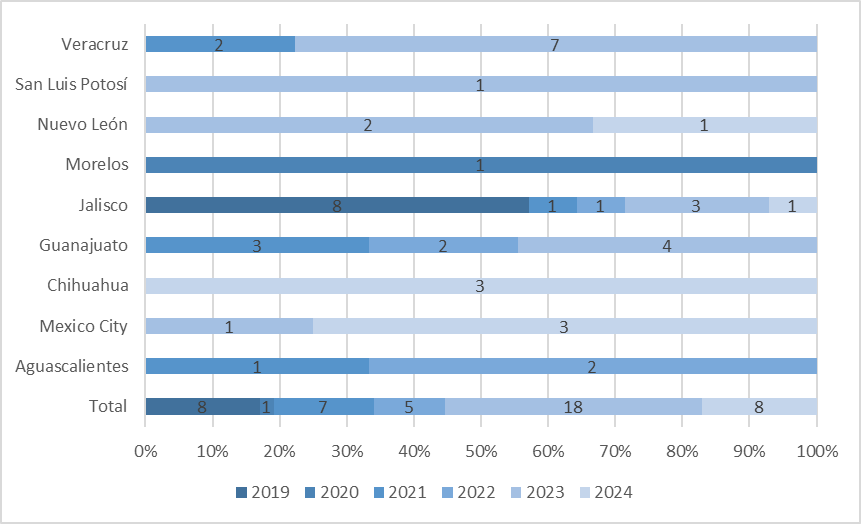
The analysis first highlights the period in which funding programs and calls for research projects began to emerge. As shown in Figure 1, these initiatives first appeared in 2019, the year immediately preceding the abolition of public trust funds by presidential decree (
Previous studies have examined nanotechnology projects funded through FOMIX and Fordecyt (
Direct comparisons between the two funding models should be interpreted with caution because they differ in scope and objectives. Moreover, the projects funded by the former National Council of Humanities, Science, and Technology (CONAHCYT)—the country’s principal federal research funding agency at the time—covered a much broader portfolio of research-oriented initiatives. Nevertheless, the findings indicate that the states included in this study have strengthened their own science and technology funding mechanisms and appear to have placed greater emphasis on supporting nanotechnology research. It is also important to note that science and technology policy in Mexico has traditionally been highly centralized, with many of the national funding calls now administered by the Secretariat of Science, Humanities, Technology, and Innovation (SECIHTI) targeting projects with nationwide impact. Conversely, FOMIX and related programs played a crucial role in promoting technological development at the state level.
Before 2019, only a few states reported funding calls dedicated to R&D. Where such programs existed, they emphasized science outreach activities, publication incentives, or benefits for members of state research systems. Beginning in 2019, however, most states had introduced at least one funding call in this area and started allocating resources to research and technological development projects, in addition to maintaining existing programs supporting science communication and the training of specialized personnel. Furthermore, in 2019, Jalisco was the only state that reported funding nanotechnology projects, while in 2020 only Morelos supported initiatives in this field. From 2021 onward, as economic and institutional activities gradually resumed following the COVID-19 pandemic, an increasing number of states began financing nanotechnology projects. Funding activity reached its peak in 2023, when 18 projects received support, before declining to eight projects in 2024.
This decline coincided with gubernatorial elections in several states that had previously allocated resources to nanotechnology, including Guanajuato and Jalisco, both of which substantially reduced their funding. Notably, Guanajuato and Veracruz, which had supported several nanotechnology projects in 2023, did not fund any such initiatives in 2024. Because this reduction occurred alongside changes in state administrations, it represents an important avenue for future research. More broadly, it relates to a longstanding issue in the public administration literature: the challenge of ensuring the continuity of public policies across political transitions and changes in government. Table 2 summarizes the number of projects funded by each state, together with the corresponding funding amounts and their percentage share of the total support identified.
State | Number of Projects | Percentage of Total Projects | Funding Amount (MXN) | Percentage of Total Amount |
| Aguascalientes | 3 | 6.38 | 273 853.87 | 0.70 |
| Mexico City | 4 | 8.51 | 4 820 500.00 | 12.27 |
| Chihuahua | 3 | 6.38 | 1 497 538.08 | 3.81 |
| Guanajuato | 9 | 19.15 | 20 272 058.00 | 51.59 |
| Jalisco | 14 | 29.79 | 8 317 855.53 | 21.17 |
| Morelos | 1 | 2.13 | 197 079.00 | 0.50 |
| Nuevo León | 3 | 6.38 | 510 000.00 | 1.30 |
| San Luis Potosí | 1 | 2.13 | 880 485.26 | 2.24 |
| Veracruz | 9 | 19.15 | 2 523 860.00 | 6.42 |
| Total | 47 | 100 | 39 293 229.74 | 100 |
Technological development is closely linked to the economic and industrial structure of a region. The capacity to generate and foster innovation is a key component of this process, and public funding serves as a driver of scientific and technological production (
As shown in Table 3, most funded projects were carried out by public universities, followed by research centers. This pattern may reflect the close relationships that public universities often maintain with state governments and with professionals in related fields, which facilitates the alignment of their projects with local needs. In addition, given their limited resources, public institutions may participate more actively in these funding calls to supplement their budgets and strengthen their research capacity.
Institution Type |
No. of Projects |
% of Total Projects |
Funding Amount (MXN) |
% of Total Amount |
| Research Center | 7 | 14.89 | 3 477 246.08 | 8.85 |
| Private Company | 6 | 12.77 | 6 528 362.53 | 16.61 |
| Individual Researcher | 6 | 12.77 | 621 079 | 1.58 |
| Private University | 6 | 12.77 | 9 943 976 | 25.31 |
| Public University | 22 | 46.81 | 18 722 566.13 | 47.65 |
| Total | 47 | 100 | 39 293 229.74 | 100 |
With respect to industries, the largest number of funded nanotechnology projects was concentrated in Health and Biomedicine—including pharmaceutics—, as shown in Table 4. These sectors not only accounted for the largest number of projects but also received the highest levels of funding, although the relationship between the number of projects and the funding amount awarded was not always proportional. A notable example is Energy and Environment, which received nearly MXN 6 million across eight projects, whereas Construction and Advanced Materials received less than half that amount despite supporting six projects. These differences may reflect variations in project nature, material requirements, and implementation costs.
Industry |
No. of Projects |
% of Total Projects |
Funding Amount (MXN) |
% of Total Amount |
| Agribusiness | 8 | 17.02 | 11 809 727.76 | 30.06 |
| Construction and Advanced Materials | 6 | 12.77 | 2 565 493.26 | 6.53 |
| Energy and Environment | 8 | 17.02 | 5 883 392.03 | 14.97 |
| Industry and Manufacturing | 5 | 10.64 | 3 125 441.53 | 7.95 |
| Health and Biomedicine | 19 | 40.43 | 15 689 175.16 | 39.93 |
| Nanotechnology Laboratory | 1 | 2.13 | 220 000.00 | 0.56 |
| Total | 47 | 100 | 39 293 229.74 | 100 |
DISCUSSION
Although the present analysis is exploratory in nature, it sheds light on the role and capacities of Mexico’s state governments in science, technology, and innovation—areas that have traditionally been examined from a national perspective, with comparatively little attention paid to the subnational level. In a federal country such as Mexico, where state governments enjoy considerable autonomy in the implementation of public policies, understanding their contribution to local development and to the country’s broader economic and social progress is essential. Within this context, subnational funding for science and technology is important not only as a mechanism for allocating financial resources but also as a factor shaping regional scientific and technological capabilities. In the absence of a coordinated national policy, these funding instruments reflect both the priorities and the institutional capacities of individual states, giving rise to differentiated patterns. This finding is consistent with the international literature on regional innovation systems, which has shown that scientific and technological capabilities tend to concentrate in territories with greater resources, infrastructure, and institutional capacity. From this perspective, the differences observed across states reflect uneven subnational capacities that may ultimately translate into divergent development trajectories (
Although Mexico’s states differ substantially in their institutional, regulatory, and socioeconomic contexts, a comparative analysis makes it possible to identify broad trends and disparities in subnational development. This approach is key to understanding internal inequalities and regional contrasts in innovation, scientific infrastructure, and technological capabilities. The evidence indicates that, following the elimination of federal co-funding mechanisms such as FOMIX and Fordecyt, only a limited number of states—primarily those with relatively high levels of industrialization, such as Guanajuato and Jalisco—implemented their own funding initiatives to support research projects in strategic fields such as nanotechnology. Moreover, even among the states that operate funding programs, information on these initiatives and their funding recipients is not always systematically compiled or publicly available, creating additional challenges for comparative analyses and for ensuring transparency in public expenditure on science and technology.
As discussed above, federal trust funds supported 74 nanotechnology projects nationwide between 2001 and 2019. In contrast, between 2019 and 2024, state governments financed 47 projects, despite the absence of federal co-funding. These figures illustrate both the considerable effort undertaken by certain states and the pronounced regional inequalities. They also point to shifts in funding schemes and a redefinition of the role of state governments, some of which have assumed a more active position in promoting technological development. Nevertheless, the evidence also suggests that these efforts remain fragmented and relatively limited in scope. In most states, existing programs continue to focus on scholarships, science outreach activities, and general incentives, whereas only a small share provides direct funding for the development of specific technologies.
The findings also show that funding tends to concentrate in sectors such as health, agribusiness, and energy, with most recipients being public universities. This pattern reflects both the concentration of scientific capabilities and local strategies aimed at strengthening regional innovation ecosystems. From an institutional perspective, it suggests that the capacity to formulate and implement technological projects continues to depend heavily on existing scientific infrastructure and on well-established academic communities with demonstrated experience in securing public research funding. Consequently, states with less developed scientific systems or weaker institutional coordination face greater barriers to launching their own research initiatives, reinforcing the territorial concentration of technological capabilities.
Against this backdrop, an important question emerges regarding the extent to which state-level funding programs should coexist with national funding strategies. Maintaining public funding options at both levels may result in overlapping responsibilities and fragmented efforts. However, in the absence of a coordinated national policy, subnational action becomes essential for sustaining scientific and technological activity, even though it inevitably reflects the priorities and institutional capacities of individual states. Without an articulated national framework, regional disparities may therefore widen further, disproportionately benefiting states with greater resources and stronger institutional capacity. In this regard, the findings underscore the importance of multilevel coordination to ensure that science, technology, and innovation policy does not depend solely on isolated and heterogeneous decisions, particularly in strategic fields such as nanotechnology, where substantial infrastructure, qualified human capital, and sustained financial investment are required.
Finally, the dependence of state programs on incumbent administrations poses considerable risks to the continuity and sustainability of public policies. The decline in funding for nanotechnology projects observed in 2024 in states such as Guanajuato and Jalisco, following changes in government, illustrates the vulnerability of these initiatives to political cycles. This finding is particularly relevant because it highlights not only the reduction in the number of funded projects but also the institutional fragility of state-level programs, many of which appear to lack robust mechanisms to ensure their continuity beyond a single administration. Unless support mechanisms for research and technological development are firmly institutionalized, regional disparities may not only persist but also deepen, ultimately compromising national competitiveness, balanced territorial development, and the consolidation of a knowledge-based economy.
CONCLUSIONS
In summary, strengthening science, technology, and innovation in Mexico requires both the active engagement of state governments and a coordinated national framework that promotes equity, policy coherence, and long-term sustainability. Only through integrated and coordinated strategies will it be possible to achieve more inclusive and balanced national development. In particular, the findings suggest that, in the absence of national co-funding mechanisms, subnational funding plays an important role. However, its impact is likely to remain limited and uneven unless it is accompanied by measures that promote program continuity, information transparency, and the reduction of structural disparities in scientific and technological capabilities across states.
One of the main limitations of this study is the heterogeneity of the data reported by the state institutions, both in terms of availability and level of detail. In addition, some states did not provide complete records on funded projects and funding recipients, which limited the scope of the analysis. Given its exploratory nature, the study adopts a descriptive approach to provide a first systematic overview of subnational funding schemes in this field. Rather than offering an exhaustive assessment, the findings establish an empirical foundation for future research examining how these funding instruments influence productive development and the configuration of territorial capabilities in federal political systems characterized by a strong tendency toward centralization.
CONFLICTS OF INTEREST
The author declares no conflicts of interest.
ARTIFICIAL INTELLIGENCE USE STATEMENT
ChatGPT (OpenAI) was used solely to assist with language editing in the original Spanish version of this article and with the translation of its abstract into English. The prompts used were: Corrige la redacción del siguiente párrafo sin omitir información y conservando las citas and Traduce a un inglés académico y formal el siguiente párrafo, conservando el sentido y el tono del texto original. ChatGPT was not used to translate the full English version of the article. The author carefully reviewed and validated all AI-generated output and assumes full responsibility for the final content.
FOOTNOTES
- arrow_upward * This study was conducted as part of the CONAHCYT Ciencia de Frontera 2019 Project (Grant No. 304320) at the Development Studies Unit of the Autonomous University of Zacatecas (UAZ). It forms part of a broader research project funded by the Mexican Secretariat of Science, Humanities, Technology, and Innovation (SECIHTI).
REFERENCES
- arrow_upward Aghion, P., Antonin, C., & Bunel, S. (2021). The Power of Creative Destruction: Economic Upheaval and the Wealth of Nations. Harvard University Press.
- arrow_upward Altamirano-Santiago, M. (2021). Políticas públicas en ciencia y tecnología en México. Gobierno 2018-2024. Revista de Investigaciones Universidad del Quindío, 33(1), 6-23. https://doi.org/10.33975/riuq.vol33n1.441
- arrow_upward Fernandes, C., Farinha, L., Ferreira, J. J., Asheim, B., & Rutten, R. (2020). Regional innovation systems: What can we learn from 25 years of scientific achievements? Regional Studies, 55(3), 377-389. https://doi.org/10.1080/00343404.2020.1782878
- arrow_upward Foladori, G., & Villa, L. L. (2024). Perspectivas sociales de las nanotecnologías en México. Tirant.
- arrow_upward Foro Consultivo Científico y Tecnológico. (2016). Catálogo de programas para el fomento innovación y la vinculación en las empresas. https://www.foroconsultivo.org.mx/libros_editados/catalogo_de_programas_para_el_fomento_innovacion_vinculacion_en_las_empresas.pdf
- arrow_upward Freeman, J., & Simonsen, B. (2015). Examining the Impact of Policy and Practice Interventions on High School Dropout and School Completion Rates: A Systematic Review of the Literature. Review of Educational Research, 85(2), 205-248. https://doi.org/10.3102/0034654314554431
- arrow_upward Gimenez, D. M., & dos Santos, A. L. (2019). Indústria 4.0, manufatura avançada e seus impactos sobre o trabalho. Instituto de Economia - Unicamp. https://www.eco.unicamp.br/images/arquivos/artigos/TD/TD371.pdf
- arrow_upward Gobierno de México. (n.d.). Plataforma Nacional de Transparencia. https://www.gob.mx/inm/articulos/plataforma-nacional-de-transparencia-261584?idiom=es
- arrow_upward Macías-Silva, M. A., Cedeño-Muñoz, J. S., Morales-Paredes, C. A., Tinizaray-Castillo, R., Perero-Espinoza, G. A., Rodríguez-Díaz, J. M., & Jarre-Castro, C. M. (2024). Nanomaterials in construction industry: An overview of their properties and contributions in building house. Case Studies in Chemical and Environmental Engineering, 10(2), art. 100863. https://doi.org/10.1016/j.cscee.2024.100863
- arrow_upward Malik, S., Muhammad, K., & Waheed, Y. (2023). Nanotechnology: A Revolution in Modern Industry. Molecules, 28(2), art. 661. https://doi.org/10.3390/molecules28020661
- arrow_upward Mazzucato, M. (2013). The Entrepreneurial State. Anthem Press.
- arrow_upward Meneses, E., & Foladori, G. (2025). Artificial Intelligence, Nanotechnologies and the Dialectics of Life. In M. Erdoğdu, E. Záyago Lau & A. C. García (Eds.), Artificial Intelligence & The Future of Humanity (pp. 71-96). Ijopec. http://www.ijopec.co.uk/wp-content/uploads/2025/06/x2025_01_ISBN-978-1-913809-51-5.pdf
- arrow_upward Ortiz-Espinoza, Á., Foladori, G., & Záyago Lau, E. (2022). Financiamiento público para nanotecnologías: el caso de Fomix y Fordecyt. Revista Legislativa de Estudios Sociales y de Opinión Pública, 15(33), 149-168. https://dialnet.unirioja.es/servlet/articulo?codigo=9200572
- arrow_upward Presidencia de los Estados Unidos Mexicanos. (2020, April 2). Decreto por el que se ordena la extinción o terminación de los fideicomisos públicos, mandatos públicos y análogos. Diario Oficial de la Federación. https://www.dof.gob.mx/nota_detalle.php?codigo=5591085&fecha=02/04/2020
- arrow_upward Roco, M. C. (2003). Converging science and technology at the nanoscale: opportunities for education and training. Nature Biotechnology, 21(10), 1247-1249. https://doi.org/10.1038/nbt1003-1247
- arrow_upward Roco, M. C., & Bainbridge, W. S. (2002). Converging Technologies for Improving Human Performance: Integrating From the Nanoscale. Journal of Nanoparticle Research, 4(4), 281-295. https://doi.org/10.1023/A:1021152023349
- arrow_upward Schwab, K. (2017). La cuarta revolución industrial. Debate.
- arrow_upward Solleiro-Rebolledo, J. L., Castañón-Ibarra, R., & Martínez-Salvador, L. E. (2019). Análisis y prospectiva de la política de ciencia, tecnología e innovación en México. Iuris Tantum, 33(30), 285-308. https://revistas.anahuac.mx/index.php/iuristantum/article/view/525
- arrow_upward Trippl, M., Baumgartinger-Seiringer, S., & Kastrup, J. (2024). Challenge-oriented regional innovation systems: Towards a research agenda. Journal of Regional R
- arrow_upward Ugarte Pineda, E., & Parra Huerta, G. (2021). La importancia del financiamiento sobre la producción científica en México. Investigación Bibliotecológica: archivonomía, bibliotecología e información, 35(87), 187-202. https://doi.org/10.22201/iibi.24488321xe.2021.87.58330
- arrow_upward Xu, L. D., Xu, E. L., & Li, L. (2018). Industry 4.0: State of the art and future trends. International Journal of Production Research, 56(8), 2941-2962. https://doi.org/10.1080/00207543.2018.1444806

 Google